
Posted in Uncategorized

Summer People

I am thankful for summer people.

I am definitely not a summer person myself. I wilt in the summer. Give me a day in the 70s or low 80s in the middle of summer or as it’s waning, and I’m thrilled because it’s a break from the heat. But in the spring? It just means the cold is over and the heat is coming, and I don’t like the thought. The cold, though, is my friend. Any tint of a chill in the air makes me so happy. Yes, I sometimes get tired of the cold. Yes, it’s annoying when my fingers act up in the cold and don’t work like they should. Yes, sometimes I wish I didn’t have to keep up with a coat. But I get tired of the heat much more quickly. Winter is my happy time.

But then there are the summer people. They love those warm spring days because that means they are about to come alive. They enjoy being out in the warmth, working in their yards or gardens, and enjoying the chance to be free from the jackets and sweaters. The things that speak coziness and delight to me are restrictive to them.

Winter is my time to shine. To have energy. To celebrate. To thrive. To soak up every ounce of the cold but to also share warmth through a pot of soup or a nice hot cup of cocoa.

Summer is their time to do the same. To show their own burst of energy that helps them celebrate and thrive. To coax growth out of the ground. To share activities and nourishment that soaks up creation.

All too often, we don’t celebrate each other’s differences. We gripe and complain about one another and wish we were all the same. The summer people wish summer would last longer and fuss at those who wish for snow. The winter people gripe about the heat and fuss at those who complain about having to put on a jacket.

Instead of celebrating one another, we fuss. We gripe. We pick. We complain.

And, sadly, heat and cold — or pumpkin spice and apple cinnamon, the “argument” that swirls every year as autumn approaches — aren’t the only things we fuss about. We pick apart one another’s personalities. We criticize someone else for their hobbies, social preferences, favorite foods, likes and dislikes, and so much more. We attack one another over every little thing.

We have a beautiful opportunity to instead celebrate one another!

I’ve been so guilty of this. It’s easy to complain. It’s easy to be frustrated about the differences in others. It’s easy to gripe that they don’t “get” me — when I refuse to “get” them either.

I’m going to practice by celebrating my summer people. I’m going to be thankful for them and cheer for their enjoyment of these warm days, even as I enjoy the cool mornings. I’m going to explore the fullness of enjoying their enjoyment while also anticipating my own delight that is still to come, even if it’s delayed a bit because of where I live.

Because our differences are sweet. And I’m thankful for every single one of them.

Posted in Uncategorized

When Something Has to Give

I have a good daily rhythm in place. It’s full, but not excessive. There is wiggle room and space to breath. There’s space for rest. Even so, I have to recognize the reality that there’s always plenty to do. And, while there’s wiggle and breathing room in the daily schedule, there’s never empty space that is just waiting to be filled.

Consequently, there are weeks when something has to give. There are times when I have to look at the routine and pick out something that can be compacted, delayed, or even completely set aside for that day or week.

I’m in the middle of a few months that will include more irregular weeks than routine ones. It’s normal for this time of year. While a few of my commitments are new, most of them are expected events, activities, or appointments that tend to all cluster together this time of year. I expect them and know to prepare for them. But their impact is still very real and very present.

And in times like these, something has to give.

Over the last couple of weeks, the “something” has been writing. On several of my normal writing days, I was on the road or participating in a commitment. Other days, I really needed to devote that time elsewhere. I did compact chores a little bit, knowing that I could shift and juggle them over the course of a few weeks without getting too far behind on anything. But, the biggest bulk of flex time could be most easily found by setting aside the writing in favor of necessities.

Here’s where the challenge comes in, though. It’s easy to assume that because writing is the easiest thing to set aside, that means it’s the least important. After all, my writing has very little definable purpose. It does not produce income. I am not working toward any particular publication. I have no deadlines. It’s just time that I’ve set aside by choice.

I may not enjoy chores, but I can only set them aside or compact them for a short time before I fall behind. They must be done. The hours each week that I devote to contract work may be very flexible, but by the end of each month, I have to have hit a certain number of work hours for the month if I am going to get paid the agreed-upon amount. How I manage those hours can flex from week to week, but ultimately (specifically by the last day of the month), I’ll have to get them all in. And, of course, there are always other responsibilities related to church and life and health that must get done.

Writing is the one thing that has no obligation. No commitment. No necessity attached to it.

In the last few months, I’ve been reminded why I started writing years ago. It’s my most reliable creative outlet. And, whether we acknowledge it or not, we are all designed to create in some way. It may not look like what our society defines as creativity. We may have to work a bit to understand it. But, it’s there. And when we stifle our creativity because it doesn’t feel practical or purposeful to a culture focused on productivity, we suffer.

For many, many years, I only wrote for work. There were a variety of reasons I stopped writing personally, but at least part of it was related to that sense of productivity and the recognition that my writing didn’t really produce anything. And through those years, my personal growth suffered because I wasn’t writing.

Now I’m trying to get back into the habit, but those old lies don’t die easily. Those lies that tell me that because my writing is not productive, it’s not important. Those lies that use the example of the truly busy weeks, those weeks when writing does have to be set aside, to try to convince me that every week is too busy. That every hour set aside for writing is taking me away from something more important. I have home projects that are glaring me in the face. I could be working more contract hours. I could be spending more time on this or that ministry investment.

There’s always something. And in the light of the “something,” I could go back to where I was for many years. I could make it the rule that writing can be set aside. I could make writing the exception, the thing that only fit when I really have time.

And then I would never have time.

It’s hard. I’m fighting it today, especially since we only have two or three routine weeks over the course of about three months. This is one of them, and there are so many other things that I could be doing to maximize my productivity this week.

Instead, here I sit. Writing. Choosing. Even if it’s just a few minutes here and there. Even if I don’t get everything published on schedule. I’m choosing to write.

Yes, there are always times when something has to give. In all honesty, even with the best and most flexible of schedules, we’re rarely going to face weeks where we can get it all done because random things always pop up. But, even when something has to give, the practice of creating is still important. It still has to be a choice.

And today, I choose to do whatever I can to keep it going.

Posted in Uncategorized

The Mountain Top?

I recently read a devotional that referenced the mountain versus valley analogy that is so common in Christian dialog. We trudge through the valley and rejoice on the mountain. That’s just the way it goes, right?

In the mountain/valley analogy, we always focus on walking through the warm, low, difficult valley as opposed to standing on the peak and breathing in the fresh, crisp mountain air. We talk about feeling low and distant from God as opposed to feeling high and close to Him. But what about the in-between? What about the climb? We don’t really talk that much about the climb.

We don’t talk about the effort it takes to get out of the valley where, even if the going is tough because of heat or undergrowth blocking our way, it’s mostly flat. We don’t talk about how we have to shift to a climb to go from the valley to the mountain. We don’t dwell on the effort it takes to be constantly moving upward.

We just talk about being either in the valley or on top of that mountain.

But, there’s a lot in between. And I daresay that, even though it’s all hard work, the in-between might be the best place to be. It does seem to be where we spend most of our time in life, doesn’t it?

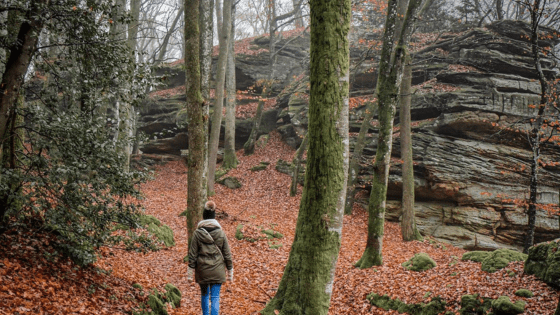
There are some beautiful places to hike here in Arkansas. One of my favorites is on Petit Jean Mountain. Now, as far as mountains go, Petit Jean isn’t much. It’s probably more of a ridge, to be honest, and those who live around “real” mountains kind of laugh at us over even calling Petit Jean a mountain. But, the lack of height doesn’t diminish the reality that it’s an absolutely beautiful spot. My favorite trail on Petit Jean actually starts at a spot on top of the mountain and descends into a little valley. A beautiful waterfall awaits hikers at the end of the trail. We hike down, see the waterfall, enjoy the beauty, and then hike back up. The “peak” of the trip is actually in the little valley, not at the top of the mountain. Hiking to the waterfall is fairly easy. But then you have to get back out. You have to go back up. You have to climb. And what waits at the end of the climb? The end of the trek, with the beautiful goal of the hike left behind, down in the valley.

On other trails at Petit Jean, there honestly isn’t anything spectacular at the end of the trail or at the top of the climb. Instead, the beauty extends all along the path. There are breathtaking moments, both in expansive views and in minute details of nature. Sometimes those moments are in a little valley, other times in the middle of a climb. Sometimes we see them by looking down and other times by looking up. Still other times, the joy is found in simply looking around us at where we are right then.

Another “mountain” in Arkansas, Pinnacle, offers a trail in which the reward is decidedly at the top. Perched just outside of Little Rock, this little mountain can be fairly quickly hiked but renders an amazing view of the Arkansas River Valley.

I wonder how many times I miss the beautiful moments in life, those moments when I might discover incredibly closeness with Christ, because the trail isn’t exactly what I expect. I look for the treasure to always be on the mountain top, and often it is there. But sometimes it’s in the valley. Other times it’s along the path itself.

Those moments can be found anywhere along our journey.

As my mind travels through Scripture, I think of the number of times when God showed His presence in the middle of…life. Sometimes it was in pain and hardship. Other times He revealed Himself as His children were simply going through the normal flow of life. And still other times, His presence was most powerful after the effort of a climb. In fact, the mountaintop experiences of Scripture are much less common than the stories of God’s presence showing up right in the middle of the hike.

The truth is that our Savior is there through it all. Sometimes we sense His presence more strongly than others. And, it’s often easier to focus on Him when we’re standing on top of the world, in awe of His creation, than when we’re huffing and puffing along the path, whether in the valley where we’re constantly dodging obstacles or on the climb as we’re trying to catch our breath.

But that doesn’t mean He’s more present in one place than the other. It may simply mean that we train our hearts and minds to see Him more clearly in one place than the other.

As I hike Arkansas, I’ve learned to train my eyes to see beauty all along the path, not just at the end. What if I were to train my spiritual eyes the same way? How differently would I approach life if I expected that glorious intimacy to exist all along the way?

Posted in Uncategorized

Ingrained

Every morning, I get on the treadmill. Well, that’s the plan, anyway. Some weeks are better than others, but I know it does help when I walk. So, even on the days when I know I have to get out the door early, even ten to fifteen minutes on the treadmill can make a difference.

Recently, on one of those short mornings, I didn’t really have enough time to listen to an audio book or lecture, so I turned on some music to help spur me on. Because it was going to be a short walk, I got warmed up, then pumped up the intensity for my quick walk. Which meant I had to focus really hard on my breathing. Guess what you can’t really do when you’re needing to focus on breathing during a high intensity workout? Yep, sing along to your favorite songs.

So, I decided to just mouth the words.

Um, guess what I do when I’m mouthing a song? I take a deep breath as if I’m actually singing, but then since I’m not really singing, I hold it instead of letting it out steadily.

Guess what isn’t a good idea when you’re doing a short, high intensity walk on the treadmill? Holding your breath for any length of time.

Oops!

I tried to stop holding my breath. I tried mouthing the words while still focusing on controlled breathing. It just wouldn’t work. I could not mouth the words to the song and breathe correctly at the same time. I’m not great at breath control under any circumstances, whether in exercising or singing. It’s something I’m trying to actively improve. But in this situation, I was downright horrible. I couldn’t do something as simple as move my lips while still managing my breathing.

That is the mark of a behavior that is very deeply ingrained, and we often have no idea how deeply it is ingrained — or even that we do it — until we try to do something that goes against the nature of the action.

A lot can be said about challenging poor behavior that is deeply ingrained, and there is a place for that. But the whole experience actually pushed my thoughts in the opposite direction. What good behaviors do I want to have that deeply ingrained?

I want to pray that way. I want prayer to be so much a part of my life that I can’t not pray. Sadly, that’s not true of me. I pray regularly. I pray throughout the day. I lift up breath prayers very often. But I still fall prey to distractions that redirect my mind away from prayer. Worry. Problem solving. Hashing over a conversation. Allowing random thoughts to distract. I pray, but…

The same is true of praise.

And speaking before I stop to think (or pray) over whether or not there are better things to say or if silence would be even better.

And so many other habits and behaviors that distract me from being the person I hunger to be.

We all know that habits can be formed through practice. Deeply ingrained behaviors go even further than habits, growing from behaviors persistently developed through practice, intentionality, and focus until they become so natural we don’t even think about them. Despite what the time management gurus might tell you, very few things in life progress to ingrained behaviors. Even breathing. Although the act of breathing might be natural to me (maybe because it’s a bit essential for life!), it’s still a bit overwhelming to think about how much I’ll have to intentionally practice if I want to breathe properly while singing and exercising — and do it without truly thinking about it.

This breathing challenge reminded me just how powerful ingrained behaviors are once they are established. And it reminded me that I have the ability to become a person of habitual prayer and praise — a person whose ingrained behaviors truly do point the world to Christ. If I’m willing to do the work.

If that’s the person I want to be, then the effort to create those behaviors is beyond worthwhile. It’s vital. And every single day of practice gets me that much closer to truly ingraining them into my innermost being.

So today, I’m consciously practicing. And tomorrow. And the next day. I’ll neglect it some days, I’m sure. I’ll get distracted at times. I’ll be downright discouraged other times. But I have determined to remind myself daily to practice again and again and again. And years from now, I’ll one day look up and discover that I can’t not pray. Or praise. Or point people to Christ.

That’s the person I want to be.

Posted in Uncategorized

Sheep or Cats?

If you are a cat person, you know that the words “lovable” and “cat” are not automatically synonymous. While there are rare instances of lovable cats (we’ve actually experienced it!), most moments when a cat seems lovable usually come about because they want something.

Right now, our house is full of temperamental cats* (or maybe there are just two, but it feels full sometimes) who want love only on their own terms. Usually in the middle of the night when we’re trying to sleep. Or while sitting on the bed while I’m standing beside it stretching before and after exercise. Or perched up on the bathroom counter while I’m trying to wash my hands or brush my teeth. (Wet fur anyone? I think I’ll pass!)

I’ve mentioned Monty before, the one that pretty much claims Doug and me as his humans. He is especially particular about when he’ll receive affection. Recently, he was once again demanding attention at an awkward time, and it dawned on me just how much we can be like cats toward our Father.

Think about it. How often do we demand His attention when we want it? How often do we walk away in a snit when He’s seeking to show us His love through mercy, grace, guidance, and discipline?

Unlike my attitude with the cats, though, God is never inconvenienced by us. It’s never a bad time for us to come to Him and seek His presence, building a relationship with Him. But, much like cats, we often act inconvenienced by Him. When He’s teaching or correcting us, showing us His will, and inviting us to be a part of the incredible power of His kingdom, we tend to have “better” things to do.

The Bible often calls us sheep.

But I think we’re also cats. Stubborn, selfish, temperamental cats. Sheep, at least, know and respond to the voice of their shepherd, even if they do stubbornly — and rather unintelligently — wander off on their own at times.

Cats ignore their humans completely, regardless of their hearing, unless they have a desire. (When it’s food time, you better believe a cat will be attentive to your every single move. And you should fear for your life if you do not ensure that the food bowl is full, showing no hint that the bottom of the bowl even exists!)

Scripture graciously calls us sheep.

Maybe it’s time we stop behaving like cats.

*The image above is not one of our cats, but I just couldn’t resist the smug look!

Posted in Uncategorized

A Nothing Day

I have nothing today.

Words are just not flowing. Thoughts are not resonating.

Typically when that happens, I go back to stuff I’ve written in the past. I have a slew of old posts that I unpublished while cleaning up my blog, intending to review them and determine whether or not they still “work.” And I have a good number of thoughts I’ve fleshed out but never edited and published.

Usually, working with one or the other triggers my brain, and I can at least edit, if not write fresh.

But not today. Today is a nothing kind of day. In fact, it’s taken me over 30 minutes just to get this much out. I’ve been tempted several times along the way to just give up and go pull out the vacuum cleaner. (If you knew how much I dislike housework and would typically rather stare at a blank screen than clean, you’d know just how empty that means the brain is today!)

But I’m committed to reestablishing a habit of writing. And today is blog writing day. That means staring at the screen and coming up with…something. Even on a nothing day.

Maybe that’s as much a part of the process as actually writing. Maybe “nothing” is as important as “something.” Maybe the nothing days force me to take time to exercise the muscles that need to be stretched in order to produce something days.

Or maybe it’s about learning to rest more effectively. It’s tempting to blank out on nothing days, but I don’t think that helps. I think it hurts. So, perhaps from a writing perspective, resting is more about just rambling through a blank screen than about taking a break from writing.

I don’t know. I don’t really have an answer. I’m not sure I even have a good question. After all, it’s a nothing day.

So, here’s my nothingness. Rambling so that I don’t just blank out. Posting so that I reinforce the habit I’m working to rebuild. Putting forth words that really don’t have any significance on their own.

All in hopes that next time I’ll have something.