
Posted in Work & Life

The Ideal Solution?

Our cat is a bit of a jerk.

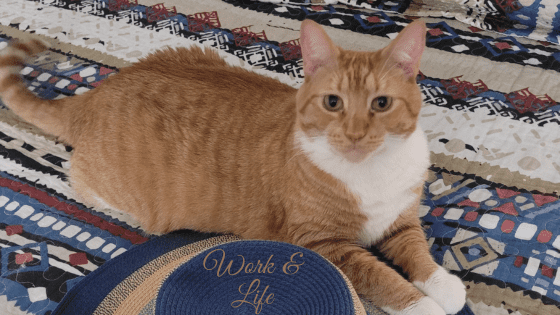
I’ve mentioned this cat before. His name is Monty, short for Monterrey Jack, and he’s orange and white and should be very lovable. We expected him to be. (Someday I’ll tell you about his predecessor, the very lovable Colby Jack, and you’ll understand why we expected it.) But, he’s not. Instead, he’s a jerk.

(For the record, yes, both cats were given cheesy names. Yes, we love cheese. And we’re cheesy. And we have a weakness for orange cats. But I digress.)

Monty has so much personality, and we really do love that cat. But he’s a mess. And his love is on his own terms.

So, back to him being a jerk.

When our oldest daughter graduated from college and moved back home for a time, she brought with her a large black cat named Anubis. Newcomer Nubs (can you tell we like nicknames around here?) got along fine with our other daughter’s cat, a tabby named Rose (who never gets called Rose but instead is referred to by her litany of nicknames, especially Flüffy), but he and Monty did not get along at all. The feud was so great (mostly Nubs terrorizing Monty) that we ended up putting a baby gate up in our bedroom doorway that Monty could go under, but that, at least for a time, blocked Nubs. Our room was Monty’s safe space. We moved his food in there, and he only needed to go out to use the litter box, which was in the laundry room very near our bedroom.

After about 10 months, our daughter and Nubs moved out. And Monty quickly rediscovered the rest of the house. Delighted, we moved his food bowl back to its original location in the bathroom connected to the laundry room — separate from the litter box area, but in the area we had designated the “cat zone” when we first moved in.

But there was a problem. He wouldn’t eat from it. Not unless he was desperate. He would only eat from Flüffy’s bowl. At the other end of the house.

That was kind of funny in and of itself because we’d originally moved both bowls back into that bathroom, since it’s where they were before Anubis moved in. While Flüffy’s bowl was in there, Monty wouldn’t touch it and would only eat out of his own bowl. Flüffy, however, who is a rather anxious cat, wouldn’t go in there to eat at all. So we decided to move her bowl back into our daughter’s room, at which point Monty decided her bowl was the only one he would eat out of. (Remember my reference to him being a jerk? Yeah. And yes, there is a point to all of this, so bear with me.)

Now, having Monty’s bowl in the laundry room was ideal for us. It kept the bowl from being under our feet (its location in our bedroom was rather awkward), and it was in a convenient location for him. But he just wouldn’t eat out of it. Meanwhile, poor Flüffy was starving to death because chunky Monty was eating all her food!

In an effort to solve the problem, we moved Monty’s food bowl back to our bedroom. But even that didn’t work because at this point it was really more about reasserting his alpha status than anything else. So, we finally put both bowls together in our daughter’s bedroom so that both cats could eat.

Not necessarily ideal, at least from our perspective, but it worked. Of course, that brings us to an important realization (Yes, I’m finally getting to the point!): an ideal solution is only ideal if it actually works. In this case, what we thought was ideal actually held no practical benefit whatsoever because it simply didn’t work.

We get caught in that trap a lot, don’t we? We read books, listen to podcasts, or attend conferences about success and make decisions based on what the experts say about ideal solutions, whether regarding our personal lives or professional success. There is often great information there, and it’s frequently solid enough to indicate that it can help meet the need. So, we work to shape our practical to fit the ideal solution. But that’s backwards. The true solution is to refine and shape the ideal until it fits with our practical reality.

Solutions only work when we take the ideal ideas and process them until they become practical ideas. In our case, the ideal was to get Monty’s food (and Flüffy’s as well), into the cat area in the laundry room. The practical need was to provide nourishment for our cats. The ideal had to be reworked and shaped until it met the practical.

Is there something in life you are trying to shape to fit the ideal? Maybe it’s time to turn it around. Perhaps the better solution is to reshape the ideal to fit your life. Only then will the ideal solution truly become the practical solution.

Posted in What I'm Learning, Work & Life

Personal Superhero

People who write for a living are superheroes.

I enjoy writing. It is nourishing to me to take the thoughts in my head and turn them into tangible concepts. And I have long had stories floating around in my head that I’d love to get out someday.

I also do want people to read what I write, mainly because I feel that writing is my strongest avenue for drawing people to Truth. I’m not always right and I know I don’t represent Christ with perfection by any stretch of the imagination. But if it is at all possible for me to help others see Him more clearly through the practice of writing, I want to do it!

In our society, though, to truly make an impact as a writer, you have to “sell” yourself. You have to draw attention and make people want to read what you have to write. That’s the part I’m horrible at. I don’t push my writing. I don’t make sure that my content is right there in front of everybody, encouraging them to see and read. I prefer to be behind the scenes in real life, and that’s no different in writing.

So on days like today when the thoughts just aren’t flowing and the writing hits roadblocks, I can’t imagine having to both write and promote myself as a competent writer. It makes me wonder what the point is. Why do I even write, anyway?

I don’t think I’m alone in thoughts like these, and not just about writing, either. I think there’s a lot of stuff we just never do in life because we go down the “why bother?” trail. We hit a bad day and suddenly see all of the things we’re not good at. So, we decide we shouldn’t bother even with the things we are good at (probably because we no longer feel good at them).

Because living life — truly living it — is scary. That’s just the reality.

I don’t like scary. I like safe. I like confident. I like to know that something I start is going to work out from beginning to end. I don’t like to invest in things that may not succeed. (For the record, some days are overwhelming enough that this even involves investing in mundane things like cooking lunch. Yes, I’m weird. Yes, today is one of those days, and it has shown in my utter lack of productivity. I’m not sure how I’m even forming coherent words at all! But I digress.)

Today is one of those no-flow, roadblock kind of days. And I almost just didn’t bother, which is honestly my typical response when I hit days like today. I almost didn’t write. I put it off for a while, filling my time with piddly, unproductive things instead of moving forward well with my day. Which means I not only wasn’t writing, I also wasn’t doing anything else good and productive and useful.

Because that’s easier and safer than diving in and trying to do something that I may not be able to complete. It’s easier than failing. It’s easier to just not do than to question whether or not doing it is worth the effort.

I didn’t punt today, though. I sat down and did. It took me a lot longer than it should have, and I wasted most of my morning in the delay. But I did it. (Oh, and lunch worked itself out, too, but that was because my wonderful hubby jumped in with an awesome suggestion. Thank you, Hubby!)

It makes me feel just a bit like a superhero. Not a superhero who can tackle the battles of the world but one who can persevere over my own struggles. An ordinary but very, very personal superhero.

I have a feeling you have days like this, too. But you’re doing life anyway. You’re pushing forward. You’re tackling the scary. That makes you a superhero, too. One who is victorious over the ordinary that feels so overwhelming.

The results don’t have to be great. Goodness knows this blog post isn’t great. But I’m doing it. And I’m publishing it before I can talk myself out of it. And I’m encouraging you to go ahead and do, too.

Be a superhero for yourself today.

Posted in What I Do, Work & Life

Should I Say That?

Years ago, I started writing because random thoughts would hit my brain and I’d want to flesh them out. Then I’d want to share them. There isn’t always a lot of consistency to those thoughts. Sometimes they are triggered by my morning Bible reading. Other times relational interaction give me pause.

There are responses to events around me, random mental pictures that I want to flesh out, new habits and practices that work for me that I want to share, and just general thoughts or ideas that come to mind.

Sometimes these ideas flow faster than I can process them. Other times it can be a disturbingly long time between ideas. But that’s another discussion for another day. (Yes, I have notes on it already!)

For today, though, the thought is this: should I really write about everything that comes to mind?

You probably already know the answer to that. It’s a resounding NO for a wide variety of reasons. But I’m not always incredibly wise about how I invest my writing time. So, I need to set myself some guidelines and boundaries to help me process what to say. And that’s what I have to say today…a glimpse into those guidelines!

Does it stick?

The best ideas are those that have staying power. The ones that I can set aside and then come back to and still know how to flesh out — and maybe even have the ability to flesh them out better than when I first had the ideas.

Now, this doesn’t mean it just floats around in my head. I’ve lost a lot of great, “sticky” ideas by not writing them down! But, if I can jot down a few notes (a brief theme or title followed by 3-5 sentences or bullet points to serve as reminders) then come back a few days, weeks, or even months later and flesh it out, it’s definitely an idea that has stuck. That makes it worth considering.

Does it grow?

Mental images of The Blob aside, good ideas really need to grow and evolve. What starts as a brain tickle needs to develop substance if it’s going to be useful for myself or anyone else.

Even a “sticky” idea can prove to have little more substance than those brief notes I jotted down. While the lack of growth doesn’t mean it never needs to be shared, it’s really not worth it to take those few bullet points and just add fluff without substance. There’s enough of that floating around. I don’t need to add to it. There are other avenues for sharing those thoughts. After all, if we would all share a few more brief, positive thoughts on social media, it might be a more encouraging place to hang out!

Does it relate?

This is a big one. I have written a lot of things that have never seen the light of day. They stay on my computer or in my journal. Why? Because they aren’t relevant to anyone other than me. That’s not to say that there aren’t other people processing the same things. But, there are certain things we shouldn’t throw out into the wild. If we share them, they should be shared privately with individuals for the purpose of encouraging and strengthening one another.

While nothing I write is relevant to everyone, it’s important to have wisdom to know when what I write is not really relevant for public sharing at all.

Does it honor Christ?

Not everything I write is a Bible thought. It doesn’t always have a spiritual theme or express ideas of faith.

And yet…

I am a Christian. That means I am a citizen of the kingdom of God. My number one priority in life should be allegiance to the Lord Jesus Christ and God the Father. Period. Even if I am writing a random tip about life, it should never, ever contradict that allegiance. My writing can’t be neutral. It is either nourishing others in their lives of allegiance — or sparking the interest of those outside the kingdom — or it is an act of rebellion. Treason. There is no middle ground.

That can sound harsh, but when you swear allegiance to something, it’s an all or nothing reality. You are either for or against. No one is ever truly neutral.

So, the things I write should reflect that I am growing in the fruit of the Spirit, even if I struggle in that growth, and that I hunger to serve my Lord.

Am I always diligent to answer all of these questions before I write or publish something? No, I’m not. But when I look back on what I’ve written over the years, the things that fit all of these are the ones that still hold true (and that I still like even after all this time). I hope that in the coming years I will become increasingly faithful to hold to these guidelines, confident in the words that are pouring forth from my fingers.

Posted in Thoughts from Life, What I Do

Day Two

Day One was a good day. Well, for writing at least.

All of my timing worked out. Even with a slightly sluggish start to the morning, I got in my exercise, morning devotional reading, and school with my son and still had time to spare before I needed to clock into work.

So, I sat down to a blank screen and had just over 1000 words written before it was time to quit. For the first time in a while, the ideas and the words came together to flow into productivity.

On the one hand, that’s a great thing. Day One success can be so helpful to get up and do Day Two. Then Day Three. Making it a habit.

But, Day One success can also be a struggle.

The very next morning, I procrastinated for 30 minutes. I wrote some reviews because that was easy and safe. I sent a couple of check-in chats on Marco Polo. I cleared my inbox.

Why?

Because I was scared to sit down to another blank screen and not have Day Two go like Day One did. On Day One, I had ideas before I ever sat down. On Day Two, I was going to have to sit down first and see if the ideas came to me.

That’s just plain intimidating.

And for over half an hour, I let that fear and intimidation keep me from even trying. I let it eat away at the time I had available to write. I let it distract me.

But I finally made it. I started tapping away at the keyboard, and the very experience of the morning gave me something to write about. I didn’t have as much time to write because of all the time I wasted. I wouldn’t make it to 1000 words. I probably wouldn’t even make half that. But I showed up, and that very act showed me that I actually did have something to say.

Here’s the deal, though. On Day Three — or Day Twelve or Day One Hundred and Fifty-Seven — I might actually sit down to a blank screen and have…nothing. At some point, my fears will become reality.

But I’m also realizing something else. On those days I’ll still have something to do. I’ll have a folder of rough drafts ready to be edited. I’ll have a folder of completed drafts ready to be published. I’ll have something to work with. Why? Because I sat down on Day One and turned my thoughts into typed words. I sat down on Day Two and conquered my intimidation.

On Day Two, I confirmed the habit of doing it anyway. Of sitting down with the intention of working toward being a writer once again. This is a part of me that has been dormant for far too long. And because of that, I’ve been incomplete. I need this.

So, I’ll do it.

I’ll do it on the days when I have the ideas before I even sit down to the computer — and then enjoy seeing those ideas materialize into coherent content. I’ll do it on the days when I have the ideas but then can’t seem to get them out coherently. I’ll do it on the days when there are no ideas beforehand, but something comes to me because I make myself do it anyway.

I’ll do it on the days when there’s nothing. Absolutely nothing. At all.

What have you allowed to slip? What have you not done because you’re not getting around to being yourself? What have you allowed intimidation to keep you from doing?

What can you do today to get started? To reinforce what you’ve started but are afraid to continue? To keep going even when you’ve hit a dry spell on something that’s been going so well? To grow and improve in something you’ve been doing diligently?

No matter the obstacles before you today…do it anyway.

Posted in What I'm Learning

Who Am I?

That is the question, isn’t it?

It’s a question I’ve been asking myself for a little while now. And I’ve been slowly coming to a surprising realization regarding the answer: who I am changes.

I used to think that wasn’t possible. Yes, our stages of life would change, our circumstances would change, and even our interests might change. But the core of who we are has to stay the same, right?

In a way, yes. I’ve been created as a unique individual and there are certain aspects of my being and my personality that will always remain constant. But over the past few years I’ve experienced some confusion as I’ve tried to evaluate what is enjoyable and fun to me. What ideal life would look like for me. What fills and nourishes me. It’s honestly easier to just default back to the things that used to answer those questions and fill in the blanks for those evaluations.

Easier, though, isn’t always right. And those old answers seem a bit off to me these days. I’m not excited about the same things I used to be excited about. I’m not nourished by the same activities or fueled by the same types of situations, events, and circumstances. I don’t even love the same gifts I used to love. Or something as basic as the same foods!

Who I am has changed.

I recently took the time to evaluate my blog and go through and unpublish a lot of posts. Most of them, in fact. Why? Because who I am has changed. I don’t communicate the same way anymore. I don’t hold all of the same thoughts and ideas. So, as I get back to writing and publishing, I want to make sure that what is posted on my blog truly reflects who I am.

I have changed.

But that still leaves me with the question: Who am I now?

I honestly don’t know. And I struggle to have the intuition to dig it out. I’m a practical person who doesn’t work well in the theoretical (that’s one thing that definitely hasn’t changed and never will!). So, it’s much easier to look back and retain who I’ve been than to look forward and figure out who I’m becoming. It’s too abstract. I instead have to go with what I know today.
Today, it’s about writing. I’m a new writer. I know that seems odd since I’ve been blogging for nearly 15 years, so let me explain: I used to write, and I loved it. I wrote about my family’s daily activities on our family blog, highlighting both the fun and the struggles we had as a family. I wrote about things I learned as a mom. Spiritual truths I’d gleaned along the way.

Then I hit a stretch of life where I could no longer be public about lesson and struggles. I won’t go into the details of why, but the reality was that I no longer had that freedom. At first I tried to journal through it all anyway without publishing it on the blogs. But, I found myself undisciplined. The rhythm of blogging ensured that I made writing a part of my daily life. Without the blogging, I found myself lacking the discipline I needed to truly hash through the process of writing.

It was a mistake. I think I knew it at the time, but I just didn’t have the energy to do anything about it. The consequence was that, over time, I lost my own voice. I did a lot of ghost writing, a lot of dispassionate writing about ideas and events that I could easily address. But they were never me.

Now I’m coming back. But “me” is very different now. I can’t just rediscover that old voice. I have to find my new one. For instance, I’m not the work-at-home, homeschooling mom of three children ranging from elementary to early high school. Instead I’m the soon-to-be empty nester who is in between jobs and wondering what’s next.

And that’s not the only thing that has changed. Ministry has changed. Marriage is very different a quarter of a century in than it was 15 years in. My fifth decade of life is different from my fourth. Life is just…different.

So, I’m diving in. I’m figuring out who I am. Not who I will be for the next however many years I have on this earth. But who I am now. This year. In 2024.

And I’m going to record it, because someday I’ll look back at all of those old blog posts that I wrote in my thirties and at the things I’m writing now as I close out my forties. I’ll take note of the journey, and I’ll compare all of that to where I am in that “someday” moment. I’ll see who I was. I’ll acknowledge who I am. And I’ll take an active part in shaping who I will become.
And one day, when I step into eternity, I’ll know fully that the whole purpose was to learn who I am ultimately: a child of God whose whole purpose is to bring glory to Him…with all of who I am.

Posted in What I'm Learning, Work & Life

A New Direction

I have a dream of one day writing fiction. There are stories bopping around in my head, many of them with great and captivating characters. In my reading experience, a great character can make up for a great number of writing flaws, but even the most creative and descriptive authors will fall flat for me if their characters aren’t captivating.

The problem, though, is that I still need a point to my stories. Just developing a character does not drive fiction. A good character is critical, but without a story, there is nothing to carry the character. And, while I have great characters and good story starters in my head, I seem to lack an overarching plot that will engage a reader through to the end.

So, I haven’t bothered to start writing that fiction.

In all honesty, it’s more comfortable in this spot of not writing. But, I also have to admit that two things are highly challenging this position of inactivity. The first one is my children. Often as they discuss the stories they are writing, they make comments like, “Guess what I discovered today? That character is a red-head! So many things about her make more sense now!” Or they’ll talk about something unexpected happening or someone doing something funny. They talk as if they’re reading stories, not writing them. As if they are watching the stories come into being, not creating them.

And my kids aren’t alone in this. I’ve seen similar comments from other authors—published authors—talking about their characters or stories surprising them with unexpected actions or events.

It baffles my mind, and yet I remember reading something about Michelangelo saying that his sculpture work was simply an act of releasing a masterpiece already there in the stone, just waiting to be exposed. It’s not a new concept for artists to feel as if they are revealing rather than creating. And maybe they are. Maybe God Himself has the designs, the stories, the beauty already there, just waiting to be exposed by those with the talent to do so.

Of course, that idea doesn’t help encourage me to write those stories because I fear that I will not have the talent to reveal anything. My husband and children are so much more creative than I am. So, I should leave it to them, right?

Except that I told you there were two challenges. And the second comes from within me.

You see, this post was not the one I originally sat down to write. I had a different thought that I wanted to write out. But, I felt like it needed an introduction. In the process of writing the introduction, a whole new thought filled my mind, and it turned into its own blog post. Then that, in turn, led to this thought. In order to not lose the first two thoughts, I made notes for this one, then went back and worked on the other two. At this point, I don’t even remember what those original two thoughts were or what blog posts they produced, as it’s taken me a while to come back and flesh out this thought (fear, perhaps?). But the point is that the extra ideas didn’t come from just thinking about the original topic. They came from acting on the thought.

I had a thought. I started writing it out. And more thoughts followed, one after another, seeming to come from nowhere.

I’m good at pondering. And pondering is important. It’s where ideas come from, and those ideas spur growth. But, pondering itself doesn’t actually produce growth. Acting on those ponderings is the only thing that will help me grow. Create. Reveal. Action is what really turns a thought into something real. Action is what turns that one thought into another and another until we are not creating, we’re discovering.

My wonderful husband pointed out to me recently that maybe I need to stop learning about writing and just start writing. And he’s right, as usual. The stories, the thoughts, the ideas are all in there somewhere. But they serve no purpose closed up inside my head. Only once I take a step and start writing will they start revealing themselves.

And you know something? Maybe if I think of myself as being God’s tool for revealing beauty rather than responsible for creating it, I just might be capable after all.

Posted in What I'm Learning, Work & Life

Building a Non-Narrative Reading Habit

A year or so ago, a friend of mine asked a question on Facebook about establishing a non-fiction reading habit. As I pondered her question I was, first and foremost, encouraged by her admission. She’s one of those people I rank very high on the “smart preacher’s wife” list—but here she was struggling with non-narrative reading just like I always have! I’d always felt “less-than” on the intelligence scale because of my struggle with non-fiction. It was encouraging to see that even smart people sometimes struggle with non-fiction.

Secondly, her question opened my eyes to the fact that I have actually achieved a long-desired turning point in my own reading habit. I have gone from struggling greatly with non-narrative reading to establishing a needed habit of it to truly enjoying it! For the first time in my life, I look with excitement on my growing list of non-fiction titles instead of feeling overwhelmed. How exactly did I get there?

More Than Fiction vs. Non-Fiction: Starting with My Strengths

Fiction lovers often talk about preferring our novels over our non-fiction. But there are more distinctions than simply fiction and non-fiction. It’s not so much that I prefer fiction. It’s that I prefer story. I love Corrie Ten Boom’s The Hiding Place just as much as From Dust and Ashes by Tricia Goyer, my long-time favorite World War II novel. One is non-fiction, the other fiction created from memories of men who lived it. But both are stories. Narratives that bring history to life.

Recognizing that reality helped me take my preference and pick out non-fiction authors who paint word pictures. Even if they don’t tell stories in purely narrative form the same way The Hiding Place does, they do bring words to life, turning them into images that explode in my visual mind, helping me grasp abstract concepts.

The biggest challenge was that the recommended “greats” of Christian literature don’t always write like that. I had to realize that there was no failure in going with my strengths. I was still challenging myself by breaking out of my fiction restriction and moving to story-telling, non-fiction writers. As long as I was challenging myself, I was not failing, no matter what authors I was “ignoring” at the time.

My goal was to read for a set amount of time each morning, so I chose books that fit well with my morning devotional time. I never dreamed what kind of doors that new habit would open!

Going with a Theme

As I became more comfortable with non-fiction, I began to branch out by choosing books based on current themes rather than writing style. I’d read books by word-picture artists like Mark Buchanan and Ken Shigematsu that greatly challenged my approach (or lack thereof) to rest and Sabbath. So, I began to intermingle other books on the same theme. Although not all of these were by authors who were great at painting word pictures, the familiar themes helped me make connections. I could take the new information and convert it myself into imagery that worked well for my method of learning.

These themes have morphed and adjusted over the years. Sometimes while working through one theme, I “accidentally” pick up on a new one, and that directs me to my next book. Some of those directions have led me to books that are very much outside of my natural inclinations and reading styles. Reading those books, especially when first starting, can be a challenge. But, the more I read, the more I get used to different writing styles and am able to better and more quickly process the information before me.

The growth didn’t stop there. Once I’d firmly established the devotional non-fiction reading habit, I added a second book each morning. This one is not always “spiritual.” Not automatically written by a Christian author. But, it always contains something that will help me become a better…something. Strengthen who I am as a wife, a mom, a writer, a homeschooler, an organizer…you get the idea. But, because I read it at the end of my morning quiet time, I always approach it with the perspective of what I have just finished studying in God’s Word and reading from my spiritually nourishing non-fiction.

Voila! A Habit is Born!

I didn’t intentionally follow these steps. I just wanted to start reading non-fiction. And, honestly, I didn’t really realize what I’d accomplished until I saw that question on Facebook. I stand now in amazement, though, as I realize just how one little action—the decision to read a non-fiction book for five minutes every morning—has helped me grow so greatly.

Small actions can produce powerful habits. What small action can you take today?

Posted in What I'm Learning, Work & Life

Tools to Inspire

Several years ago, I taught myself how to knit. That seems like such a simple statement to encompass the full victory of this process. You see, many, many, many years before, some friends had tried to teach me to knit. They loved knitting and couldn’t imagine not knowing how to do it. I could crochet. Why not knit.

But I couldn’t. Two needles covered in loops that you maneuvered in a variety of ways just did not compute in my mind. So, I’d sit with my single little crochet hook and they would sit with their knitting needles, and we’d have a grand ole time.

It was a failure I never could shake, though, because so many beautiful patterns called for knitting. My favorite patterns, in fact. Oh, the crochet patterns were pretty. Don’t get me wrong. But there was something about the style of knit that I longed to be able to accomplish.

So, finally, as an adult, I decided to give it another try. And somehow, this time, I succeeded. Perhaps it was the teaching method. Perhaps it was that I saw the diagrams in a book instead of simply trying to mimic the style of someone else. Perhaps it was the patience that I’d learned in the two plus decades since my first attempt. Maybe it was simply a true desire. Back then, my friends wanted me to learn. This time, I wanted to learn. Makes a difference!

Whatever the case, I succeeded. I didn’t become phenomenal or grasp intricate patterns quickly. But, I did learn.

I don’t knit constantly, or even daily. It’s an occasional burst here and there, dropped for a time when a project demands more attention than I can give it. When a day comes along that allows me to give the project extra attention, I get it back to a point of being easy enough to pick up for ten minutes here or thirty minutes there. Then I can keep it going during a work meeting (when my involvement is more about listening than actively engaging) or school with the kids (when we are discussing a book together).

By necessity, most of my projects remain simple, although I do enjoy challenging myself with a new stitch here or a new design there. I like to create projects that allow me to merge the simple with the complex, though, so I’m frequently learning new techniques but also have something that’s easy to pick up and do without a whole lot of need to watch a pattern.

Because of this desire to challenge my skills, I have needed certain tools. Various sizes and styles of needles. Place markers and counters. Cable hooks. I keep it all on the inexpensive end because I’m not enough of an enthusiast to spend a lot of money on the hobby. But, even those inexpensive tools give me a chance to experiment and learn.

At one point, I picked up a little plastic case full of knitting tools. I’d chosen this kit because it had several marker options and a couple of counters. But when I opened it, I also saw a wide variety of other tools. Tools I had never seen before. I had no idea what they were called (again, inexpensive set…no labels) or how to find out. As time has passed, I’ve learned about a couple of them, but there are still several that leave me baffled.

But they also inspire me. They make me want to learn more about knitting. Figure out new skills. Try new challenges. Explore new options. Could this be the tool for that fancy stitch? Might that one help me feel a little more coordinated with cable knitting? Or enable a more elaborate cable? The tools motivate my curiosity and nudge my desire to learn. Well, most of the time, at least.
Here’s the deal: sometimes these unknown tools scare me a bit. They remind me of my limitations. They let me know how much I can’t do. And sometimes that is more overwhelming than inspiring.

Do you ever feel that way about your spiritual growth? Do you ever feel like you’re plugging along nicely, only to suddenly get a glimpse of tools, resources, and learning scales that you’ve never even thought of before? Do you ever feel that you will never be able to learn enough? Grow enough? Use resources well enough?

Or are you motivated and inspired to reach for a new goal? Learn a new skill? Climb a higher peak?

I know we will all hit walls that scare us just a bit. We will be overwhelmed by the discovery of just how much we don’t know. But, my prayer for both myself and for you, dear reader, is that those moments aren’t what define us. My prayer is that the more common response of our heart is to be inspired. To be motivated. To desire to learn how to tackle that new skill. To use that new resource. To climb to that next level.

To not be defined by fear, but to be motivated by inspiration.

Image by Tammy McLean from Pixabay
Posted in Work & Life

Getting It Done

It never ceases to amaze me the number of practical life lessons I’ve learned because of the challenges I’ve worked through in homeschooling. For instance, in the homeschool community, record-keeping discussions are common. What do I keep? How much do I keep? What information is needed? How do I gather, organize, and maintain the necessary information?

The needs vary from state to state, depending on local homeschooling laws. Some states, like Arkansas, are very lax. I fill out a form every year stating my intent to homeschool. That’s it. In other states, parents have to have regular meetings with education officials, showing not only intentions but also progress. Samples of work, grades, test results, etc.

Now, on the one hand, I am thankful that Arkansas does not require such things. On the other hand, that makes it easy to lose track of where the kids actually are and what progress they have made. I have had to be intentional from the beginning about choosing curricula designed to help me keep them on track, knowing that my husband and I are accountable for the progress of our children – if not to a state education representative, then definitely to ourselves and to their future needs.

This intentionality in homeschooling serves as a continual reminder that there’s not always someone else to keep me accountable and on track in life any more than there is in homeschooling! I have to be intentional and diligent about finding ways to hold myself accountable in every aspect of life.

Keep in mind that just because I know I should find ways to hold myself accountable doesn’t mean I always do it. But, when I am diligent, here are some of the things that work:

Recognize the Trouble Spots

Like with homeschool record-keeping, there are areas where we know we will face problems if we do not keep ourselves accountable. So, the first step is to recognize those trouble areas. One for our family comes at meal-time. I hate to decide what to cook. So, menu planning is critical for me. If I don’t plan, we don’t eat well. We either eat less healthily or more expensively or both. So, the first step is recognizing the trouble spot that mealtime can be for me.

Make a Plan

Once the problem is identified, a plan has to be made. I can say I’m going to cook well or teach my kids well or make progress in any other area of life. But unless I actually create an avenue to accomplish this, it will never get done! So, a plan is critical. I have a list of what needs to be done each year to prepare for and progress through a school year. I know each month when I need to menu plan. (And before you think I’m always on top of this, realize that last year I failed in this area much more often than I succeeded. I’m a work in progress.) I have plans for other areas of life as well, including trying to get back to regular writing. It doesn’t have to be anything rigid, but having a plan keeps the need right in front of me.

Find Accountability

My job is the best example of this. Every Monday, each employee in the small company I work for gives our boss a list of priorities for the week, talking through them with her and with one another for clarification. At the end of each week, we send her a record of how we spent our time. This is not because she doesn’t trust us or is trying to micromanage and nitpick. In fact, it is just the opposite. These lists help her know where our energy is going, allowing her to keep track of whether or not the limited time, energy, and resources of our company are being used effectively. But, this also allows me to clearly see where I am using my time and gives me a measure of accountability for my work days.

By using the same principle in other areas of life, I don’t have to handle the full weight of responsibility all on my own. I can have others help hold me accountable.

Implement!

As is obvious with the confessed menu plan failures, implementation is the final key. We can know what to do, plan to do it, and even have others remind us. But, ultimately, it’s up to us to take action. And when we do, the pay-off is more than worth the effort.

Posted in Helpful Hints, What Works for Me, Work & Life

Erasable Ink

Sometimes, life really comes down to the practical. No deep lessons. No profound thoughts. Just basic and practical.

Sometimes as I ponder depth and meaning and how to surrender to the surgery I desperately need the Lord to do on the deep parts of my heart, mind, and habits, I forget just how important those basic and practical things are.

Like erasable ink.

Several years ago, a friend introduced me to Frixion pens. I’d never liked erasable pens because they never seemed to really erase. But these? Oh my word…they work!! And I became addicted! They’re pretty and fun and just a treat to use. They add a little pizazz to life.

But, there’s more to these pens than just fun. There are actually two reasons I really, really like the idea of being able to use erasable ink pens, especially in my planners.

Flexibility

The first really is obvious. I always function better when I can plan ahead, and sometimes I need to plan FAR ahead. But the truth is that life changes. Plans change. I need to be able to erase and make changes, both in my personal planner (the Mommy brain, as my kids call it) and in my homeschool planner. It’s just a necessity.

But, that can be done in pencil, can’t it? Yes, it can. And, for a long time, it was done in pencil. Erasable colored pencils, to be certain, because I color code. In the homeschool planner, each child has a color for independent work and a color for work I do with them (read-alouds, etc.). In my personal planner, I have separate colors for general family life, school, work, church, writing, and personal development. It saves space, helps me keep it all distinguished, and helps me not overlook tasks and activities. Color is my friend.

But, why ink?

Commitment

While pencil works well for flexibility, it doesn’t work well – at least mentally – for commitment. You’ve probably heard the phrase, “I’ll pencil you in.” More often than not, that means plans will change. We are not committed to penciled-in obligations, tasks, and events.

Yes, it’s mental. And yes, it’s something we might just need to get over. But, for me, being able to use ink instead of pencil helps with that mental commitment – even if they are equally erasable. There’s just something about seeing it in ink that solidifies a task, event, or other commitment in my mind.

It’s just a little thing. But sometimes those little things make the deeper things more feasible. Even something as little, as practical, as basic as using erasable ink.