
Posted in Thoughts from Creation, Thoughts from Life

What Are You Creating?

Last week I asked what you were reading. Today, I have a similar question: what are you creating?

The more I learn about what it means to be made in the image of God, the more I see creativity shine as a beautiful example. He is so very creative, not only in the way He fashioned the universe and mankind, but also in the way He has engaged with His creation throughout its — and our — existence. There seems to be no limit to the discovery of new aspects of His creativity!

And the most beautiful part of it all is that He shares creativity with us. Because we are made in His image, we have endless avenues for exploring creativity. Often, though, we miss it because we miss the true definition of creativity.

It’s easy to connect creativity specifically to the arts. Someone who can paint or draw or sculpt or carve or assemble beautiful works of art. Someone who can produce beautiful music. Someone who can design patterns or create beautiful things with fabric or yarn. Those are the creative people.

But we don’t all fit into those categories. And even those who dabble in the arts might not consider themselves truly creative. Everything I do craft-wise is sourced from the idea or pattern of someone else. Am I truly creative if I’m simply copying or following directions using a skill I’ve learned?

The answer is yes. And I’m learning that everyone has some measure of creativity.

Yours might be in how you relate to people. Or cook a meal. Or mow a lawn. You might not be able to paint a solid color evenly on a plain board to save your life, but if someone needs to know the best way to fence off their back yard, you’re the person to call. You might not be able to sew a straight seam no matter how hard you try, but when you tell a story, others are immediately captivated.

Creativity may be the ability to see a new topic to research. It might be the enjoyment of pulling out decorations for every season. It could be knowing just what to plant each season to create a yard that brings joy to others.

It might also be simply following directions to accomplish something. That’s me, and I have long believed that meant I wasn’t creative. And yet, when I follow directions and something good comes from it, even if it’s following directions for a task I’m not really great at, I’m exercising my creativity. It could be as simple as following a recipe to produce food that tastes good, even though cooking is not something I enjoy. It could be the act of enjoying the sight of the Norfolk pine I all but killed years ago, now flourishing and growing so tall that I can’t help but wonder where I’ll put it to protect it from the week of cold we might get this winter!

Right now, I’m working on two sweaters. I’ve never made sweaters before, but I’m currently crocheting one and knitting the other. I’m also crocheting a blanket. I’m strictly following existing patterns, using skills other people have taught me. Even the colors are some my daughter helped me pick out and pair together in an effort to use up some of our yarn stash. It feels very uncreative. It feels more like a simple task I have chosen for the purpose of helping my brain and body relax. It was hard to find the patterns. Hard to come up with the ideas. Creativity isn’t supposed to be that hard, is it?

And yet, I’m creating. In my own way. And it is nourishing me.

My challenge to you is to rethink creativity in your own life. Stop and evaluate the things you’re doing. What brings nourishment? What spurs you to learn more about yourself? What draws you closer to your Creator?

If you can’t answer those questions, perhaps your next challenge is to stop and ask your Creator to help you see how you can image Him through creativity. Let Him open your mind to what is possible. To what fits with how He created you.

Then come back and answer the question: what are you creating? By answering and sharing that answer with those around us, we might just help others see creativity in themselves, possibly in ways they never imagined!


Posted in Thoughts from Life

From the Middle

I got a chuckle the other day as I read some social media posts from a first-year homeschool mom. She really is doing well, it seems. She’s been able to process wisdom from more experienced homeschool parents, and she’s implementing that wisdom well. But, there were a few spots where I still wanted to say, “Bless your heart,” or “Oh, honey!” You know…those lovely Southern phrases we pull out when we just don’t know what else to say.

At the same time, though, I applaud her for openly sharing her learning journey. So often, we hear from the veterans only. Those who have such a wealth of experience to share. And their wisdom is so incredibly valuable! But it can also be like drinking from a fire hydrant, especially if it’s decades of experience being handed down to someone just getting started — someone who actually does need the time to develop before they can truly handle that full slate of resources.

I know I’ve been guilty of sharing advice with other people this way, whether in homeschooling or ministry or parenting or any other area where I have a smackerel of experience. It can be…a lot.

But there’s a space that rarely gets shared from. That space right in the middle. The place where we have passed the idealism of the original thought, idea, or inspiration, but we haven’t yet seen how it turns out. We don’t yet know if our attempts will actually work. We have no idea if the advice is sound. And, to be truly honest, we can often find ourselves pretty disillusioned and discouraged. Who wants to share any of that?

Honestly, I think we’re the wisest in that middle space. We’ve been hit with reality a few times, and it illuminates the flaws in our initial idealistic inspiration. We’re encountering the holes that need to be filled; we’re being stopped in our tracks by problems that need to be solved; we’re seeing ideas that need to be revisited and revised. We still have no idea what the outcome will be and what additional errors or useless actions we’ll process along the way. But we’re gaining the tools we need to evaluate each step of the journey. And we’re getting better at it as we go.

That’s a hard space to share, to be honest. It doesn’t sell books. It doesn’t “preach” or enable one to gain any sort of platform. It has no confirmation of validity.

Even so, it’s where the vast majority of us exist. Honestly, I was in “the middle” of homeschooling until the moment my youngest finished his last high school requirement. And even then, I didn’t really know if I’d succeeded in equipping all three of them well. Well into my “retirement,” I’m still processing what did and did not work — what I’d do differently if I began again armed with the knowledge I have now. (And I have no idea if the “different” would actually work better.)

Currently, I’m in the middle of figuring out what life looks like as a “retired” homeschool teacher who is floundering through multiple ill-fitting jobs and just trying to figure out what’s next. What does it mean to be the mom of adults? Am I building the relational skills I’ll need to possibly become a mother-in-law someday? How are we as a family handling the challenge of staying connected in a new and different way, building on the foundation we laid when we all lived under the same roof? How is my approach to employment now paving the way for what I’m supposed to do with the rest of my life?

The middle is squishy. It’s gray. It’s confusing. It’s uncertain.

Yet it is a place that needs to be shared. It is more important to talk about the middle than it is to rave about cool new ideas or share advice from places of success and completion. We need to see each other in the middle. We need to know how someone else is solving problems. Or filling holes, or revising ideas. Or restarting completely when it all falls apart.

It’s hard to share from the middle, but maybe that’s one of the things I need to be learning. Maybe that’s a space of vulnerability I need to be willing to express.

How about you? Are you in the middle on anything right now? How about we meet each other there and walk through the journey together? It might make the completion even more victorious!

Posted in Thoughts from Life

No Perfect Code

I love getting to learn new skills. One of the skills I’ve learned over the past decade or so has been a very rudimentary understanding of a couple of coding languages. I don’t know anywhere near enough to write more than a few very basic components of code. Nor do I know how to do any major troubleshooting if something is wrong. But, I know enough to make minor tweaks and updates to existing code or to solve very basic problems.

The nice thing about code is that problems can often be fixed by adding or removing one single character. Of course, that’s also the bad thing about code. If something’s wrong, it could be off by one single character, which can be tough to find.

Either way, though, it’s objective. It’s a logic problem. Creating code and solving problems might be a headache (okay, so no “might” to that — there’s always some form of headache when it comes to coding, it’s just a matter of how big the headache is), but it’s still formulaic.

How tempting is it to try to approach life that way? To believe that we can solve anything and everything if we can just find the right button to push?

And, in all honesty, we do approach life that way. Our self-help books and marketing show this to be true.
Follow these steps and you can write and sell your book.
Choose this path, and you can achieve your dream job.
Take these supplements or follow this plan and you can get healthy and skinny.
Do this with your children and they’ll turn out brilliant and successful and perfect.

If you would just do it my way using my tips and tricks and products, everything will be just perfect.

Except it won’t. Life doesn’t work that way. Life is not code. Life is subjective and messy, and what works perfectly in one situation doesn’t work in another.

On the one hand, I like that because it gives me freedom to say, “I’m glad that works for you, but it’s just not me.” On the other hand, though, I do wish I had a formula. I wish I could just insert the right code and have everything fall into place for my husband, my children, and myself. I wish I could just follow a plan and have everything work perfectly for our church. I wish I could just say the right words in prayer and have my prayer journal be filled with answers to prayer instead of requests that seem to stubbornly stay unanswered.

There’s no perfect code, and it’s annoying. There’s no perfect motivational trick, and it’s exhausting. There’s no way to fix things, and it’s heartbreaking.

But, there’s God. There is an all-powerful, perfect, just, righteous, and holy God who is also loving and intimate and close. There’s a God who is always constant and whose character doesn’t change, but whose character includes so much creativity that He doesn’t have to act the same way twice. He can keep us surprised. Keep us, by necessity, trusting in Him.

That trust is hard sometimes. Serving a God whose creativity is that big means we cannot predict, cannot solve, cannot logic our way through the circumstances of life because His ways are too big to fit into those boxes. That’s really the essence of trust, though. Giving up our right to the ability to figure out solutions on our own. To surrender to His ability instead.

To wait. To watch. To rest. To abide.

No, there’s no perfect code. And for someone who likes to logic and checklist their way through things, that can be hard.

But it’s also good. Because creative love is better, and the love of God is the greatest of all. I’ll trust in that.

Posted in Thoughts, Thoughts from Life

Not My Strength

I’ve started three different posts this morning, but none of them were posts that lend themselves toward quick completion. So, I’ll share them…later. For today, I found this thought from nearly eleven years ago. I have only guesses about what the task was that caused such issues back then, but I know I’ve experienced this struggle many times since then. And, honestly, I frequently need this reminder to not rely on my own strength. So, today I share these “old” but still relevant thoughts with you while the “fresh” thoughts continue to percolate and find their way to completion.

Do you have one of those areas? Of course you do. We all do. That thing that, whether we like it or not, we absolutely stink at!

Yet somehow, at some point, we find ourselves having to do that very thing.

I’ve dealt with that thing in ministry. I’ve dealt with it at work. In fact, I’ve got one of those things on my work plate right now. This week it has caused me to spend several hours plodding through a still unfinished task that should have been done in under an hour. Because it’s not my strength. Because I’m not good at it.

But guess what, my friends. Even those things need to be done. And sometimes we get to be the chosen ones. For some reason, the wonderfully gifted just can’t do it this time around. So, it falls to us.

So, we do it.

As frustrating as it can be to have to tackle things that do not fall within our strengths, I believe God has a very grand purpose when He puts the jobs before us.

First, we are reminded that the strength is His, not ours. Why, oh why, do we need that reminder? But we do, don’t we? We go through daily life and rely increasingly on our own strength. Oh, my friend, our strength is so small! Even in the areas of our giftings, our strength is so very limited. And the more we limit our activities to our “natural talents,” the more even those areas of talent become a struggle.

If God is not working through us, then we’re not working successfully. Period. And when we forget that reality, God has to remind us – usually by taking us outside our comfort zones and forcing us to rely on His strength again.

Second, we understand others better. If you are a natural when it comes to working with children, you might not understand my struggle with and aversion to being involved in children’s ministry. On the other hand, if you tell me that a simple sewing pattern looks like a foreign language to you, it will blow my mind. It’s just a pattern. It’s as clear as day. Right?

Just because a task is natural to me does not mean it will be to you, and vice versa. And that’s okay. It really is. Neither of us is deficient in any way. We are not faulty or incomplete.

We say that we know that to be true – we all readily agree that different people have different talents. But, often we forget to make that knowledge a part of our everyday understanding of people. We get irritable when someone else doesn’t “get” it. And God has to put a task before us that stretches us outside our strengths to remind us to be patient with others.

I often like to complain when a task outside my strengths is put before me. But, I should instead thank God for the opportunity to stretch myself and better appreciate those who typically do the task. (And believe me, I’m very appreciative this week!) May that become our faithful response!

Originally published November, 2015
Posted in Thoughts from Life

Jumble

My thoughts are all jumbled up today, and it’s honestly hard to sort them out. It’s like having the pieces of a dozen puzzles all mixed up together. Or that chaos that would ensue if the multiple cones of yarn in my craft bag were to become unrolled and all knotted together.

I have a lot of thoughts, but they’re all knotted and tangled and scrambled together, and it’s hard to even find a single place to start.

That’s how life is sometimes, isn’t it? Life doesn’t let us deal with one scenario at a time, neatly and cleanly. It mixes and jumbles them all in together. It blends them to the point where it can be hard to even see their distinction. And it’s not just the problematic portions of life. Sometimes, it’s hard to find the edges of the good as we try to push through the bad. And often we feel like the task is too big to even try.

But, try we must.

So, today I’m starting with my thoughts. I’m try to find an end that I can start tugging on to see where it goes. Is it attached to that over there? What happens if I pull at this knot over here?

And wouldn’t you know, pulling is working. They’re starting to unravel a bit. They’re starting to separate and allow me to see what’s worth keeping and what’s not. In fact, by the time you actually read this post, it will probably be several weeks down the road, because several of these thoughts I’m pulling on feel like thoughts I can complete today or this week or in the coming weeks.

When life is a jumble, it’s easy to just give in to being overwhelmed by the chaos. But if we can take a few minutes to focus on one knot at a time, to narrow our focus and solve one little thing that we can, sometimes the jumble begins to make sense. It might still be huge, but maybe it will look a little less overwhelming.

What one free end, one small knot, one little and solvable problem can you focus on today? May it help you see that the jumble of life isn’t so overwhelming after all.

Posted in Thoughts from Life

What to Say

I’ve been writing for a long time. Sometimes it’s easy to share my thoughts. Other times, they form easily in my head, but I struggle to get them out — to communicate them well.

Then there are those times when I honestly don’t know what to say. I feel that anything I have to contribute would be trite and make light of something that I really do take seriously. September 11 is always one of those days. Many years I’ve chosen to skip writing or posting on social media at all because I don’t know how to communicate anything relevant, and I fear that my “normal life” comments will be wrong somehow.

But even though I might not know what to say, I strongly remember the feelings. I remember the details. I remember the impact. I remember feeling odd because the events of that day and the days to follow impacted me strongly even though I didn’t personally know anyone who lost their life or lost a family member.

I remember. And I feel it.

And it dawned on me that maybe that’s what I have to say today. Maybe I have words of encouragement for others who keep silent on commemoration days. Or during hard situations. Or in the midst of heart-rending controversies. I see you. I understand. I get that you aren’t silent because you lack feelings or opinions. You’re not ignoring anything. Instead, you are bearing it silently because you do not want to diminish in any way. Or perhaps you are engaging more locally and personally, face to face with those around you. Maybe you are doing your best to invest in whatever way you can, but it’s just not as visible or eloquent or far-reaching as the investment of others.

That’s okay. It’s good even. We need it all. We need those who can be publicly eloquent, moving us and reminding us to never forget. We need those who shine a bold and bright light on evils that would prefer to grow in darkness. We need those who know what to say.

But we also need those who know when their silence is better. Who know when a hug for a neighbor is better than a post on social media. When a close action comes more naturally than a public statement.

My one request is this: whatever our form of expression, may it be real. Whether we do so in public protest or in quiet work, may we never cease to fight against injustice. May we lift up the crushed and oppressed, offer genuine and valid comfort for those in agony, and always put our actions behind our words, whether they are declared publicly or spoken softly.

May it always be real.

Posted in Thoughts from Life, Thoughts from Scripture

Thoughts from Moses

Do you ever look at certain stories in the Bible and wonder how in the world people can respond the way they do? I do. Moses’ behavior in Exodus 3-4 is one example. Here Moses is, standing in front of a bush that is on fire but not being destroyed, talking to Almighty God. And what does he do? He argues.

Well, at first he’s afraid, which is a very natural response. And he sees his own inadequacies in the face of a holy, awesome God. Again, not only natural, but very appropriate.

But, then Moses goes above and beyond the point of recognizing his inadequacies. He starts arguing to the point of informing God that He’s wrong. Ouch! It’s easy to condemn Moses for his behavior. But, I can’t help but want to dig deeper. Why would Moses go to such extremes?

I think the answer might lie in Exodus 2, in the hands of the fellow Hebrews Moses simply wanted to help.

Years later, after Moses had grown up, he went out to his own people and observed their forced labor. He saw an Egyptian striking a Hebrew, one of his people. Looking all around and seeing no one, he struck the Egyptian dead and hid him in the sand. The next day he went out and saw two Hebrews fighting. He asked the one in the wrong, “Why are you attacking your neighbor?”

“Who made you a commander and judge over us?” the man replied. “Are you planning to kill me as you killed the Egyptian?”

Then Moses became afraid and thought, “What I did is certainly known.”

When Pharaoh heard about this, he tried to kill Moses. But Moses fled from Pharaoh and went to live in the land of Midian, and sat down by a well. – Exodus 2:11-15

Keep in mind that Moses was called and preserved from birth for the purpose of being used by God to free the Israelites. He might not yet have known how to listen to God’s plan, but he already had a huge burden for the people of God.

Yet even from the very beginning, the people he wanted to help lashed out at him, rejecting his help. (And this would be repeated so very many times over the next forty years.) They may even have been the reason Pharaoh learned about the murder. Now, don’t get me wrong — I don’t believe Moses was in the right here in his choice to kill the Egyptian. I believe he let his passion rule, and God needed to get ahold of him and teach him a lot. Even so, being attacked by the very people he thought he was helping had to leave a wound.

A wound that seemed to still be bothersome forty years after Moses fled Egypt.

A wound that had settled in so firmly that he seemed to honestly believe Almighty God, the great I AM, didn’t really know what He was talking about.

Obviously, Scripture doesn’t explicitly say, “Moses didn’t believe God because he’d been deeply hurt by the Hebrews before, and he didn’t think it was possible for them to accept him as their leader no matter what I AM said.” But I’ve seen what the wounds from a friend can do.

I’ve seen someone express passion and excitement because God was working and it was visible. The delight in being a part of that work was so tangible! But, doubt began to creep in. Then an attack came. Not from the world, but from a friend. From a beloved fellow Christian. And the wound struck so deep that it overcame the passion and excitement. Delight turned into confusion and an insatiable urge to just escape. Walk away from all of the work. Walk away from being used by God. Hide and never feel that hurt again.

I’ve not just seen that hurt in others. I’ve felt it myself, so very strongly. It’s a deep wound.

Cherished loved ones can hurt us. Those who should be our allies can derail us. Friends can deceive and incapacitate us. The most tragic reality is that the actions of fellow believers can convince us that the all-powerful, almighty, unfailing, all-knowing, loving God who called us doesn’t know what He’s talking about. Yes, we can and do respond just like Moses did. Ouch.

And more often than not, they aren’t doing it intentionally. They’re just acting out of a focus on self instead of on God and others. It’s easy to do. We’ve all been there, especially when we’re struggling with something. Think about the Israelites. Their problem wasn’t really with Moses. It was with their oppressors. They were tired. Weighted down. And lashing out at the most available person — who just happened to be the person who wanted to help them.

No wonder Scripture tells us so many times to encourage one another. To build one another up. To be a community of unity. Of nourishment. Of exhortation. Yes, to call out sin in one another, but never, ever, ever to tear one another down. Because we have to be reminded to look beyond ourselves. We don’t remember on our own.

God’s enemy wants to divide us. He wants to isolate us. He wants to cause disunity among us. Because when he does, he can cause us to doubt God’s calling. He can drive us to argue that we’re not enough. And when we’re alone, we’re not enough. But when we’re together, serving our Lord God in the unifying power of His Spirit, nothing can stop us.

Which option will we choose?

Posted in Thoughts from Life, What I'm Learning

Frogging

I recently started knitting a sweater. This is a big deal for me. Most of my knitting attempts have been things like dish cloths or squares that I’d eventually assemble into a blanket. Or a simple lace shawl. All things with very clear-cut pattern instructions. Nothing big or major.

Then I saw a sweater pattern in one of my daughter’s pattern books, and I fell in love. I also realized that the pattern would let me use some yarn that had been in my stockpile for years. It’s so very soft, and I’d long wanted to use it for a sweater. But, I was about a skein short for any of the sweater patterns I’d found. This pattern allowed me to mix that yarn with a couple of other colors. Perfect!

Right.

Following a full pattern for building a sweater is very different from reading a pattern chart to create a fun design in a square. Or even from learning a sequence that creates a lace pattern and allows increases and decreases. Following this type of pattern requires knowing that M1 means “make one” and then knowing what your options are for “making” a stitch where one currently doesn’t exist. It means knowing how to knit short row and what DS both stands for and means.

Are you lost yet? I know the feeling!

Oh, and I haven’t even mentioned the color work. I’ve done knitting where you change colors between rows. But, knitting where you work back and forth between two colors to create a pattern? Yeah, this is a first for me.

But, I was determined to give this a shot, so I got started. My first time through, I had a lot of snags and pulls before I ever got through the the first ten rows of stitches. So, I pulled it out and started again. The second try looked much better, but then I realized I did not, in fact, make my short rows correctly, and there were holes that shouldn’t be there. No worries. I knew a way to fix that…later.

I finally got to the color work section, and I discovered that it was much easier — and more fun — than expected! Unfortunately, I got to the end of the nine rows of that small color working section, only to realize I had miscounted a small section in the front…on the very first row. I though I’d been paying attention the whole time to make sure the pattern was working right. But, I’d missed that one part. Two dozen stitches or less. But enough. And front and center on the neckline.

I had to frog it all. Again. (And I had to look up why pulling out work is called “frogging.” I’d heard it for years but never understood it, and for some reason it suddenly became very important to know. Apparently, it’s because when you mumble, “Rip it! Rip it!” as you are pulling out stitches, it sounds like “ribbit.” Sounds like as fun of an explanation as any!)

I frogged it. I restarted. Again. And I managed to make a nice, even starting chain. And a lovely ribbed neckline. And to create short rows with only a few gaps that will need to be closed instead of a lot. And then somehow mess up my count on an increase row. I was so frustrated at that point that I was ready to give up because I’m not great at frogging multiple rows without having to pull everything out and start again. Fortunately, my daughter came to my rescue and quickly got me back to a good spot.

Which let me get back to solid progress. And mostly correct counts on my increase rows (nothing that couldn’t easily be adjusted in the next row). And color work that I’m very proud of, both on the front and the back. And consistent tension on my even stitches.

Now, I’m well on my way to actually making my first sweater — one that I will hopefully be comfortable wearing because it looks decent!

Granted, I have a long way to go. But I’m getting there! And I’m learning so much through the repetition of frogging and restarting, getting a little more practice with new skills.

Having to ditch hard work is frustrating. Going back to square one because of yet another mistake is disheartening. But, when we keep trying, even after having to frog it all, we learn that we’ve grown. We see that trying again is paying off.

May we never be derailed by the frogging necessary in life, frustrating though it may be. May we instead embrace the learning and growing, recognizing that we are better because of the froggy moments in our lives.

Posted in Thoughts from Life, Thoughts from Scripture

Words

Have you ever stopped to really think about how we use words?

You might think that this would come naturally to a writer. That I would be deeply attentive to every word I use and its nuance. But, that’s not really true. I am as nonchalant about words as the next person, using vocabulary, phrases, and grammatical structures habitually, without stopping to really process whether or not I am truly communicating my thoughts well.

In fact, I did it in that last sentence. Think about the word “habitually” — or even “habit.” It is often used in a manner which indicates an action taken without thought. Do I really not think about how I use my words? That’s a ridiculous notion, to be honest. Although sometimes I do speak before I think — we all do that at times — typically even the “habitual” words and phrases I use are intentional choices to attempt to communicate well.

So, even though we might think that having a habit means the ability to do something so naturally that we don’t even think about it, the truth is that we don’t actually use the word “habit” that way.

Just to diverge for a moment, the top definition in Webster’s dictionary for habit is “a settled tendency or usual manner of behavior,” followed by the second definition, which includes, “an acquired mode of behavior that has become nearly or completely involuntary,” “addiction,” and “a behavior pattern acquired by frequent repetition or physiologic exposure that shows itself in regularity or increased facility of performance.” Oh, and if you keep looking, you’ll see older definitions related to clothing, appearance, or even the action of dressing oneself!1

If you’re anything like me, the next time you use the word “habit” out of habit, you’re probably going to stop yourself and think, “Wait, did I really use that word well?”

That, my friends, is the point. What we say matters. But, it’s not just the words we use or the tones and attitudes we present when we use those words. It’s also the way other people understand our words.

That’s a heavy burden to bear, I know. If I talk about doing something habitually, and another person interprets that to mean that I can do it without truly thinking or processing, they may feel that they will never be able to succeed in that area. But, if they think of it as a behavior I’ve acquired or that is typical for me, they may realize that even a habit takes work and effort. Even after being accustomed to doing it. Together, I and the person to whom I am speaking are jointly responsible for making sure that we understand one another and are communicating with clarity.

And guess what? We’ll never, ever, ever do that perfectly!

Yeah, sorry. Didn’t mean to be a downer there. But it’s the truth. So, if it is the truth, what do we do about it?

I could give you a whole list of good communication techniques, but you can search for those yourself just as easily. I could talk to you about building healthy relationships, but trying to accomplish that in a few hundred words would make something that is exceedingly important feel very trite.

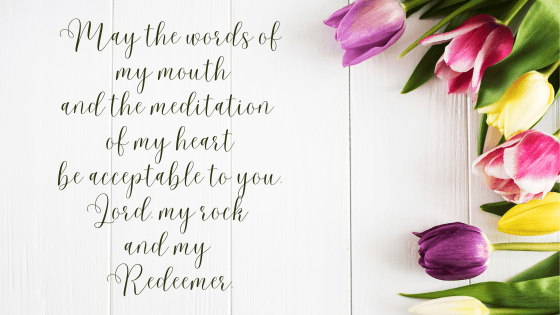
Instead, I’ll share with you what’s on my bedroom wall. It’s a beautiful calligraphy print of Psalm 19:14, which reads, “May the words of my mouth and the meditation of my heart be acceptable to you, Lord, my rock and my Redeemer.” (CSB)

Does that answer all our questions? Give us solid vocabulary to rely on that everyone will understand with complete clarity? Ensure that we never say a misunderstood thing ever again?

Nope. Not by a long shot.

But it does rightly direct our intentions. If my goal is to communicate flawlessly with you, I will fail. I’ll pick a wrong word or unwittingly say something that is a trigger for you. But, our amazing God, our Father, Lord, Rock, and Redeemer, knows us all. He knows our hearts. He knows not just what we say, but what we mean. And we can trust Him to bridge the gaps between us.

But only if our goal is first and foremost to be acceptable to Him.

That’s how I want to think, speak, write, and communicate. In a way that makes Him smile. That deepens my relationship with Him. That then, in turn, helps you see His love and pleasure as well. I forget that goal sometimes, which is why I have the verse on my wall, right by the door. I see it every day. I am reminded every day. Even so, I still miss it so often. But I want to keep growing. Keep learning. Keep practicing.

And maybe, before too much longer, that kind of communication will truly be my habit.

1. Merriam-Webster.com Dictionary, s.v. “habit,” accessed August 17, 2026, https://www.merriam-webster.com/dictionary/habit.

Posted in Thoughts from Life

What is Finished?

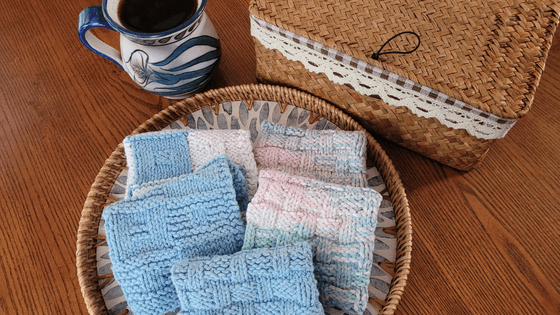
When I first sat down to start fleshing out this thought, I had just put three dish cloths in the laundry.

It seems like such an odd statement. What’s the big deal about washing three dish cloths?

Well, let me tell you a bit of a story.

I love handmade dish cloths. There’s something about washing dishes with that particular texture that just works. Some do work better than others, to be sure. The cutesy knit cloths with cows and dogs and dragons and dinos that I made when the kids were younger work fine, but the best ones are those with stronger texture variations that allow for soft but effective scrubbing.

Those cutesy cloths eventually wore out, and I realized it was time — probably well past time — to make a new batch of cloths. It took me a while, but I finally got around to starting the project. I had a couple of partially used cones of cotton yarn that didn’t have enough left for integrating into other projects, so that made yarn choice easy. The next step was to choose patterns. It didn’t matter if they were knit or crochet. I simply wanted them to be cute, but also functional, while being quick and easy to make. I found about a dozen patterns to try and dove in. Several times I’d start a pattern, get about a fourth of the way in, then decide that I didn’t like the feel or look or size or that the pattern would require too much attention. But I kept trying, knowing I’d get it figured it out.

I finally settled on two. My favorite, a texturally delightful knit basket weave was quick, simple, and could easily be adjusted to a variety of sizes. The other pattern was also quick, easy (unless I tried to alternate colors like I did with the first attempt at that pattern; beautiful results, but slow work!), and perfect for wiping counters.

Colors settled. Patterns chosen. Finally, I was ready to start creating my stash.

But, here’s the catch. The whole planning process took several weeks. And, I’m not super quick at knitting or crocheting. And, the first basket weave cloth I made I had to undo because I’d over-adjusted the size and made it too small. You see where this is going. This “quick and easy” plan to replace my dish cloths was turning out to be quite slow.

Which lead to another issue. I’m a finisher. So, of course, I wanted to finish all of the dish cloths before running them through the wash and integrating them into our daily usage. Very practical, right? Plan well, implement the plan, get it completed, then apply it. That’s how life should be.

Except, it’s not.

Life isn’t that clean. Or tidy. Or smooth. Life doesn’t let us focus on a thing, whatever that thing may be, and bring it to completion before throwing us a curve ball or introducing a new thing that needs to be tackled. Sometimes we have to live with small steps, rejoicing in the segments instead of waiting for the big finish.

Of course, that leaves a new challenge. What really does it mean to be finished? Where is that victory line we’re aiming toward? How many boxes really have to be checked off to indicate that we’ve made it? Are we finished when we’ve reached our original goal? Are we finished when we’re functional?

Or are we ever truly finished?

That’s a hard question for me in the grand scheme of life. It’s a rather philosophical one, and processing philosophical questions is not a big strength of mine. I prefer to tackle questions I can truly answer. And projects I can truly finish.

But since life isn’t that clean, I’m trying to use my little projects to practice tackling the big philosophical question, starting with running three completed dish cloths through the laundry so we could go ahead and start replacing the worn out ones. I eventually finished three more. In the meantime, I started other projects, some small and some large. Some would be finished quickly. On another, I set a one-year goal, knowing it would take me a while.

The finish line that I so dearly love may be hard to define. But that should never stop me from starting. Or from implementing along the way.

So, today, I’ll celebrate those three dish cloths. I’ll celebrate that I did actually finish that project. And I’ll keep pushing through life trusting that the One who gave me this desire to finish will guide me for His glory.

That’s answer enough for today.