
Posted in Thoughts from Life, Thoughts from Scripture

Words

Have you ever stopped to really think about how we use words?

You might think that this would come naturally to a writer. That I would be deeply attentive to every word I use and its nuance. But, that’s not really true. I am as nonchalant about words as the next person, using vocabulary, phrases, and grammatical structures habitually, without stopping to really process whether or not I am truly communicating my thoughts well.

In fact, I did it in that last sentence. Think about the word “habitually” — or even “habit.” It is often used in a manner which indicates an action taken without thought. Do I really not think about how I use my words? That’s a ridiculous notion, to be honest. Although sometimes I do speak before I think — we all do that at times — typically even the “habitual” words and phrases I use are intentional choices to attempt to communicate well.

So, even though we might think that having a habit means the ability to do something so naturally that we don’t even think about it, the truth is that we don’t actually use the word “habit” that way.

Just to diverge for a moment, the top definition in Webster’s dictionary for habit is “a settled tendency or usual manner of behavior,” followed by the second definition, which includes, “an acquired mode of behavior that has become nearly or completely involuntary,” “addiction,” and “a behavior pattern acquired by frequent repetition or physiologic exposure that shows itself in regularity or increased facility of performance.” Oh, and if you keep looking, you’ll see older definitions related to clothing, appearance, or even the action of dressing oneself!1

If you’re anything like me, the next time you use the word “habit” out of habit, you’re probably going to stop yourself and think, “Wait, did I really use that word well?”

That, my friends, is the point. What we say matters. But, it’s not just the words we use or the tones and attitudes we present when we use those words. It’s also the way other people understand our words.

That’s a heavy burden to bear, I know. If I talk about doing something habitually, and another person interprets that to mean that I can do it without truly thinking or processing, they may feel that they will never be able to succeed in that area. But, if they think of it as a behavior I’ve acquired or that is typical for me, they may realize that even a habit takes work and effort. Even after being accustomed to doing it. Together, I and the person to whom I am speaking are jointly responsible for making sure that we understand one another and are communicating with clarity.

And guess what? We’ll never, ever, ever do that perfectly!

Yeah, sorry. Didn’t mean to be a downer there. But it’s the truth. So, if it is the truth, what do we do about it?

I could give you a whole list of good communication techniques, but you can search for those yourself just as easily. I could talk to you about building healthy relationships, but trying to accomplish that in a few hundred words would make something that is exceedingly important feel very trite.

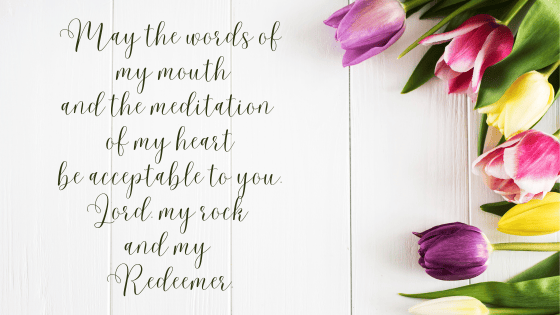
Instead, I’ll share with you what’s on my bedroom wall. It’s a beautiful calligraphy print of Psalm 19:14, which reads, “May the words of my mouth and the meditation of my heart be acceptable to you, Lord, my rock and my Redeemer.” (CSB)

Does that answer all our questions? Give us solid vocabulary to rely on that everyone will understand with complete clarity? Ensure that we never say a misunderstood thing ever again?

Nope. Not by a long shot.

But it does rightly direct our intentions. If my goal is to communicate flawlessly with you, I will fail. I’ll pick a wrong word or unwittingly say something that is a trigger for you. But, our amazing God, our Father, Lord, Rock, and Redeemer, knows us all. He knows our hearts. He knows not just what we say, but what we mean. And we can trust Him to bridge the gaps between us.

But only if our goal is first and foremost to be acceptable to Him.

That’s how I want to think, speak, write, and communicate. In a way that makes Him smile. That deepens my relationship with Him. That then, in turn, helps you see His love and pleasure as well. I forget that goal sometimes, which is why I have the verse on my wall, right by the door. I see it every day. I am reminded every day. Even so, I still miss it so often. But I want to keep growing. Keep learning. Keep practicing.

And maybe, before too much longer, that kind of communication will truly be my habit.

1. Merriam-Webster.com Dictionary, s.v. “habit,” accessed August 17, 2026, https://www.merriam-webster.com/dictionary/habit.

Posted in Marriage

I’m Proud of You

I’m proud of my husband. In so many ways for so many things. He’s a pretty amazing guy.

I’m proud of him when other people are proud of him. I’m proud of him when others are agitated with him. I’m proud of his successes and I’m proud of the way he learns from his failures.

The problem is that I don’t always tell him I’m proud of him.

The older our marriage grows, the more I learn that words matter. The spoken words matter, but so do the unspoken. The things we learn to leave unsaid because we know it’s best to not say them. The things we refuse to say, even though we know we should. And the things we just forget to say, whether for good or for ill.

It all matters.

Some days, when there are words I haven’t said to my husband or my children or even to others in my life, I think it might be easier to say those words here. To process them in writing and say them to the wide world, offering advice that I know to be true rather than implementing the truth into my own life. Sharing publicly in hopes that my husband or children or friends or extended family will just read it here instead of making me go to them. Writing it out in a relatively generic thought instead of forming deeply personal and sometimes very raw, unprocessed words in a face-to-face conversation. But, it is my goal to never do that.

So, instead of leaving you with examples of saying the words that matter, I’m simply striving to do it myself. To be sure to speak when I am proud, to share when I have a challenge, and to converse face to face when I’d rather try to hash it out with a keyboard.

What spoken words do you need to keep quiet this week? What unspoken words do you need to say?

Remember, it all matters.

Posted in Marriage

The Way We Think

As homeschooling has developed and grown over the years, many families have discovered a fantastic reality: school doesn’t always have to look like school! Homeschoolers have the beautiful freedom to tailor an education to a single child. This fall, I don’t have to walk my youngest through fourth grade the same way I taught his older sisters. By the time my seventh grader reaches her sophomore year of high school, the practical details of her daily work load will shape up very differently than it will with my oldest this year, even if they take the exact same courses!

To accomplish this customization, I have spent years exploring learning styles and special needs. Processing every bit of information I’ve taken in – even information about needs none of my children have – I’ve been able to explore what does and does not work for each child. And, I learn something new every single year. It’s a journey of constant discovery, and exploring how they learn has allowed me to get to know my children in a very precious way.

Learning Styles & Marriage

For some reason, though, until recently I have never really contemplated how learning styles affect marital relationships. It’s not that I haven’t pondered the way my husband learns, especially the ways his mental processing differs from mine. I have. That sort of observation just comes naturally to me, so I’ve observed his learning style for years and marveled at our differences. But, although you’d think it obvious for someone like me to make the connection, I have never really reflected on how our learning differences have impacted our marriage, for good or for ill.

Fortunately, even if I haven’t reflected on that impact, I have automatically responded to it over the years.

Consider these realities:

– How we learn affects how we present information. If we learn best through picture or illustration, we will use as much illustration as possible when passing information on to others. If we are more black and white, then we will be direct and pack as much information as possible into a short amount of speech.
– We receive what others are communicating based on the way our brains process information. Consider the presentation thoughts and turn them around. How would you receive information offered by someone who presents differently than you do?
– Misunderstandings often arise based on differences in mental processing, sometimes resulting in fights and anger simply because of communication differences.

Now, stop and think for a moment. How do you process information? How do you explain what you’re thinking? How does that compare to your spouse’s methods of processing and communication?

Here’s another point to ponder. Does your spouse communicate and process with you the same way he does with other people?

All of these thoughts and realizations rained down on me just recently as I described something I was thinking to my husband. He doesn’t need word pictures, but I do. And, on so many occasions, he has patiently listened as I’ve described my word pictures in detail, processing out loud as I try to explain to him what I’m thinking. Meanwhile, another recent conversation made me realize that he’s comfortable communicating with me in ways that he does not communicate with others, leading to unique discussion situations that do not occur anywhere else in his life. So, I have to evaluate our private conversations differently than I do our public conversations.

Oh, what an impact his patience and my discernment – or lack thereof on both accounts – have on our marriage!

There is no single solution for effective communication in marriage. But, when we make the effort to have a well-rounded understanding of our spouses and their personalities, our ability to communicate with one another can grow by leaps and bounds.