
Posted in Faith Nuggets, Thoughts from Scripture

Taking the Name

For 28 years, I’ve been known as a Hibbard. Admittedly, during the first couple of years, it was a little slow to “take.” We got married in our college town and lived there for the first six months. Any of my friends who were still in school were more familiar with my maiden name. Then we lived in my hometown for a while, attending church with people who had known my family and me for most, if not all, of my life. You can imagine how hard it was for some of them to call me Hibbard instead of Browning!

About a year a half into our marriage, though, we moved out of state. We met new people. Built new relationships. To these “new” people, I was a Hibbard, not a Browning. I might not have carried the genetics, but I carried the name. Over the years, that name grew to have a distinctive meaning to those who knew us, and I grew increasingly proud to carry it.

Don’t get me wrong. I’ve never been ashamed of being a Browning. I’m quite proud to carry that connection. But, when I married, I didn’t just take my husband’s name, I took a new identity. An identity he and I have formed together and shared with our children. One that is uniquely us, a combination of both trees of family joined together.

Over the past few months, I’ve encountered a wide range of Scripture passages referencing the Name of the Lord. They all remind us of the powerful identify of the Lord God Almighty. Of the redemptive and sacrificial power of the Lord Jesus Christ.

Then I ponder the commandment to not take the Name of the Lord in vain. And I think of John 13:34-35 where Jesus is sharing some final thoughts with His disciples before going to the cross. He tells them, “I give you a new command: Love one another. Just as I have loved you, you are also to love one another. By this everyone will know that you are my disciples, if you love one another.” (emphasis mine)

Do you see that? Everyone will know that we are His disciples — that we bear His Name — if we love one another.

Hmmm…

When we become Christians, we take the Name of Jesus just as clearly as I took the name Hibbard. We become public representatives of the King of kings and Lord of lords. He allows us to be the earthly picture of Himself, shaping what those around us see Him to be.

That’s what it means to take the Lord’s Name.

So, what does it mean to take it in vain? Does it really just boil down to the words we say? To never using a curse word or crude language? Or could it possibly mean something more?

Jesus said that everyone would know that we are His Name-bearers if we love one another. So, what does it mean when we don’t love one another? What does it mean when we fight among ourselves? When we call each other names or question one another’s salvation because of differing beliefs? When we refuse to show love to Christians — those who also bear the name of Christ — from another color or race or culture or even denomination simply because they are not like us? Because they do not fit with our preferences? Because they don’t agree with our politics?

We may be able to declare without hesitation that we’ve never aloud a curse word or even a hint of crudeness pass our lips. But can we truly state that we’ve never taken the Name of the Lord in vain?

I can’t. There have been too many times when I have not borne the name “Christian” well. When I’ve been unloving, despite the fact that Jesus loves with perfect purity. When I’ve been selfish, where Jesus is selfless. When I’ve been unforgiving in spite of the unconditional forgiveness Jesus offered me long before I even knew I wanted or needed it. When I’ve preserved my life and my desires even knowing that Jesus has called me to lay down it all down for the sake of His Name.

And I’ve had to confess each and every time.

We like to whittle our faith down to pithy statements and easily checked boxes. But, our responsibility, no matter what commandments in Scripture we look to, is to bear the Name of a holy God. A perfect God. A God who loves more completely and purely and perfectly than we could ever imagine loving.

We are called to take His Name.

When I took my husband’s name, I chose a new identity. I chose to be connected to him and to reflect that connection in every aspect of my life.

We do the same when we take the Name of Christ. To take it in vain means that we refuse to be a reflection of Him. Upholding the Name of Christ means we walk in that connection, in His life, fully and completely, setting aside any of our own individualistic identity. Will we always do that perfectly? No, of course not. But it does mean that we live with that intention. And when we falter, we repent without hesitation. We live a reflection of His forgiveness. We live in love for one another…so that all will know we are His.

We’ve taken His Name. May we live to carry it well and never in van.
Posted in Thoughts from Scripture

Words on a Page

Have you ever encountered a passage of Scripture that just didn’t click with your brain? That really was no more than words on a page?

That sounds sacrilegious, doesn’t it? Rebellious in so many ways. (Also, it bugs me that sacrilegious reverses the “i” and the “e” in religious, making it very hard for me to spell, but that’s not important right now.)

Let’s stop and think about this for a moment, though. If we believe that the Holy Spirit brings the Word of God to life in our hearts and minds, using black and white words on a page to help us get to know the true Word, Jesus Himself, then it would make sense that the Spirit wouldn’t illuminate all of the Bible to us at once. It would be far too much. Our brains couldn’t handle it. So, from that perspective, it makes sense that we don’t “get” all of the Bible.

But that should never keep us from working toward that goal, opening ourselves to the Spirit’s guidance as we grasp truths a little at a time.

When we do, we will eventually experience that moment when something that didn’t make sense before suddenly does. When what was just words on a page becomes alive. When understanding clicks and the light comes on.

That’s the Spirit, by the way, fulfilling the promise of Jesus to not just comfort but teach and guide. It’s an amazing reality!

Psalm 119 used to be one of those “words on a page” passages for me. As the longest chapter in the Bible, it often felt tedious and repetitive. Then the Spirit opened it up to me. It’s been years, decades even, since that happened, but I still remember it vividly. Suddenly this poem went from words on a page to a celebration of the very Word I was exploring. I began to sense the passion behind the words.

We have no idea who penned Psalm 119. It could have even been a group of worshipers, each assigned a letter of the Hebrew alphabet (Psalm 119 is an acrostic poem with 22 stanzas, one for each letter of the alphabet) and told to write words of praise to God for His law. Or it could have been a single individual excited about how the law helped them understand God. Whatever the case, Psalm 119 is essentially a love song for the Word of God, focused on what we now know as the first five books of the Bible.

I “caught” that passion one day when reading it after another passage had caught my eye. I don’t remember what the other passage was, just that I was excited about learning and growing and experiencing the teaching of the Holy Spirit. So, when I read Psalm 119, I realized the psalmist was experiencing the same thing, a joyous response to the life-giving reality of the Word of God. The psalm would never again be just words on a page.

I confess that right now I’m in a bit of a bog when it comes to reading the Bible. I do it every day, but processing takes work. Very little jumps off the page at me. I have to work for it. Dig for it. Study it. All of which is a good approach to Scripture, but it can be hard to do for my daily reading when I don’t have several hours to sit with a chapter.

I’ve been in this place before. A place where I get the most out of the Sunday school or Bible study passage that I sit with and immerse myself in for a whole week rather than from my daily reading. I feel like I’m missing a lot and struggling a lot.

So, I go back to Psalm 119, and I’m reminded of the deep beauty of the Word and of the reality that the Spirit is teaching me faithfully. Sometimes it’s bold and bright and eye-catching. Sometimes it’s slow and steady and even laborious. But, it’s always there. And I am thankful.

Posted in Thoughts from Scripture

Work

Work.

Does it ever feel like a four-letter word to you? I confess, it does to me at times. (Honestly, right now is one of those times!) A job that is stressful and disheartening can weigh us down tremendously, but so can the idea of any work. It can feel so negative. So burdensome. So opposite of the life we’re supposed to live.

And when we see work that way, it can infect the fullness of our attitudes, leading us to reflect a blah-ness about everything we do.

I was feeling this rather heavily one morning as I looked ahead to the day. I honestly just didn’t want to do it. Any of it. The employment work was discouraging. The life work interminable. All of it was compounded by a long string of 100-degree days behind us, a forecast that promised much more of the same, and drought with no promise of relief. Life just felt heavy, and I didn’t want to do any of it.

And wouldn’t you know it, that morning, my Bible reading was 1 Thessalonians 1, which begins this way:

Paul, Silvanus, and Timothy:
To the church of the Thessalonians in God the Father and the Lord Jesus Christ.
Grace to you and peace.
We always thank God for all of you, making mention of you constantly in our prayers. We recall, in the presence of our God and Father, your work produced by faith, your labor motivated by love, and your endurance inspired by hope in our Lord Jesus Christ.
I Thessalonians 1:1-3 (CSB) emphasis mine

Verse three stopped me in my tracks, especially considering the teeny glimpse into Thessalonian life that Acts 17 gives us. Paul didn’t get to spend a lot of time in Thessalonica because of the character of the people there. In fact, Acts 17:11 compares the Thessaolonians to the people of Berea, the next town Paul went to, by stating that the Bereans “were of more noble character than those in Thessalonica.” Paul’s ministry in this less-than-noble town had been short-lived, yet there were those who chose to follow Christ. A church was born, even in this town. And I can imagine that the Christians left behind by Paul weren’t responded to well by the crew that both ran Paul out of Thessalonica and followed him to Berea to run him out of there as well.

And yet, they persevered to the point of being highly praised by Paul for their work.

Work produced by faith.

Not by the culture. Not by the demands of life. But by faith. They worked because of their allegiance to God Almighty.

We have a hard time wrapping our heads around how much religion was integrated with every day life for people like the Thessalonians. By becoming Christians, they had to re-evaluate everything. Every aspect of life. And they chose to do it in a way that, according to Paul, was firmly grounded in faith in the Lord Jesus Christ.

Labor motivated by love.

I work because I am supposed to. Whether it’s the income-based jobs God has put before me or the other aspects of work — church, life, family, etc. — I labor from obedience. The thing about obedience, though, is that we sometimes think we’re okay as long as we’re checking off the “obey” box. As long as we’re fulfilling the obligation, that’s all that matters.

But it’s not all that matters. The church in Thessalonica apparently understood that clearly, because their labor was motivated not by obedience or obligation. It was motivated by love. Oh how much we could accomplish with love as our motivation!

Endurance inspired by hope in our Lord Jesus Christ.

So often my endurance is inspired by necessity. I’m here. I have no other choice but to be here. So I keep on keeping on because there really isn’t another option.

But, there is. If I’m here, it’s because God put me here. If I’m here, it’s because He has a purpose. If I’m here, it’s to accomplish the work set forth by the Lord Jesus Christ to draw all humanity to Himself. To see the fulfillment of the eternal kingdom. If I’m here, it is because of the hope of that fulfillment.

I’m about to clock in and start work for the day. It’s a job that, on the surface, has nothing to do with eternity. I’ll go through the steps, then break for lunch, then come back, then do chores, then wrap up the day to try to get some sleep so I can do it all over again.

What if I remembered that the will of God is not disconnected from daily life? What if I lived today the way the Thessalonian Christians lived it? What if I worked as unto the Lord, recognizing that He has me here for a reason, no matter how pointless the job seems? What if I am motivated by love? Inspired by hope in Christ Jesus?

What might I see if I live that way? I’m ready to find out!

Posted in Reviews

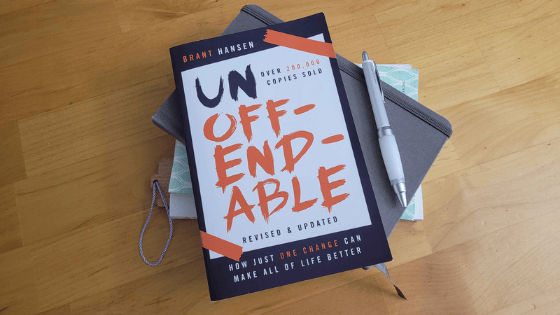
Book Review: Unoffendable

My husband and I frequently share tidbits from books we’re reading. Sometimes the tidbits he shares with me let me know that he’s run across a book I need to read too.

Unoffendable by Brant Hansen was one such book. So, today I’m going to see if I can remember how to write a book review so I can share this book with you as well!

The premise is very simple and is actually stated on the back cover: “What if we decided not to be offended?” The style of the book itself is just as simple, at least in regards to readability. It’s one of those engaging, enjoyable, quick reads with perfectly sized chapters and subsections.

The content of Unoffendable, though, is far from simple. Hansen argues that our anger and quick offense are not the useful tools we think they are. To be honest, I had some of the same responses that he reports receiving from other critics: Are there not legitimate times to be angry? Are there not times when taking offense spurs us to action? Do we not fall into the trap of ambivalence if we refuse to become angry about injustice?

Hansen would answer “no” to every one of those questions, backing up his perspective with a combination of solid biblical support and personal experience. He isn’t just preaching a theoretical sermon. He’s sharing what he has learned from his own study of the Word of God, as well as his experience of living out the lessons he’s learned.

Ultimately, two points in Hansen’s arguments hit home most strongly and bring the rest of the book into focus for me. The first is his discussion on righteous anger, questioning our ability to truly handle our anger in a righteous manner with no sin. If we stop and think about it, are we really able to be angry and not sin? Or is that perhaps only something God can accomplish?

The second is his perspective that anger frequently does not drive us to positive action. It leads us to talk a big talk and make sure to air our opinions. But, action that fights against injustice more faithfully emerges from love and compassion than from anger.

In sharing the lessons that God has been teaching him, Hansen is honest and open. He is not afraid to admit his own poor responses and foibles. He’s in no way claiming to have it all figured out. Instead, he’s excited about the peace and growth that have come from taking this one step of obedience, and he wants others to know the same peace and growth.

Unoffendable has not cured me of being offended or angry. But it has made me stop and notice. And the noticing has been rather uncomfortable. But that’s the way of conviction and growth, and I definitely want to grow more. I’m thankful for Hansen’s willingness to share his own growth to help us better process God’s teaching on how we as His children should handle our anger.

Posted in Thoughts from Life

No Perfect Code

I love getting to learn new skills. One of the skills I’ve learned over the past decade or so has been a very rudimentary understanding of a couple of coding languages. I don’t know anywhere near enough to write more than a few very basic components of code. Nor do I know how to do any major troubleshooting if something is wrong. But, I know enough to make minor tweaks and updates to existing code or to solve very basic problems.

The nice thing about code is that problems can often be fixed by adding or removing one single character. Of course, that’s also the bad thing about code. If something’s wrong, it could be off by one single character, which can be tough to find.

Either way, though, it’s objective. It’s a logic problem. Creating code and solving problems might be a headache (okay, so no “might” to that — there’s always some form of headache when it comes to coding, it’s just a matter of how big the headache is), but it’s still formulaic.

How tempting is it to try to approach life that way? To believe that we can solve anything and everything if we can just find the right button to push?

And, in all honesty, we do approach life that way. Our self-help books and marketing show this to be true.
Follow these steps and you can write and sell your book.
Choose this path, and you can achieve your dream job.
Take these supplements or follow this plan and you can get healthy and skinny.
Do this with your children and they’ll turn out brilliant and successful and perfect.

If you would just do it my way using my tips and tricks and products, everything will be just perfect.

Except it won’t. Life doesn’t work that way. Life is not code. Life is subjective and messy, and what works perfectly in one situation doesn’t work in another.

On the one hand, I like that because it gives me freedom to say, “I’m glad that works for you, but it’s just not me.” On the other hand, though, I do wish I had a formula. I wish I could just insert the right code and have everything fall into place for my husband, my children, and myself. I wish I could just follow a plan and have everything work perfectly for our church. I wish I could just say the right words in prayer and have my prayer journal be filled with answers to prayer instead of requests that seem to stubbornly stay unanswered.

There’s no perfect code, and it’s annoying. There’s no perfect motivational trick, and it’s exhausting. There’s no way to fix things, and it’s heartbreaking.

But, there’s God. There is an all-powerful, perfect, just, righteous, and holy God who is also loving and intimate and close. There’s a God who is always constant and whose character doesn’t change, but whose character includes so much creativity that He doesn’t have to act the same way twice. He can keep us surprised. Keep us, by necessity, trusting in Him.

That trust is hard sometimes. Serving a God whose creativity is that big means we cannot predict, cannot solve, cannot logic our way through the circumstances of life because His ways are too big to fit into those boxes. That’s really the essence of trust, though. Giving up our right to the ability to figure out solutions on our own. To surrender to His ability instead.

To wait. To watch. To rest. To abide.

No, there’s no perfect code. And for someone who likes to logic and checklist their way through things, that can be hard.

But it’s also good. Because creative love is better, and the love of God is the greatest of all. I’ll trust in that.

Posted in Thoughts, Thoughts from Life

Not My Strength

I’ve started three different posts this morning, but none of them were posts that lend themselves toward quick completion. So, I’ll share them…later. For today, I found this thought from nearly eleven years ago. I have only guesses about what the task was that caused such issues back then, but I know I’ve experienced this struggle many times since then. And, honestly, I frequently need this reminder to not rely on my own strength. So, today I share these “old” but still relevant thoughts with you while the “fresh” thoughts continue to percolate and find their way to completion.

Do you have one of those areas? Of course you do. We all do. That thing that, whether we like it or not, we absolutely stink at!

Yet somehow, at some point, we find ourselves having to do that very thing.

I’ve dealt with that thing in ministry. I’ve dealt with it at work. In fact, I’ve got one of those things on my work plate right now. This week it has caused me to spend several hours plodding through a still unfinished task that should have been done in under an hour. Because it’s not my strength. Because I’m not good at it.

But guess what, my friends. Even those things need to be done. And sometimes we get to be the chosen ones. For some reason, the wonderfully gifted just can’t do it this time around. So, it falls to us.

So, we do it.

As frustrating as it can be to have to tackle things that do not fall within our strengths, I believe God has a very grand purpose when He puts the jobs before us.

First, we are reminded that the strength is His, not ours. Why, oh why, do we need that reminder? But we do, don’t we? We go through daily life and rely increasingly on our own strength. Oh, my friend, our strength is so small! Even in the areas of our giftings, our strength is so very limited. And the more we limit our activities to our “natural talents,” the more even those areas of talent become a struggle.

If God is not working through us, then we’re not working successfully. Period. And when we forget that reality, God has to remind us – usually by taking us outside our comfort zones and forcing us to rely on His strength again.

Second, we understand others better. If you are a natural when it comes to working with children, you might not understand my struggle with and aversion to being involved in children’s ministry. On the other hand, if you tell me that a simple sewing pattern looks like a foreign language to you, it will blow my mind. It’s just a pattern. It’s as clear as day. Right?

Just because a task is natural to me does not mean it will be to you, and vice versa. And that’s okay. It really is. Neither of us is deficient in any way. We are not faulty or incomplete.

We say that we know that to be true – we all readily agree that different people have different talents. But, often we forget to make that knowledge a part of our everyday understanding of people. We get irritable when someone else doesn’t “get” it. And God has to put a task before us that stretches us outside our strengths to remind us to be patient with others.

I often like to complain when a task outside my strengths is put before me. But, I should instead thank God for the opportunity to stretch myself and better appreciate those who typically do the task. (And believe me, I’m very appreciative this week!) May that become our faithful response!

Originally published November, 2015
Posted in Thoughts from Others, Thoughts from Scripture

Not Alone

Some mornings, I read and have to work pretty hard to process what I’ve read. I want to study and grow and learn, but some mornings I just have to make it my goal to get the information into my head and trust that the understanding will dawn eventually.

Other mornings, though, things just jump out at me. Sometimes a lot of things, sometimes a few. But, they literally leap off the page and catch me by surprise.

Then there are days when I’m distracted and struggling for most of the reading, but one little thing still grabs at me. Reading back through my journal, I discovered an entry about one of those days. It was the first day of a new year, but the week was about halfway through — and it had been a long week already. I was tired. My shoulders were stiff with tension. And my head was not really grasping the sense of a new beginning or fresh start of any sort. On days like that, an arbitrary date on a calendar declaring, “New Year!!!” doesn’t really offer a promise that things will be truly new or good or different.

So instead of feeling celebratory, I started the day a wee bit grouchy. And then I read these words:

The psalmist insists that no one anytime, anywhere, praises the Lord alone.

The sentence came from a commentary on the Psalms entitled The Psalms: Jesus’s Prayer Book by Douglas D. Webster. I’d been reading the four-book series all during the previous year as a companion to our church reading plan, which had spent the year working slowly and steadily through the Psalms. The plan ran over just a few days into the new year, and the reading on this particular morning was Psalm 148, a sweeping song of praise encompassing the whole of creation. In fact, it’s hard to read the psalm without thinking of God’s act of creation, especially since another devotional reading that morning centered on Genesis 1.

The whole set of readings offered a powerful reminder of praise, even speaking into my grouchy, tired, cranky morning. Even so, this one little quote took me off guard.

Why?

Because it made me realize that, so often, I choose to approach praise as if I’m alone. Just me trying to figure out how to praise God in the middle of the “whatever” of my life, even if I’m with others who are doing the same thing. We’ve made our relationship with God so personal that it has become individualistic. And that leaves us feeling alone.

But we’re not. Ever. Even if there wasn’t another person around with a heart to praise our Savior, Lord, and Creator, we still wouldn’t be alone because all of creation is constantly praising Him.

We never, ever praise alone.

Whether through the laughter of my family, the songs of a congregation, or the music of wind chimes as the breeze blows around them, praise is everywhere. And I’m a part of it.

I should know this. And, deep inside, I realize I do know it. But I hadn’t really been living the knowledge. Instead, I’d been complaining because I felt alone.

The most beautiful thing about the Spirit’s instruction and illumination of God’s Word is that we become nourished even when the circumstances don’t change. My week was still long. The challenges were still there. But the reminder shifted my focus, as is evident in my journal entry for the next day. How amazing to serve that kind of God.

And to know, we’re never alone.

Posted in Thoughts from Life, Thoughts from Scripture

Thoughts from Moses

Do you ever look at certain stories in the Bible and wonder how in the world people can respond the way they do? I do. Moses’ behavior in Exodus 3-4 is one example. Here Moses is, standing in front of a bush that is on fire but not being destroyed, talking to Almighty God. And what does he do? He argues.

Well, at first he’s afraid, which is a very natural response. And he sees his own inadequacies in the face of a holy, awesome God. Again, not only natural, but very appropriate.

But, then Moses goes above and beyond the point of recognizing his inadequacies. He starts arguing to the point of informing God that He’s wrong. Ouch! It’s easy to condemn Moses for his behavior. But, I can’t help but want to dig deeper. Why would Moses go to such extremes?

I think the answer might lie in Exodus 2, in the hands of the fellow Hebrews Moses simply wanted to help.

Years later, after Moses had grown up, he went out to his own people and observed their forced labor. He saw an Egyptian striking a Hebrew, one of his people. Looking all around and seeing no one, he struck the Egyptian dead and hid him in the sand. The next day he went out and saw two Hebrews fighting. He asked the one in the wrong, “Why are you attacking your neighbor?”

“Who made you a commander and judge over us?” the man replied. “Are you planning to kill me as you killed the Egyptian?”

Then Moses became afraid and thought, “What I did is certainly known.”

When Pharaoh heard about this, he tried to kill Moses. But Moses fled from Pharaoh and went to live in the land of Midian, and sat down by a well. – Exodus 2:11-15

Keep in mind that Moses was called and preserved from birth for the purpose of being used by God to free the Israelites. He might not yet have known how to listen to God’s plan, but he already had a huge burden for the people of God.

Yet even from the very beginning, the people he wanted to help lashed out at him, rejecting his help. (And this would be repeated so very many times over the next forty years.) They may even have been the reason Pharaoh learned about the murder. Now, don’t get me wrong — I don’t believe Moses was in the right here in his choice to kill the Egyptian. I believe he let his passion rule, and God needed to get ahold of him and teach him a lot. Even so, being attacked by the very people he thought he was helping had to leave a wound.

A wound that seemed to still be bothersome forty years after Moses fled Egypt.

A wound that had settled in so firmly that he seemed to honestly believe Almighty God, the great I AM, didn’t really know what He was talking about.

Obviously, Scripture doesn’t explicitly say, “Moses didn’t believe God because he’d been deeply hurt by the Hebrews before, and he didn’t think it was possible for them to accept him as their leader no matter what I AM said.” But I’ve seen what the wounds from a friend can do.

I’ve seen someone express passion and excitement because God was working and it was visible. The delight in being a part of that work was so tangible! But, doubt began to creep in. Then an attack came. Not from the world, but from a friend. From a beloved fellow Christian. And the wound struck so deep that it overcame the passion and excitement. Delight turned into confusion and an insatiable urge to just escape. Walk away from all of the work. Walk away from being used by God. Hide and never feel that hurt again.

I’ve not just seen that hurt in others. I’ve felt it myself, so very strongly. It’s a deep wound.

Cherished loved ones can hurt us. Those who should be our allies can derail us. Friends can deceive and incapacitate us. The most tragic reality is that the actions of fellow believers can convince us that the all-powerful, almighty, unfailing, all-knowing, loving God who called us doesn’t know what He’s talking about. Yes, we can and do respond just like Moses did. Ouch.

And more often than not, they aren’t doing it intentionally. They’re just acting out of a focus on self instead of on God and others. It’s easy to do. We’ve all been there, especially when we’re struggling with something. Think about the Israelites. Their problem wasn’t really with Moses. It was with their oppressors. They were tired. Weighted down. And lashing out at the most available person — who just happened to be the person who wanted to help them.

No wonder Scripture tells us so many times to encourage one another. To build one another up. To be a community of unity. Of nourishment. Of exhortation. Yes, to call out sin in one another, but never, ever, ever to tear one another down. Because we have to be reminded to look beyond ourselves. We don’t remember on our own.

God’s enemy wants to divide us. He wants to isolate us. He wants to cause disunity among us. Because when he does, he can cause us to doubt God’s calling. He can drive us to argue that we’re not enough. And when we’re alone, we’re not enough. But when we’re together, serving our Lord God in the unifying power of His Spirit, nothing can stop us.

Which option will we choose?

Posted in Thoughts from Scripture

No Big Picture – Part 2

Chewing on thoughts from Scripture never fails to produce results. Maybe that’s why we are reminded so often to meditate on God’s Word.

That was definitely the case as I continued to meditate on John 5:19-20 after the verses literally jumped off the page at me. I shared my immediate thoughts last week, but the concept continued to deepen. Continued to form. Continued to work on my heart.

Here are the verses again, just as a reminder:

Jesus replied, “Truly I tell you, the Son is not able to do anything on his own, but only what he sees the Father doing. For whatever the Father does, the Son likewise does these things. For the Father loves the Son and shows him everything he is doing, and he will show him greater works than these so that you will be amazed. John 5:19-20 CSB

The initial realization was that Jesus didn’t have the big picture. By choice. He surrendered it when He took on flesh.

That is mind-boggling enough. But, the more I contemplated it all, the more the enormity of the situation began to sink into my slow brain. Before taking on flesh, the Son didn’t have to be shown anything. He was part of it. He automatically knew it. John 1 tells us that He was there in the beginning. He already existed with God. He knew it all because He ordained it all.

But He surrendered that full knowledge when He took on flesh, putting Himself in a place where He had to rely on the Father to show Him what was going on. He had to trust that the Father would show Him what was relevant when it was relevant. And He never doubted that it would happen, because He trusted the Father’s love and wisdom explicitly.

Here’s where this all hits me. I crave the big picture in life as much as I crave it in my job. I want to see it all so I can then break it down and tackle each step as needed. In my work, that’s necessary. The issues I’ve had in recent years have come down to the reality that I haven’t had enough information, and those who’ve had the information have neglected to give it to me. There was a breakdown. I work for good people. But they miss things. Because of that, I can’t automatically trust them to give me what I need when I need it.

In a way, that’s an understandable frustration with the small reality of work. But, when I crave it in life as a whole, the life that is supposed to be 100% surrendered to the Lord Jesus Christ and, by extension, God the Father, it reveals a problem. A sinful lack of trust kind of problem.

God the Father knows what I need. He knows when I need it. If it comes from Him, I can trust that it’s enough to take the next step, as long as I’m listening faithfully. He never gives too little. If I mess up, it’s because I responded poorly to what He gave me; it’s never because He didn’t give me enough information or the right information.

And yet, I often treat Him like my boss and coworkers. I fuss that I need more. More information. More guidance. More clarity. More…something. That I need to see the big picture. I need to see where He’s taking me so I can figure out my next steps.

That’s faithlessness, pure and simple. Sinful faithlessness.

Ouch.

I have tried to orchestrate life. Break down the big picture. Make things fit just so. And I’ve hit brick walls of frustration on so many things. But the Lord spoke into my striving, whispering truth into my spirit. He showed me the answers He’s already given me. He pointed me to prayers I’ve been praying and how my current uncertainty is actually an answer to some of those prayers. He showed me the action I need to take right now. Today. This week. It doesn’t solve next week or next month. It doesn’t make all of the pieces come together. In fact, it tempts me to ask more questions.

But God isn’t calling me to solve those things. He’s calling me to trust Him today. To see what He has put right in front of me and to do that. Only that. To leave the rest — the big picture — in His hands. Because He knows what to do with it. For all the ways He’s gifted me to break down dreams and visions and ideas into tangible actions, He has not gifted me to solve life’s big issues. That’s His job, not mine.

So today I confess my lack of trust. I repent of my whiny refusal to act simply because I don’t have all the information I think I need. I surrender my need for the big picture. And I make a commitment to do follow along with what I see the Father doing today.

In work. In life. In everything. That’s more than enough.

Posted in Meditations & Meanderings, Thoughts from Scripture

Comfort

“Comfort, comfort my people,”
says your God.
“Speak kindly to Jerusalem and tell her
that her time of warfare is over,
that her punishment is completed.
For the Lord has made her pay double for all her sins.”
Isaiah 40:1-2

I just love the book of Isaiah. I don’t slow down as often as I should when I read it. But when I do, it always grabs me, both in the devastating first part and the hopeful second part.

Isaiah 40 is one of the better known passages of the book, thanks to its Messianic tone and frequent reference in sermon, song, and more. Because of that, sometimes it’s easy for me to read through it without slowing down. I know what it says. It’s familiar. It’s clear.

When I do slow down, though, I’m nearly blown away. Just think about it for a minute. For centuries, God had watched His people reject Him, ignore Him, disobey Him, and suffer the consequences of their refusal to follow Him. They blamed Him for their suffering even while choosing to chase after the things He explicitly told them would hurt them.

Ultimately, they chose punishment instead of His care. His heart grieved, but He knew that the only way to get their attention was to allow them to experience the consequences of their choices.

That’s the first part of Isaiah. But then, the story shifts, enough so that some theologians insist that the second part of Isaiah had to have been written by a different author. And yet, it all comes from the same God. The God who instructs and lays out a clear path of obedience for His people. The God who gives His people a choice. The God who grieves when His people choose to reject and disobey Him. The God who allows the punishment and consequences to fall.

And the God of chapter 40 who declares comfort.

When someone has hurt me, I may forgive them, but I don’t necessarily embrace them again. I will either walk away completely, choosing a separate path from them, or I’ll erect a barrier that keeps them at arm’s length.

Not God! He leans right back in. He embraces. He comforts. He restores intimacy. He draws His people close to His heart, putting them right back on His path.

How astounding is that! How loving! How powerful!

And what should my response be?

First, to recognize the boon this is for me. He takes me back. He embraces me. He welcomes me back into His intimacy even when I’ve messed up royally. He loves my confession and repentance and is right there to welcome me back into His embrace every single time, comforting me even as I grieve over my choice to hurt Him…yet again.

Second, to be a reflection of this to those around me. They, too, are that close to His comfort. His intimacy. His grace and mercy and lovingkindness. And I get to be a conduit of that.

I get choked up every time I think of how Isaiah must have felt when this message flowed through Him to the people of Israel. He’d been proclaiming judgment and punishment. Destruction and captivity. Suddenly, though, he could declare comfort and intimacy. He had the opportunity to speak of the incomprehensible love of God, to declare its closeness and assurance. Where he’d only been able to speak of doom, he could now shout about joy.

What a treasure! What a delight! And I get to declare the same thing, but with even more clarity than Isaiah because I know the rest of the story! Instead of knowing that sometime in the future there will be a Savior, I get to look back and see how Isaiah’s prophecies were fulfilled through the incarnation of Christ.

I get to point to the exact moment in history when the comfort of God was sealed through the destruction of death. Wow!

This is the truth I want to live. Abundantly, powerfully, openly. Declaring God’s comfort to all, that they may have the chance to receive — no matter where they’ve been.