
Posted in Faith Nuggets, Thoughts, Thoughts from Scripture

Leading the Leaders

Lately I’ve been working through some thoughts about leadership that will eventually make their way into coherent form. But, the foundation of the thought is this: A major message blared to youth when I was growing up revolved around how important it was to be a leader instead of a follower. And I wondered about that even then — how can you have leaders with no followers? Followers will always outnumber leaders, but there is also wisdom to be had in following. That’s a portion of what this post, written well over a decade ago, addresses, and revisiting it is helping me as I hash out the fullness of my thoughts. So, I figured I’d reshare it today. Enjoy!

The reign of Hezekiah has always thrilled me. If I had to pick a favorite king of Judah, he would be the one. After generations of sinfulness and disobedience, Hezekiah decides to do it right.

He wastes no time beginning reforms.

In the first year of his reign, in the first month, he opened the doors of the house of the Lord and repaired them. He brought in the priests and the Levites and gathered them into the square on the east. Then he said to them, “Listen to me, O Levites. Consecrate yourselves now, and consecrate the house of the Lord, the God of your fathers, and carry the uncleanness out from the holy place. 2 Chronicles 29:3-5

Where It Starts

There is something I find interesting in this story. Hezekiah instructs the priests and Levites right here in the very beginning. Yet all through the reforms, a certain theme is repeated:

But the priests were too few, so that they were unable to skin all the burnt offerings; therefore their brothers the Levites helped them until the work was completed and until the other priests had consecrated themselves. For the Levites were more conscientious to consecrate themselves than the priests. 2 Chronicles 29:34

For the king and his princes and all the assembly in Jerusalem had decided to celebrate the Passover in the second month, 3 since they could not celebrate it at that time, because the priests had not consecrated themselves in sufficient numbers, nor had the people been gathered to Jerusalem. 2 Chronicles 30:3-4

Then they slaughtered the Passover lambs on the fourteenth of the second month. And the priests and Levites were ashamed of themselves, and consecrated themselves and brought burnt offerings to the house of the Lord. 2 Chronicles 30:15

For Hezekiah king of Judah had contributed to the assembly 1,000 bulls and 7,000 sheep, and the princes had contributed to the assembly 1,000 bulls and 10,000 sheep; and a large number of priests consecrated themselves. 2 Chronicles 30:24

Do you see the progression here?

– Hezekiah initiated.
– Some of the religious leaders responded, but not all.
– The people responded in greater numbers.
– The religious leaders slowly came around, feeling convicted because of the response of the people.

There are a couple of lessons to learn from this.

First, our positions mean something! Hezekiah should not have been the initiator. The people should not have been ahead of the priests and Levites. It was the job of the priests and Levites to instruct the king and be spiritual leaders for the people. They failed and then had to play catch-up when they should have been leading.

Fortunately, others stepped up! This leads directly to the second lesson.

Don’t wait for the “right” person to act! Leaders do not always lead as they should. Sometimes they get complacent. That does not give followers an excuse. Sometimes people must be willing to motivate their leaders to action.

You might not see yourself as a leader, and that’s okay. Not everyone is a leader. But, that doesn’t excuse you from action. If you are choosing to sit around and do nothing simply because your leaders are not acting, then you are living in sin. You share a measure of responsibility with your leaders. And you are capable of instigating a change!

The priests should have been the ones to direct the king and mobilize the Levites. The Levites should have been the ones to teach the people, stirring them to action. Instead, Hezekiah pushed the priests and Levites. Then he stirred the people to action. The Levites got a more decent start than the priests, but it was only the amazing responsiveness of the people that truly lit a fire under the sluggish priests. The ones who should have started everything were the last to respond.

Where will you and I fall? May we be the first!

Originally published July, 2014
Posted in Thoughts from Others, Thoughts from Scripture

Not Alone

Some mornings, I read and have to work pretty hard to process what I’ve read. I want to study and grow and learn, but some mornings I just have to make it my goal to get the information into my head and trust that the understanding will dawn eventually.

Other mornings, though, things just jump out at me. Sometimes a lot of things, sometimes a few. But, they literally leap off the page and catch me by surprise.

Then there are days when I’m distracted and struggling for most of the reading, but one little thing still grabs at me. Reading back through my journal, I discovered an entry about one of those days. It was the first day of a new year, but the week was about halfway through — and it had been a long week already. I was tired. My shoulders were stiff with tension. And my head was not really grasping the sense of a new beginning or fresh start of any sort. On days like that, an arbitrary date on a calendar declaring, “New Year!!!” doesn’t really offer a promise that things will be truly new or good or different.

So instead of feeling celebratory, I started the day a wee bit grouchy. And then I read these words:

The psalmist insists that no one anytime, anywhere, praises the Lord alone.

The sentence came from a commentary on the Psalms entitled The Psalms: Jesus’s Prayer Book by Douglas D. Webster. I’d been reading the four-book series all during the previous year as a companion to our church reading plan, which had spent the year working slowly and steadily through the Psalms. The plan ran over just a few days into the new year, and the reading on this particular morning was Psalm 148, a sweeping song of praise encompassing the whole of creation. In fact, it’s hard to read the psalm without thinking of God’s act of creation, especially since another devotional reading that morning centered on Genesis 1.

The whole set of readings offered a powerful reminder of praise, even speaking into my grouchy, tired, cranky morning. Even so, this one little quote took me off guard.

Why?

Because it made me realize that, so often, I choose to approach praise as if I’m alone. Just me trying to figure out how to praise God in the middle of the “whatever” of my life, even if I’m with others who are doing the same thing. We’ve made our relationship with God so personal that it has become individualistic. And that leaves us feeling alone.

But we’re not. Ever. Even if there wasn’t another person around with a heart to praise our Savior, Lord, and Creator, we still wouldn’t be alone because all of creation is constantly praising Him.

We never, ever praise alone.

Whether through the laughter of my family, the songs of a congregation, or the music of wind chimes as the breeze blows around them, praise is everywhere. And I’m a part of it.

I should know this. And, deep inside, I realize I do know it. But I hadn’t really been living the knowledge. Instead, I’d been complaining because I felt alone.

The most beautiful thing about the Spirit’s instruction and illumination of God’s Word is that we become nourished even when the circumstances don’t change. My week was still long. The challenges were still there. But the reminder shifted my focus, as is evident in my journal entry for the next day. How amazing to serve that kind of God.

And to know, we’re never alone.

Posted in Thoughts from Life, Thoughts from Scripture

Words

Have you ever stopped to really think about how we use words?

You might think that this would come naturally to a writer. That I would be deeply attentive to every word I use and its nuance. But, that’s not really true. I am as nonchalant about words as the next person, using vocabulary, phrases, and grammatical structures habitually, without stopping to really process whether or not I am truly communicating my thoughts well.

In fact, I did it in that last sentence. Think about the word “habitually” — or even “habit.” It is often used in a manner which indicates an action taken without thought. Do I really not think about how I use my words? That’s a ridiculous notion, to be honest. Although sometimes I do speak before I think — we all do that at times — typically even the “habitual” words and phrases I use are intentional choices to attempt to communicate well.

So, even though we might think that having a habit means the ability to do something so naturally that we don’t even think about it, the truth is that we don’t actually use the word “habit” that way.

Just to diverge for a moment, the top definition in Webster’s dictionary for habit is “a settled tendency or usual manner of behavior,” followed by the second definition, which includes, “an acquired mode of behavior that has become nearly or completely involuntary,” “addiction,” and “a behavior pattern acquired by frequent repetition or physiologic exposure that shows itself in regularity or increased facility of performance.” Oh, and if you keep looking, you’ll see older definitions related to clothing, appearance, or even the action of dressing oneself!1

If you’re anything like me, the next time you use the word “habit” out of habit, you’re probably going to stop yourself and think, “Wait, did I really use that word well?”

That, my friends, is the point. What we say matters. But, it’s not just the words we use or the tones and attitudes we present when we use those words. It’s also the way other people understand our words.

That’s a heavy burden to bear, I know. If I talk about doing something habitually, and another person interprets that to mean that I can do it without truly thinking or processing, they may feel that they will never be able to succeed in that area. But, if they think of it as a behavior I’ve acquired or that is typical for me, they may realize that even a habit takes work and effort. Even after being accustomed to doing it. Together, I and the person to whom I am speaking are jointly responsible for making sure that we understand one another and are communicating with clarity.

And guess what? We’ll never, ever, ever do that perfectly!

Yeah, sorry. Didn’t mean to be a downer there. But it’s the truth. So, if it is the truth, what do we do about it?

I could give you a whole list of good communication techniques, but you can search for those yourself just as easily. I could talk to you about building healthy relationships, but trying to accomplish that in a few hundred words would make something that is exceedingly important feel very trite.

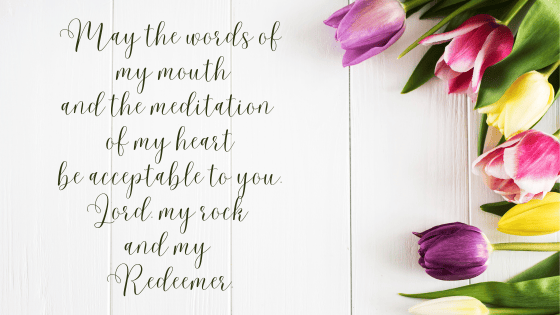
Instead, I’ll share with you what’s on my bedroom wall. It’s a beautiful calligraphy print of Psalm 19:14, which reads, “May the words of my mouth and the meditation of my heart be acceptable to you, Lord, my rock and my Redeemer.” (CSB)

Does that answer all our questions? Give us solid vocabulary to rely on that everyone will understand with complete clarity? Ensure that we never say a misunderstood thing ever again?

Nope. Not by a long shot.

But it does rightly direct our intentions. If my goal is to communicate flawlessly with you, I will fail. I’ll pick a wrong word or unwittingly say something that is a trigger for you. But, our amazing God, our Father, Lord, Rock, and Redeemer, knows us all. He knows our hearts. He knows not just what we say, but what we mean. And we can trust Him to bridge the gaps between us.

But only if our goal is first and foremost to be acceptable to Him.

That’s how I want to think, speak, write, and communicate. In a way that makes Him smile. That deepens my relationship with Him. That then, in turn, helps you see His love and pleasure as well. I forget that goal sometimes, which is why I have the verse on my wall, right by the door. I see it every day. I am reminded every day. Even so, I still miss it so often. But I want to keep growing. Keep learning. Keep practicing.

And maybe, before too much longer, that kind of communication will truly be my habit.

1. Merriam-Webster.com Dictionary, s.v. “habit,” accessed August 17, 2026, https://www.merriam-webster.com/dictionary/habit.

Posted in Thoughts from Scripture

No Big Picture – Part 2

Chewing on thoughts from Scripture never fails to produce results. Maybe that’s why we are reminded so often to meditate on God’s Word.

That was definitely the case as I continued to meditate on John 5:19-20 after the verses literally jumped off the page at me. I shared my immediate thoughts last week, but the concept continued to deepen. Continued to form. Continued to work on my heart.

Here are the verses again, just as a reminder:

Jesus replied, “Truly I tell you, the Son is not able to do anything on his own, but only what he sees the Father doing. For whatever the Father does, the Son likewise does these things. For the Father loves the Son and shows him everything he is doing, and he will show him greater works than these so that you will be amazed. John 5:19-20 CSB

The initial realization was that Jesus didn’t have the big picture. By choice. He surrendered it when He took on flesh.

That is mind-boggling enough. But, the more I contemplated it all, the more the enormity of the situation began to sink into my slow brain. Before taking on flesh, the Son didn’t have to be shown anything. He was part of it. He automatically knew it. John 1 tells us that He was there in the beginning. He already existed with God. He knew it all because He ordained it all.

But He surrendered that full knowledge when He took on flesh, putting Himself in a place where He had to rely on the Father to show Him what was going on. He had to trust that the Father would show Him what was relevant when it was relevant. And He never doubted that it would happen, because He trusted the Father’s love and wisdom explicitly.

Here’s where this all hits me. I crave the big picture in life as much as I crave it in my job. I want to see it all so I can then break it down and tackle each step as needed. In my work, that’s necessary. The issues I’ve had in recent years have come down to the reality that I haven’t had enough information, and those who’ve had the information have neglected to give it to me. There was a breakdown. I work for good people. But they miss things. Because of that, I can’t automatically trust them to give me what I need when I need it.

In a way, that’s an understandable frustration with the small reality of work. But, when I crave it in life as a whole, the life that is supposed to be 100% surrendered to the Lord Jesus Christ and, by extension, God the Father, it reveals a problem. A sinful lack of trust kind of problem.

God the Father knows what I need. He knows when I need it. If it comes from Him, I can trust that it’s enough to take the next step, as long as I’m listening faithfully. He never gives too little. If I mess up, it’s because I responded poorly to what He gave me; it’s never because He didn’t give me enough information or the right information.

And yet, I often treat Him like my boss and coworkers. I fuss that I need more. More information. More guidance. More clarity. More…something. That I need to see the big picture. I need to see where He’s taking me so I can figure out my next steps.

That’s faithlessness, pure and simple. Sinful faithlessness.

Ouch.

I have tried to orchestrate life. Break down the big picture. Make things fit just so. And I’ve hit brick walls of frustration on so many things. But the Lord spoke into my striving, whispering truth into my spirit. He showed me the answers He’s already given me. He pointed me to prayers I’ve been praying and how my current uncertainty is actually an answer to some of those prayers. He showed me the action I need to take right now. Today. This week. It doesn’t solve next week or next month. It doesn’t make all of the pieces come together. In fact, it tempts me to ask more questions.

But God isn’t calling me to solve those things. He’s calling me to trust Him today. To see what He has put right in front of me and to do that. Only that. To leave the rest — the big picture — in His hands. Because He knows what to do with it. For all the ways He’s gifted me to break down dreams and visions and ideas into tangible actions, He has not gifted me to solve life’s big issues. That’s His job, not mine.

So today I confess my lack of trust. I repent of my whiny refusal to act simply because I don’t have all the information I think I need. I surrender my need for the big picture. And I make a commitment to do follow along with what I see the Father doing today.

In work. In life. In everything. That’s more than enough.

Posted in Meditations & Meanderings, Thoughts from Scripture

No Big Picture – Part 1

I love the way different brains work. I love seeing how we process tasks set before us in very different ways. And I love how we need each other to tackle a task.

For instance, some people can envision projects. They can see what doesn’t exist and create ideas. To be honest, those people blow my mind! If it doesn’t already exist in my awareness, I’m very unlikely to come up with it.

But, the people who come up with those ideas often struggle to know how to implement their dreams and visions. That’s where I often shine. As long as I have the tools and knowledge at my disposal to make it happen, I can break down a dream or vision into practical, viable action steps.

Here’s where things break down for me, though. I can take a big picture and break it down for a whole team, then see exactly where I can complete tasks within my strengths that work well with the strengths of other people on the team. Or, if someone else has already broken it all down, I can so very easily coordinate with the rest of the team as long as I have the big picture.

For most of my adult life, I’ve been in roles where I had the big picture, primarily because that is where I function best. I either had the big picture because I was part of making the vision practical, or I’ve had it because I’ve been one of the people on the team always “in the know.” Only occasionally have I operated with merely a slice of the information. Only rarely have I been the one working task to task, having to wait for the next assignment because I had no concept of the big picture that would automatically give me context for how my current assignment fit or what I might be called on to do next.

Those times have not gone well for me.

Unfortunately, that’s where I have found myself for quite some time in one of my roles. Working task to task with no real context for how it fit in the big picture. Just the task ahead of me. It has worked…technically. But there have also been many times when I’ve wasted time doing something that fit the letter of the task at hand but didn’t fit with the big picture. Times when I’ve done things the old way, not knowing that the “way” had changed. Even times when I’ve messed up completely and caused something to break and have to be fixed. All because I didn’t know the big picture.

It has been frustrating. Where in the past I’ve been either responsible or at least “in the know,” in recent years I’ve been on the outside. Given just enough information for what’s right in front of me, with no context or big picture. My work has felt stagnant. No learning. No growing. No problem-solving. Just completing tasks that I can’t even see the purpose for — especially in those times when the tasks have ultimately been dumped because they weren’t needed after all. (And those are usually the tasks that, in the past, I would have recognized early on in my “big picture breakdown” and would eliminate. But without the big picture, I couldn’t eliminate them.) In short, I’ve struggled a lot and have questioned so many times if I needed to just walk away.

And yet, even though that work is mindless and doesn’t allow me to grow, this life situation has caused growth. I just didn’t realize it until I was smacked upside the head while reading John 5.

Jesus replied, “Truly I tell you, the Son is not able to do anything on his own, but only what he sees the Father doing. For whatever the Father does, the Son likewise does these things. For the Father loves the Son and shows him everything he is doing, and he will show him greater works than these so that you will be amazed. John 5:19-20 CSB

When I read this, I immediately was convicted of my need for the big picture, not just in work, but in life. In following Christ.

Jesus surrendered the big picture and chose to simply follow the Father. I’m supposed to be like Jesus.

Maybe, just maybe, I can practice this with the “small” thing of work, trusting Him to guide me to be the best employee I can be. And then maybe that practice will expand to the bigger scope of life.

Hmmm. Maybe that’s worth chewing on a bit.

Posted in Faith Nuggets, Repost, Thoughts from Life, Thoughts from Scripture

Expected Rest

Part 2 of the rest series!

Recently I shared that God has been teaching me a good deal about rest. I love that the learning never stops. He builds on each lesson, continually growing me. The more I learn, the more I see how much I have left to learn.

Discovering the depths of rest is no exception.

In addition to the surprising lesson that rest is relational, God is showing me more and more that rest is expected. I suppose in the true nature of biblical instruction, I should say that rest is commanded, for that is the reality. Either way, rest is not an option.

But I am just beginning to understand why God expects us to take rest seriously.

What keeps us from resting?

I asked myself that question recently, and I was not too fond of the answer: a lack of trust prevents my rest.

Far too often, I resemble the children of Israel wandering in the desert. They grumbled about the lack of food. So, God sent them manna. But, He told them to collect the manna in a certain way. Five days out of every week they were commanded to collect only what they needed for that day. On the sixth day, their collection was to be enough for two days.

It was illogical. It was improbable. Why would manna that did not last more than twenty-four hours five days a week last forty-eight hours on the sixth day? Had I been among the Israelites, I probably would have obeyed, simply because I am a rule follower by nature. But I can guarantee you I would have been very skeptical that first week. Even if I took God at His word, it would not have been easy.

But He said to rest on the Sabbath. And He never gives a command or holds an expectation without providing the means for obedience.

That is as true for me today as it was for the Israelites then. God expects me to rest, and He will always provide the way for me to accomplish it.

What about the work I am behind on? What about the little things that have not been done during the week because of other obligations? What about the expectations upon me? What if I let someone down? What if I do not get something done?

Yes, God even has provision for those.

If I choose to not rest, it is because I do not trust Him to take care of everything just as He said He would. And believe me, it feels as improbable, illogical, and unlikely as the preservation of manna. But it is just as expected for me as it was for them.

May we trust Him enough to obey and rest.

This is part two of the rest series originally published in Arkansas Baptist News.

Posted in Faith Nuggets, Thoughts from Scripture

Weary to Renewed: Driven to the Word

Oh how much I needed to reread this today! It speaks to exactly where I am…weary. But when it comes to keeping my heart prepared for the Holy Spirit to continually speak through the Word, whether my Bible is physically before me or not, I’ve been falling flat. I’ve been going through motions of reading. If you’re in a similar spot, I pray these thoughts from years ago will encourage you like they are encouraging me today. 

I’ve been weary lately. And in my weariness, I’ve been crying out to the Lord for strength. One morning this week, a thought passed through my mind before I was even fully awake.

The Lord will renew your strength.

As I awakened fully, I realized that the thought was just a inaccurate version of Isaiah 40:31. I’ve transitioned most of my Scripture memory to NASB, but even if I memorize this particular verse in other translations, I believe my mind will always go first to the beautiful KJV:

But they that wait upon the Lord shall renew their strength…

Do you see the difference between my early morning thought and the actually verse? “They that wait…shall renew” versus “The Lord will renew…”

Because of the differences, I was driven back to Isaiah for context. I knew the idea of the context, but what were the exact words? Why would I think, even in my dreaming state, the words “The Lord will renew your strength” instead of just drawing comfort from a familiar and well-loved memory verse?

As I read backwards a bit, I saw this:

Why do you say, O Jacob, and assert, O Israel, “My way is hidden from the Lord, and the justice due me escapes the notice of my God”? Do you not know? Have you not heard? The Everlasting God, the Lord, the Creator of the ends of the earth does not become weary or tired. His understanding is inscrutable. He gives strength to the weary, and to him who lacks might He increases power. Isaiah 40:27-29

Oh, how much I could say about the whole process that took me from full-fledged weariness through an early morning sub-conscious thought to renewal. But, the truth is that such a process is intimate and personal. It comes from relationship, and there is nothing I can share that will draw you into that renewal. That’s between you and the Lord.

But, two other powerful realities struck me through all of this.

God takes what we have and builds on it.

I cannot remember when I memorized Isaiah 40:30-31. But I know that I’ve returned to it so many times that it is an ingrained part of me. This week, God took it, His Word, the seedling of His very Spirit within me, and used it to renew my strength.

Oh, my dear friend, if you are not hiding God’s Word in your heart, making it a part of you, then you are missing the most powerful avenue by which our Father connects with us. I’m not talking memorization, although that is the most direct avenue by which God’s Word is hidden in our hearts. I’m talking immersion. Digging deep. Not just reading to read, but learning, growing, and interacting with the Word of God, making it an integral part of your being.

Always go back to the Word.

The thought that came to my mind was not just intended to help me remember a beloved verse. It was intended to drive me back to the Bible. To study. To evaluate context. To explore more deeply. Not to simply rely on what I remembered, but to discover more.

We have the amazing privilege of having Scripture readily available to us. Not only do we have it in print, but most of us can pull up our phones and computers and snag any translation at the press of a button. There are hundreds of thousands of people lacking that privilege. But, we have it.

And our heavenly Father wants us to use it.

No matter how many great snippets of Scripture you’ve memorized, how many wonderful sermons or devotionals you’ve heard, how many solid interpretations you’ve heeded, always go back to the Word itself. It is alive. It is breathing. It is active. It is fresh. And when we return to it with open hearts and minds, the Holy Spirit will reveal living truths that speak to our immediate standing with Christ, even from the most familiar of passages.

Perhaps today your struggle is not weariness. Perhaps it’s something else entirely. Whatever it is, I guarantee your heavenly Father is ready to speak life and strength and power and truth into your need. Will you immerse yourself in His Word and allow His Spirit to bring renewal to your heart?

Posted in Faith Nuggets, Thoughts from Scripture

Able To Aid

In full disclosure, I’ve been in a dry season when it comes to drawing from Scripture right now. I read faithfully. I process as best I can. But I’m struggling to draw out and engage with truths. In times like this, I find that going back and reviewing past journaling and writing is a huge help. It reminds me that this is just a phase and that sometimes I need to revisit old lessons and remember what I’ve forgotten. This just “happened” to be the old post I clicked on yesterday, and it was a reminder I so greatly needed in that moment. God is so faithful that He directs even my random clicks. I am thankful.

Some mornings as I sit down to process through my readings, I get sidetracked. This form of sidetracking isn’t by glancing at e-mails or Facebook, texting with a friend, or anything like that (although I confess that does happen far too often). In this particular instance, I’m referring to getting sidetracked by a verse that isn’t really part of the “point” for the day.

Then again, maybe it is. God has a funny way of doing that.

This week, the distraction was a passing devotional reference to a verse in Hebrews. It’s easy for me to get lazy and just ignore passing references like that, so years ago I determined to be intentional about looking up those references every time. Here’s what I read when I looked up this particular verse:

For since He Himself was tempted in that which He has suffered, He is able to come to the aid of those who are tempted. Hebrews 2:18 NASB (emphasis mine)

As I read these verses, I realized that I’ve always had an incomplete foundation when it comes to temptation. Had I ever stopped to process my understanding of how we are to biblically handle temptation, I would have realized that my foundation lacked something. But, until this week, I never gave it a second thought.

Here’s the foundation I’ve always had:

  • James 1 teaches that temptation is not of God, and I must flee it.
  • 1 Corinthians 10:13 shows me that God will provide a way of escape from temptation.
  • I still fall to temptation, but the blood of Jesus covers me, and I can come before Him in repentance and receive forgiveness even when I do not take the way of escape.

But, looking at Hebrews 2, there’s something else I was missing. Another crucial truth: I don’t have to run away on my own strength. I don’t have to find the escape with my own clouded vision. Jesus is able (and therefore willing) to come to my aid!

That is so logical. It’s so clear. It’s nothing really new. Yet, how often do I act on it?

I confess, often when I’m struggling against temptation, I feel too weak to even look for the way of escape. But my precious Savior has not left me to do it on my own. He is ready and able to help. I just have to call on Him.

He is my way of escape.

We cannot fight temptation on our own. We do not have the strength. (If we did, we wouldn’t need Christ’s salvation.) Only with the Spirit living within us can we walk through the escape provided. But in the ugliness of our temptation, we don’t feel able or worthy or permitted to call upon the purity that is Jesus Christ.

But oh how opposite from truth that is!

No, we’re not worthy, even at our best. But able? It only takes a plea for help! Oh, and the most glorious part is that we’re not only permitted, we’re invited. Welcomed. Encouraged. Admonished. Instructed. Commanded, even, to call upon Jesus.

And how do we remember that in the throes of temptation? How do we fight the darkness enough to convince ourselves that we can call upon Jesus for aid? By memorizing this verse now (and maybe a few around it – the whole context is powerful!), putting it in our arsenal so the Spirit can bring it to our minds in the moment of weakness.

He is able to come to my aid. Oh what a glorious truth!

Posted in Thoughts from Life, Thoughts from Scripture

The Place of Impact

If you’ve ever sought out advice about how to read the Bible, you’ve probably received a wide variety of recommendations. Some will suggest that you should read the Bible straight through from cover to cover every single year. Or, if not cover to cover, then in chronological order. But, definitely the whole thing. Every year.

Others suggest that if you read that quickly, you’ll miss details. So, you should focus in on individual books of the Bible and take as long as you need to explore them from year to year. It might be three, five, or more years before you get through the whole Bible, but the close focus is more important than getting all the way through.

As with much advice passed around in life, advice about how to approach Bible reading is frequently presented as one or the other with no in-between. There’s a right way and a wrong way. Which one are you going to pick?

If I’ve learned anything about advice over the years, it’s that the real solution is rarely black and white. It almost never falls to one extreme or the other. The best spot is somewhere in the middle. With Scripture reading, it’s a both-and approach. Get the big picture and get the details. We need both.

Recently, though, I realized that even that is not complete advice simply because it’s not a one-time thing. It’s not a situation of reading the Bible through one year to get the big picture, then slowing down from then on to get the details. It’s important to go back and forth. Get the big picture, get the details, then apply the details back onto the big picture again. And repeat. Again and again and again.

This reality was highlighted for me when preparing to teach a lesson from Philippians 3. All of it. Crammed into one short lesson.

Now, I love Philippians. It’s such a practical epistle, giving solid instruction. It’s also so…cheerful. It makes me smile and reminds me that healthy community is possible. But, let me tell you, there is a lot packed into that short epistle. And as I studied, I was overwhelmed by it all. I know Philippians well, having studied it deeply on multiple occasions. I have explored the big picture. I’ve focused on the details. I’ve studied and explored and learned so very much.

In this particular instance, though, that knowledge was working against me. I spent the entire week trying to figure out how to summarize the details of a whole chapter and do it in a way that was coherent and meaningful for a youth Sunday school lesson. I never could quite get it. It wasn’t until Sunday morning, day of the lesson, that I finally had my “aha” moment. I finally remembered to step back again. To take in the context of the whole epistle. To see where chapter 3 fit into the overall flow.

(To be completely transparent, I’m pretty sure the Spirit had been whispering that to me all week, but I’m pretty hard-headed sometimes and don’t listen well.)

As soon as I stepped back, the patterns showed up. I began to see how the various parts of chapter three all intertwined. No, we didn’t have time for the details. But we had time for a meaningful lesson.

I don’t say all of this to give my own brand of advice. I share this to remind us to wash all advice, especially advice on walking with Christ, through the lens of experience. Activity. Actually doing the walking while following the leadership of the Holy Spirit. A novel concept, I know.

We often don’t know what we’re missing in our studies of Scripture until we are pressed to share what we’ve learned with other people. Likewise, we don’t really see what’s missing in a lot of our pat spiritual answers until we’ve had to drag our methods, beliefs, and preconceived ideas through the realities of life. And sometimes those realities are a little messy — muddy, even.

My one-week experience of studying Philippians 3 for a Sunday school lesson was a small drop in the bucket of my overall life. But, that experience very much exemplifies how I need to pattern my life as a follower of Christ. The big picture view of Christian experience, idealistic though it may be, is very critical to our growth. The nitty gritty details — represented by our focus on how the Word and our faith speaks into today’s challenges, needs, and struggles — are also critical. Both grow us. They hone our listening skills and help us see Christ at work all around us, at every turn. In all honesty, though, they tend to limit us to a combination of idealism and very specific, personal application.

If we’re going to impact the world around us and give our neighbors a vision of Christ’s love for them, we have to move beyond both idealism and personal application. Fortunately, when we allow the Holy Spirit to be active and alive within us, He has the ability to merge the two and communicate the powerful love of God to those around us in a way that speaks to their own idealism and personal needs. He can handle using our growth to speak into the messy realities of the lives around us.

That’s where I want to live. In the place where both my big picture idealism and detailed experiences can truly be used by the Spirit to impact the life of another.

Posted in Thoughts from Scripture

Growing

I am growing. It’s a natural part of life. We should always be growing mentally, emotionally, spiritually…in many ways. Growth is life, and we should seek it, even when it’s not the most comfortable thing in the world.

Over the years, though, I’ve learned a truth about growth. Just about the time you think you’ve made good progress and you can claim a measure of maturity in an area, something comes along to show you just how much you have left to learn. This is most especially true when it comes to spiritual growth. The Holy Spirit is such an amazing teacher, isn’t He? He gives us just what we need each step of the way to learn the next lesson. But, on the flip side, this means that we don’t see the fullness of the growing challenge ahead of us. We see the next step or two. Not the full hill. He’s patient with us and kind to us and helps us not feel so overwhelmed on the journey. But, we still have to recognize that our growth won’t stop with the next lesson learned.

Recently I was preparing a Bible study lesson/discussion on 1 Corinthians 1:10-25, the next passage in the guide I was working through for this particular group time. I went in with a general theme to work from, but mostly I did what I normally do when exploring a passage for personal study or teaching. I started reading through the passage repeatedly, asking the Lord to show me where He wanted me to go with the discussion time.

Sometimes I pray that prayer very specifically in hopes that He’ll give me just what I’m supposed to share in the Bible study or discussion time. But I know better. He never stops there. He also always gives me my own little private training session. Or discipline session. Or kick in the behind. Whatever you want to call it. It’s real. And it’s not always fun.

But it’s always good and necessary.

In this particular instance, I was doing a little research on Corinth, learning about the Corinthians’ love for a good debate and their societal tendency to elevate those who were the most eloquent in said debates. I jokingly thought to myself how poor of a fit I’d have been in Corinth. I hate debates and arguments. I want to just make a statement that will help both sides understand each other and move on. Agree to disagree, people. It’s okay! You can have different views and still get along. Let’s make it happen!

I processed through this passage, expecting to make my mental observation about not wanting to move to first-century Corinth and move on. But no. The Lord gave me that nudge that said, “Let’s take a look at this for a minute.”

Uh-oh.

The hinge point was verses 22-23: “For the Jews ask for signs and the Greeks seek wisdom, but we preach Christ crucified, a stumbling block to the Jews and foolishness to the Gentiles.”

And the thought came to my mind: What is your goal when you try to bring peace to an argument? Is it to bring peace? Or to proclaim Christ?

Oof. I knew immediately that this thought was not one for building a lesson or laying the groundwork for a discussion. This was for me. This was to wake me up to my own priorities. I hunger to stop conflict. To make things feel better and help people see eye to eye. That’s enough, right? Nope. Not if my calling, my whole purpose in life, is to point people to Jesus Christ. If that’s my purpose, then it’s not about this side or that. It’s about Jesus. Period. A no-brainer, right? And yet, it was still a lesson I needed to be taught.

This is the reality of spiritual growth. It can come from unexpected directions at unexpected times. It can catch us right in the middle of a moment when our focus is on something completely different. It can catch us by surprise. But, if we’re listening, we always know when that moment hits. We suddenly see something very clearly and wonder that we didn’t know it all along. And then we are confronted with the challenge of implementing this new understanding in our lives.

That’s growth. It’s not huge or magic or like a bolt of lightning striking us with an epiphany. It doesn’t always “preach.” It doesn’t even have to be specifically while we’re studying Scripture. I’ve had these nudges in the middle of cooking a meal, teaching my children, or driving down the road.

Growth is listening. It’s being aware when the Spirit says, “Let’s take this further.” It’s recognizing that the Lord Jesus Christ knows each of us better than anyone. He knows what we know and what we have yet to learn. He knows what we’re going through and what we’ll be facing next week. He knows what we need to pay attention to. And He will tell us.

And when we listen, we grow. It’s not always pleasant. It’s not always fun. It sometimes hurts.

But it’s always, always good.