
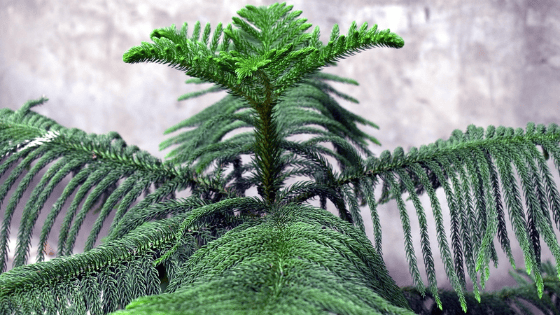
We love Christmas trees. Yes, plural. We’re those people. We haven’t always had multiple Christmas trees up in our home, but when our eclectic ornament stash outgrew our single tree, it was a lovely excuse to get a second one for the living room. I’d have one in every room of the house if I could figure out the space issue.
Even though I can’t put one in every room, we do always have one in our bedroom. The solution to the space problem — and to the cat problem, to be honest — is to keep it small. Years and years and years ago, my grandmother got us a little tabletop tree with fiber optic lights. That little tree wore out quite some time ago, so we found another one and have kept up the practice of always having a little tree, usually about three feet tall, to set up on one of our dressers.
One year, my husband saw little potted Norfolk Island pines in a store around Christmas time and had the thought to give a live tree a shot.
The tree was quite small, and it was a bit challenging to find a string of lights short enough and lightweight enough to decorate the baby tree, but it was a fun problem to solve. And the tree was so cute! It looked more like a bush than a tree, to be honest, with the multiple young trunks (which looked much more like stems at the time) intermingling to spread out their wispy branches.
After Christmas, we removed the lights and moved the tree to a hanging basket in the living room so it could get good light and be protected from the cat who would go to great lengths to try to pounce it. Eventually the weather warmed up and I moved it outside. And eventually, I accomplished what I frequently accomplish with plants — I killed it.
Or so I thought.
The tree was down to a single stick, and I thought for sure that single stick was completely dead. But, miraculously, it started to show green again. Then more green. Unlike the bushy fun of the original tree, this one formed distinct single layers of branches, one per year. Each winter, we’d bring the tree indoors to protect it from freezing, and it would go dormant while it waited for the heat to return. As soon as the temperatures warmed back up, we’d move it back outside where it would flourish in the summer heat. Each year we’d marvel at the inches added to the little tree we once thought dead.
Then came this year. Most years, I move the tree outside during warm spells in the spring, then bring it back in when the overnight lows inevitably dip. It usually doesn’t go out permanently until April or May, and growth starts a month or two later. Not this year. This year the temperatures were such that I moved the tree out in February, only bringing it back in briefly for a couple of cold spells in March. And growth started by April. Then more growth. Then more. The tree that typically only grew four to six inches per year was thriving in the very heat that made the rest of us crazy. By the time we finally hit a true cold snap, the tree had grown nearly 18 inches and had produced two layers of new branches instead of its normal one.
This year has been a brutal one weather-wise. We’re 15 months into a substantial drought after falling behind on rain the year before that. Temperatures have been extreme, with highs in the 90’s starting much earlier and lasting much later than normal, including breaking the record for the latest 100-degree day. Everything around us is wilting, withering, and dying, even as the temperatures are finally dropping.
Except that tree. Small critters rooted around in its soil. Squirrels drank the water from its base pot when they couldn’t find any elsewhere. And honestly, the tree greatly prefers humid air to a dry heat, so the lack of humidity this summer was hard on it. Even so, it thrived. Although it showed distress a few times with some deadened tips on the branches, it grew like it had never grown before. It grew so much that, once the temperatures did drop and we had to bring it inside, we struggled to find a place to put it.
The place we found is right in my line of sight as I sit here and write this morning. It leans a bit. It looks uneven in places. But it’s a beautiful reminder that some things really do thrive in hard times. When there is challenge. When resources aren’t plentiful and have to be shared.
In our own lives, it’s sometimes easier to see the wilted edges of our hard times than to see our own growth. We notice the squirrels drinking our water, we feel other critters digging in our soil, and the lack of much-needed moisture in the air keeps us from breathing well. We sometimes can’t feel the way God is still tending to our needs. Our struggle keeps us from seeing the way He’s encouraging and nourishing others through us. And we definitely don’t see our own growth.
That doesn’t mean it’s not there.
That not-so-little tree is my reminder that, even in my own drought, He’s taking care of me. He’s helping me grow. And I just might come to the other side and discover that the growth is greater than anything I’d ever experience in a “good” season.


