Posted in Around the Web, Thoughts from Scripture

The Lord’s Prayer

A couple of years ago, contrary to the anti-liturgy tradition of Baptists, my preacher husband began a Sunday morning practice of reciting the Lord’s Prayer to close out a corporate prayer time. Like most of our congregation, I had known the Lord’s Prayer for as long as I could remember. But, reciting it together as a church body each Sunday has breathed life into a familiar old passage in ways I never could have anticipated.

A PRAYER THAT BINDS

When a congregation chooses to truly pay attention and seek the Lord together using the points of this prayer, a level of intimacy spreads throughout the church family. Don’t get me wrong – not everyone in our church prays in a heartfelt manner. In fact, it is very much a learning process, and many in our congregation simply repeat the words without much thought. But, in the voices of others, I can hear the same passion that I feel in my own heart. That passion both binds us together and drives us to learn powerful truths about prayer.

Click here to read the rest of the article on wellplannedgal.com.

Posted in Thoughts from Others, What Works for Me

Relational Instruction

Last week, I shared the first of two thoughts inspired by a stranger’s random comment. The first had to do with how we learn. The second is more about how we teach – or maybe more how we share advice.

What About Ideals?

When the Facebook stranger offered his one-word instruction regarding my family’s library visit, he gave me instruction without having any knowledge of me or my family. He instructed based on his ideals, not based on relationship.

While I do agree that we must hold firmly to certain ideals, I have learned that the number of firm ideals is, in all honesty, much smaller than I might like to believe. There are biblical truths that must govern every action. Then there are the lesser things.

How we learn is a much lesser thing. And, it is something learned through relationship. Through interaction. I am still discovering how my children learn best. I am still working to teach them according to their strengths, while teaching them also to challenge themselves in their weaknesses.

My husband’s teaching is an even better example. He has served in ministry for over twenty years, and it has been fascinating to watch him tailor his teaching method to each new congregation. He may have taught the same lessons over the years, but he has rarely taught them the same way. Why? Because his audiences – his congregations – have differed. As a result, he has always taken the time to get to know each congregation as much as possible in order to teach according to their strengths.

Relationships are key to teaching and learning.

The stranger who replied to my comment has no relationship with my family. Yet, I also have no relationship with him. Just as he cannot know how to best teach my family, I cannot know how he best learns.

Yet, I wonder how many times I’ve imparted advice in the same way. Without relationship.

These thoughts do not simply apply to parenting and how I raise/teach my children. They apply to life. How do we interact with others who learn and grow in gloriously different ways? How often do we attempt to corral others into our patterns? And how often do we instruct without first building relationship?

Instead of continuing to be agitated, I’m now rather thankful to this complete stranger, because he made me think. I won’t be changing my habits and restricting my children (or myself!) to non-fiction only. But, I will be more careful to stop and think before I speak. To get to know before I instruct. And to delight in the ways God created us to be gloriously individual!

Posted in Around the Web, Christmas, Faith Nuggets

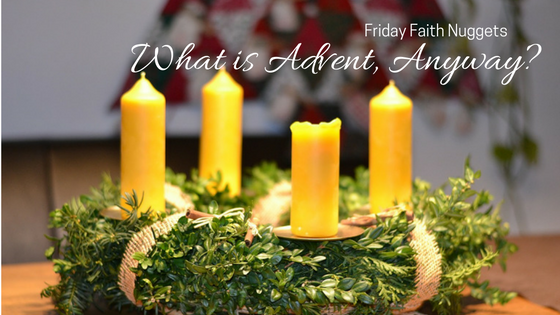
What is Advent, Anyway?

‘Tis the season when Advent books and products are everywhere! There are Advent wreaths, Advent calendars, Advent devotionals, Advent Bible studies . . . and the list goes on. But, what exactly is Advent? What does it mean?

Advent Defined

In one of his devotionals, my husband describes Advent as “the idea of coming, of expectation.” Christmas celebrates the incredible moment when Jesus, King of creation, left royalty beyond our imagining to come live as the humblest of humans — all for the sake of mankind’s redemption. Our redemption!

When we celebrate Advent, we do more than simply set aside one day to wish Jesus, “Happy birthday!” We reset our focus over the course of the whole season. Nothing can make Christmas more precious than an increased awareness of what Jesus really accomplished by taking on our flesh.

When is Advent?

Advent begins four Sundays before Christmas and runs through Christmas Day. Because of this, the season can vary in length from twenty-three to thirty-five days, depending on which day of the week Christmas falls.*

Some devotionals and celebration plans also include the Twelve Days of Christmas. No, that is not just an annoying Christmas song! It is, in fact, the time between Christmas and Epiphany (January 6), the day traditionally set aside to honor the Magi’s visit.

How Does One Celebrate Advent?

The celebration is about as varied as the people who celebrate. As long as you are diving into the spiritual significance of the incarnation of Christ on a weekly or daily basis, you are celebrating Advent. But, just in case you need a little more guidance, here are a few suggestions:

Find a Devotional

Advent devotionals range in style from weekly (each of the four Sundays and Christmas Day) to daily. Strive to find one that not only meets your schedule but also has content to appropriately meet your family’s needs.

Light Candles on an Advent Wreath

Advent wreaths, like devotionals, come in many forms, shapes, and sizes. But all Advent wreaths have at least four candle holders. The idea is to light one candle each Sunday of Advent. A fifth, larger candle should fit in the center of the wreath (some wreaths will have a candle holder for the middle). This is the “Jesus” candle, intended to be lit either on Christmas Eve or Christmas Day.

Each Sunday, light one candle. If you have chosen an Advent devotional, read the entry for that Sunday. If not, choose a focus for the season and discuss a portion of it each time you light a candle. Here are some ideas:

  • people of Advent such as the shepherds, Magi, angels, and Mary & Joseph; or Zacharias & Elizabeth, the innkeeper, Anna, and Simeon
  • Messianic prophecies
  • topics such as love, joy, peace, and patience, discussing how they relate to Christmas

Use an Advent Calendar

There are Advent calendars designed to open windows to cute pictures each day, create a manger scene, decorate a tree, discover a surprise, play music, and on and on! Whether you choose one of these or create one yourself, let this be more than just a daily countdown to Christmas Day. Let it be a time when you stop in the midst of the busy season and honestly refocus on the true reason for celebration.

Sing a Carol a Day

There are enough fantastic Christmas songs to pick one a day throughout Advent. Every day, sing or listen to one Christ-centered Christmas song as a family. Then discuss what that song communicates about Jesus and his first coming. (This can also take the place of a topical discussion when lighting the Advent wreath.)

In the words of my pastor husband, “You cannot fail Advent.” As long as you take a moment weekly or daily to step back and consider the truth of Christmas, you are appropriately celebrating Advent.

*This year, 2016, Advent began on Sunday, November 27, and runs a full five weeks. But, it’s not too late to start! 

This article was originally written for Well Planned Gal and published on hedua.com, now wellplannedgal.com. Reprinted with permission.


Posted in Around the Web, Thoughts from Others

The Impact of Story

My job opens the door for me to interact with some fantastic people. Last fall, I had the privilege of interviewing Warren Walsh, Editorial Director for YWAM Publishing, for a pair of Family Magazine articles. This morning, the first of these articles was republished online.

The stories Warren shared express so beautifully the reason I believe strongly in the ability of story to impact lives. This article also shares a fantastic opportunity for ministry this Christmas – one dear to the heart of my family.

Read and enjoy!

***************************************

Prison Heroes 101

Stories are the mother tongue and currency of our hearts. This is the stuff with which we do the business transaction of life. It’s worldview. – Warren Walsh

For decades, YWAM Publishing has worked to produce and distribute resources that stir Christians to actively impact their world for Christ. But recently, a door has opened for YWAM to directly partner with their readers to minister in a powerful way through the Prison Heroes 101 project. YWAM Publishing Editorial Director Warren Walsh shares that, in all his years at YWAM, he has “never seen a project that has as much traction as this one does.”

What exactly is the Prison Heroes 101? What does it accomplish? Why is it such a powerful and successful project? And how is it relevant to the HEDUA audience? Family Magazine had the privilege of sitting down with Warren Walsh to discuss these very questions.

Please click here to read the rest of the article.

Posted in Thoughts from Others, What Works for Me

The Beauty of Story

Some time ago, I commented on someone else’s Facebook post. It was an innocent comment about letting my children grab books from the library. I made the comment and forgot about it. But, months – yes, months – later, I was drawn back to the post when a complete stranger replied to my comment. It was a simple response:

“Non-fiction.”

That’s all it said. But the meaning was very clear. I would be a bad mother if I allowed my children to choose a new fiction favorite. I would be a bad teacher if I dared think they could learn from fiction.

Yes, I read all of that into this stranger’s simple response. Why? Because I’d heard the argument many, many times before.

Beyond What We Love

A quick response popped into my head. I wanted to make some comment about how sad it was that this stranger had never had the joy of learning from a fictional story. But, something stopped me. And as I took a moment to breathe and think, my irritation was replaced with sadness as two thoughts came to my mind.

Today, I want to share the first of those thoughts.

It is true that learning through story – whether fiction or non-fiction – can be incredibly joyful. But this stranger’s comment led me to realize just how often we dismiss forms of teaching that are not natural to us, simply because we do not learn well through them.

Several dear friends of mine greatly dislike fiction. It holds no allure for them. In fact, their minds simply do not process through story. Yet, they still recognize story as a powerful teaching tool. I, on the other hand, struggle with non-fiction that is not story-based. My mind needs a picture to take raw facts and turn them into something meaningful. Yet, I know that there is great value in learning to process factual information. So, I challenge myself to read non-fiction.

Learning happens in so many ways, yet we often get so caught up in our own learning preferences that we neglect – or even deny – all others. Then we criticize those who do not learn our way.

Every single time I have a “what works for me” thought, I am instantly reminded that it will not automatically work for my husband or my children or my dearest of friends or my fellow church members or my co-workers. If we all learned the same way, how boring would that be?!

So, what works for me? Learning through story and through narrative while stretching and challenging myself through non-fiction.

What works for you?

Posted in Faith Nuggets

Willing to Work

I find it funny when people say, “Oh, I could never do _________. I’m not ________ enough.” Go ahead – just fill in the blank. You just might be able to remember at time when you have said just such a thing. I know I can!
As is frequently the case, God has used both life in general and my children specifically to make me completely rethink my “I could never” statements. Take my oldest child, for instance.

No Outlet

For years I have marveled at the stories floating around in my daughter’s mind. She is so incredibly creative, and she has concocted entire worlds in her imagination. For years, I tried to figure out how to get those worlds out of her head and into a form that she could share with others. When she was little, I had this notion that, as soon as she learned how to write, she would be able to keep a journal and just write everything out. When she finally did learn how to write, however, it didn’t take long for that notion to crumble.

The physical act of writing proved to be excruciatingly tedious for my sweet girl. She could draw all day long. But handwriting was a completely different story. She hated it. And I finally accepted the fact that my sweet girl would never write. She finally accepted that it was okay to hate writing, even though she needed to learn the basic skills involved. But when it came to those stories, I was determined to not give up. We would just have to get them on paper another way.

Discovery

Fast forward a few years. As my daughter grew older, she learned a new skill: typing. Or keyboarding. Or whatever it is called these days. She learned how to push the letter keys on a computer keyboard in quick succession to cause letters and words to appear on a computer screen, an action that opened a whole new world to her. And created quite a shock for her mother!

First, she wrote a nearly perfect book report without help. Then, single-paragraph writing assignments for school became easier for her.

But it didn’t stop there! I nearly fell out of my chair the day she said, “Mommy, I got to write three paragraphs in language arts today!”

Got to? GOT to? Whatever happened to “had to”?

It got better still. She followed that statement up with, “It was fun!” I almost cried.

A few days later, I walked into the living room to see her propped up before a laptop, tapping away.

“What are you doing?” I asked, curious.

“Writing a fantasy novel,” came her matter-of-fact reply. Later than night she asked me to help her set a daily writing goal. Yes, that time I really did cry.

Work for It!

My child thought she hated to write. But she discovered she just needed the right avenue through which to do it.
All of us have dreams and talents. But, we often find ourselves limited when it comes to actually turning those dreams into reality or utilizing those talents. So, we hole up. Or give up. Or push it all down. We neglect to fight for those dreams. We refuse to push for ways to express our talents. We are unwilling to think outside the box.
Scripture is full of evidence that God is not limited by normalcy. Story after story reveals how He worked creatively, uniquely, and unexpectedly in the lives of biblical heroes. The incredible reality is that you and I are no different. Were our talents and dreams to be fulfilled through normal ways, how often would we give glory to our Creator? But, when He makes us turn to Him for a creative solution, He is glorified as the world watches what only He can accomplish through us.

I have been privileged to read some of my daughter’s novel and peruse several related short stories. It is so obvious to me that God made no mistake when He created an incredibly imaginative child who hated to write. She had to blossom. She had to push. And now, she loves writing more than she ever would have had she not had to work for it.
What are you willing to work for?

Posted in Thoughts from Life, What I Do

Working Mom

I have a question for you. When you think of your identity, what title do you give to yourself? I have several. Pastor’s Wife. Homeschool Mom. Writer. Editor. And, up until recently, Stay at Home Mom.

Has something changed? you might ask. In fact, I can almost see the wondering on the faces of some friends, wondering if I’ve suddenly decided to put the kids in school and work outside the home. And, no, it’s nothing like that. It’s more of a discovery.

Defining Stay at Home Mom

It’s a realization that for many, many years, I’ve struggled with my role as a mom.

I have this mental definition for the “Stay at Home Mom” title. It’s a mom who essentially structures her life around the care of her home and family. Everything else is secondary.

For fifteen years, I’ve called myself a stay at home mom. But, can I share a little secret with you? I have never fit the boundaries of my own definition, and I have always felt the conflict of that without ever understanding why.

Just recently, it all clicked in my head when I realized that I have actually worked for nine of my fifteen years of motherhood. And, in the years I didn’t work, I always had something specific to focus on. In the early years of motherhood, it was photo editing. I loved to take pictures, keep them well organized on my computer, and edit them in a variety of ways. Later, I started writing and discovered the world of product and book reviews. Only now do I see that I looked upon both of those “hobbies” as jobs.

Only now do I see that I’m not really a stay at home mom, and I never have been. On the contrary, I have always been a working mom. The whole time.

A Beautiful Mental Shift

Admitting that is a big deal for me, because I realize I have always felt a bit ashamed of my jobs – ashamed that I enjoyed them more than keeping up with my home or cooking for my family. It’s not that I preferred being away from my family. Quite the contrary! I love being with my family. But, I’ve always preferred the work that is not home related. The more I loved my jobs, the more I felt like a stay-at-home mom failure.

Something about the simple admission that I am a working mom changes so much in my head. You see, like many of my friends who also work – some from home and others outside the home, both in part-time and full-time capacities – I still prioritize my family. I shape my work options around doing what’s best for my family. I work in a way that allows me to homeschool. I work in a way that makes me available to my children when they need me, while still setting parameters and boundaries for work time. My family is no less of a priority. But, the care of my home is not my job. It’s a joint responsibility for every family member.

I cannot even begin to explain how that admission has eliminated conflict for me. That realization has helped me interact better with my children. It will allow me to share responsibilities of home care more freely, rather than feeling like a failure because I thought I couldn’t keep up with my job.

I’m a work in a way that most vibrantly nourishes my family working mom.

And, do you know what? I still highly value stay at home moms. But I also absolutely love who I am and what I do.

What about you? What title have you adopted? Does it fit?

Posted in Faith Nuggets, Thoughts from Scripture

Who Are My Counselors?

Recently, I was reading 2 Samuel 10 in my daily Bible reading. What a sad story. Because King Hanun listened to the bad advice of his princes, a series of battles followed that cost hundreds of lives.
I can’t help but compare this to Rehoboam in 1 Kings 12 or King Xerxes and Haman in the book of Esther. Even Absalom in 2 Samuel 17 is an example of following bad advice, even though we all cheer when we read his story, knowing that Hushai’s counsel was actually intentionally given to save the lives of King David and the people with him.
Considering all of these stories, I can’t help but come to a couple of conclusions.

Counsel is important.

There’s a lot of cockiness wrapped up in every one of the personalities mentioned above. Yet, each one of them sought counsel. Even with their high opinion of themselves, they still sought out the counsel of others.
Most of what we observe in the character and behavior of these men is not admirable, and we should not strive to emulate it. Except in this one thing. Like them, we should never be too proud to seek counsel.
But, we should remember a second reality that these men, sadly, ignored.

Our choice in counsel is even more important.

This is where I’ve been parked lately. How do I choose my counselors? Do I seek out those who will simply support what I already want to do? Do I look for the popular or easy to follow advice? Or do I see advisers that will steer me well, regardless of my desires?

The wise choice seems obvious, doesn’t it? Yet, so often that wisdom does not flow through into our practical choices. We instead surround ourselves with advisers and counselors who advise based on practical ideas or pros and cons or what they see will make us happiest or what will keep our relationships and status quo running smoothly.
The advice we need has nothing to do with the most practical option or even our happiness or relationships. It has to do with the will of the Lord. In fact, far more often than not, His will seems to completely contradict the practical and “obvious” route. His will involves trust even when the path is not clear. It involves obedience even when the results seem painful.
Godly advisers will help us know how to trust and obey. Are those the counselors we seek?

Posted in Faith Nuggets

Fruit or Weed?

This year, we tried to grow strawberries.

We purchased young plants, laid a foundation for them, added some soil, followed the directions to get the plants into the ground, and waited expectantly.

The plants did start to grow quickly. And, we did find a few little strawberries, some of which were mouth-wateringly delicious. But, that was it. A handful of little bitty strawberries, followed by nothing.

Well, I can’t exactly say nothing. Lots of green. But no strawberries.

Meanwhile, though, another vine has grown quite well in the same soil. And some grass. And a few other weeds. No matter how much we have tried to keep them out of the strawberry patch, they have stubbornly returned. And they grow well. Very, very well.

The same soil denies growth to the strawberries but allows the weeds to flourish.

What about our spiritual soil?

I suppose the real question is not about our soil but about our ability to discern whether the growth is fruit or weeds. You see, some weeds resemble desirable plants. The vine that is working very hard to take over our strawberry patch (and many other places in our yard) is not an ugly vine. In fact, looking out my window today, I see some pretty purple flowers on the vine. To an unpracticed gardener like myself, it might often be difficult to determine what is weed and what is actually a desirable plant.

And, sadly, the same is true spiritually. Many, many things sprout up from our spiritual soil that seem to be great spiritual fruit. Productivity at church. A great feeling of communion and community through a Bible study or other small group. Or even a belief that we “know” what Scripture is saying about this topic or that.

How can we tell if our spiritual growth is fruit or weeds?

1) Real growth always points to Jesus Christ. There will be a desire to glorify Him, draw closer to Him, and honor Him in every way.
2) Real growth dives deeply into the Word of God. It is not topical, nor is it focused on limited portions of Scripture. A passion for the whole of Scripture is evident.
2) Real growth deepens our hunger. We won’t be able to get enough. We’ll want more of Scripture, more of Christian community, and more growth for ourselves and those around us.
3) Real growth is unselfish. This is most evident in that small group time. Do we just want more of our group, or do we want more of God’s work, whatever that looks like? If we just want more of our group, it’s not real growth.
4) Real growth results in a passion for the lost and for growth in other believers. We want to see the kingdom expanded, and we’re willing to do what it takes to accomplish that.

Real growth does not crave comfort. It is never satisfied with the knowledge and understanding already gleaned. And it cannot be contained. It desires to explode and expand, and it is not satisfied with staying as it is.

My strawberry plants cannot move to new soil. In fact, it’s really too late for me to do anything about them this year. Next year, I want to do more to provide better, richer, more nourishing soil. I want to do more to rid our strawberry patch of the random weeds and annoying, invasive vine. I want to create an environment for my strawberries to grow well.

As believers, we don’t have to wait for next year, though. We can check our soil today. We can evaluate our growth and do what we need to do to make sure that what we see growing in our lives is true fruit, not weeds.

What’s growing in your soil?

Posted in Thoughts from Life, What Works for Me

Time for Change

People who know me well know that I like to change things up, especially in my house. The fact that we have rearranged very little in our house over the past year shows just how crazy the year has been!

But, contrary to what some people may believe, I do not like change for the sake of change. In fact, I often shy away from change as strongly as the person who has lived in the same house, with the same furniture arrangement, for forty years. Change in and of itself is not fun. The benefits, though, are great. Perhaps that is why I enjoy changing things up – I have lived a life full of changes and moves and rearrangements and I have seen and enjoyed the positive results too many times in my life to ignore the fact that it can be a good thing.

Change reduces clutter.

Whether it is in a home, a schedule, or a heart, change helps us see where we have piled up junk and forces us to at least acknowledge the junk. Even if we just move it from one place to another, we cannot ignore it. We have to recognize. Over time, if we are growing in maturity, we will deal with the junk and clean up the clutter in our lives. We’ll free up space to move in our homes, space to serve in our schedules, and space for the Lord to reign in our hearts.

Change deals with problems.

Have you ever experienced the ripple effect of a schedule that no longer functions? As a homeschooler, I have dealt with that many times! Our needs change, and sometimes that old routine causes more harm than good. The same is true in all aspects of our lives. We cling to what used to work, even after it no longer functions properly. As a result, we often find ourselves struggling unnecessarily. A simple tweak is all we need to get back on track.

Change brings freshness.

There is a reason we are inclined toward spring cleaning! We get stuck in ruts that make everything seem stale. Spring cleaning – even if nothing is drastically changed – shakes things up a bit and freshens up the stale. Whether we realize it or not, that alone is change, and it does not just impact our homes. It impacts our emotions and sense of freedom.

Right now we’re praying about changes in our family schedule and routine. What will help our mornings run more smoothly, giving us a peaceful start to the day instead of leaving us feeling rushed and behind? What will allow us to interact more fully with our neighbors whose schedules seem so different from our own? What will ensure that we all get the rest we need while maximizing each day? All of this will throw us out of rhythm for a bit, but once it’s all said and done, I think we’ll feel more refreshed than we have felt in a long time!

No, I don’t love change just for the sake of change. But, the benefits are truly wonderful!