Posted in Advent, Thoughts from Others

Advent Week 3: Frankincense for Remembering

Our Advent focus at church continues with the three gifts of Christmas, this week focusing on frankincense. The primary question brought up in this week’s sermon (which you can find here) connected the idea of worship and incense: what “smells” like worship in our lives?

Smell is a very powerful trigger. In an instant, a single odor can take us from joy to anxiety, from depression to comfort. Smell incites physical responses such as allergies or migraines. It triggers emotions. It prompts memories. It activates cravings. It provides warnings and feeds anticipation.

Some people are more sensitive to scents than others. I fall in the “more” category. Things like perfumes or tobacco of any sort can quickly trigger an allergic response or migraine — or both — for me. On the other hand, scents that don’t cause a negative impact can fill me with excitement!

I don’t know that I ever tire of the smell of cinnamon. It’s comfort and health and pleasure and joy and so many other emotions I can’t even name.
The smell of rain after a dry spell is a lifelong treasure.
The smell of snow always makes me smile.
The smell of meat cooking, of a wood fire, of leather, of a new book…

I could go on and on.

As I think about the power of smells and ponder the question of what “smells” like worship in my life, I realize that the things I do — and even my very presence — can have as strong of an impact on others as certain smells.

I’ve always wanted to have a positive impact on people, to be considered a positive presence in their lives. But, I’ve always wrestled with the feeling that I’m the opposite. Growing up, I believed that others didn’t truly like being around me. They just felt obligated for one reason or another (I could always come up with a reason), and if they were left to their preferences, I wouldn’t be wanted. While I do know that was true in some situations, much of that revolved around my own insecurities, and those insecurities have persisted into adulthood.

But as I ponder this question more, I realize that the anxiety I felt about other people stemmed from the fact that my approach was wrong. I am not here to have a positive impact on people. I’m here for one reason and one reason only: to point others to Jesus. That’s it.

The “smell” of my presence in this world should be the “smell” of Jesus.

I know for a fact that I don’t do that well. I’m a perfectionist, and so my “smell” is often that of making sure all of the details line up. My “smell” too frequently makes others feel that they don’t measure up, despite the fact that I’m the one who feels inadequate in most situations. My “smell” is caught up in the here and now. In the details. In things being “right.”

While in some situations the details are important, they are always secondary to Jesus. Always. And that’s what my life should reflect.

I should radiate worship. The love of Christ. The joy of His presence. The comfort of His grace. The power of His forgiveness. The reality of His pure judgment (and never mine!) that is so entwined with everlasting, unfailing love that the two can never be separated. Those things are the smell of worship. The smell of Christ Jesus.

To be honest, I’m not overly enamored by the smell of frankincense. It’s not bad. It doesn’t cause a migraine or trigger my allergies or incite negative emotions. It’s just not a favorite smell. But, I love the idea that, in Old Testament texts, it’s shown as the smell of worship. It was included in almost every worship-based sacrifice, as well as being part of the unique incense blend laid out by God for use in the tabernacle. When the Israelites smelled frankincense, they would think of worship. Every time.

That’s how I want to live my life, as a person who makes others think of worship. Of the presence of Christ. But how do I get there?

By establishing my own reminders to focus on worship throughout each day. The smell of frankincense might not do the trick for me as it did for the Israelites, but there are many other things that can remind me. My job is to let those triggers do their work. To not be numb to them, as we can often become numb to certain sights and smells. To actively respond in worship whenever I encounter the reminders.

I can only draw others to Christ when I am faithfully focusing on Him myself.

Lord, make me like frankincense!

Posted in Advent, Thoughts from Scripture

Advent Week 2: Gold for a King

We are in the second week of Advent, and our theme at church on Sunday was gold, representing the kingship of Jesus.

We love to focus on Baby Jesus at Christmas. On His vulnerability and all that He surrendered to take on our flesh and walk among us. And we need to remember all that He surrendered. All that He sacrificed. All that He willingly released to humble Himself and come to us. Philippians 2 reminds us of the reason why we need to remember Jesus and His humble entrance into our world: we are to live with the same humility that He showed.

But, in focusing on Him as Baby, we sometimes make the mistake of thinking that He came the first time as just a Baby, and that His presence as King will be for next time.

The presence of the Magi in Matthew 2 tells a different story. They brought Him gold and welcomed Him as the born King of the Jews. He’s always been King, from before creation. His birth and time on earth didn’t change that. Baby Jesus was still King.

That was the thrust of Sunday’s sermon (which you can find here). It was nothing new to me. Yet it seems that I have to frequently revisit my own response to this truth. And what I’ve seen of my heart this week has been rather convicting.

As a society, what is our response to “important” people? Whether it’s a ruler or a celebrity, what is our collective dream? Is it not to be seen by them? We get all excited when we get to meet a famous person or when we find out stories about how good or kind they were in a specific situation. We love to see what they give to us.

When it comes to Jesus, He gave everything. He surrendered His glory and entered our pain-filled world so He could walk with us. It is good and right to see what He’s done for us. But, how often do we let that be our primary focus? How He sees us? What He can do for us?

I’ve been struck by several Messianic passages I’ve read lately that discus what it looks like to welcome a King. It’s not just about what He chose to do for us. It’s about how we choose to receive Him.

Psalm 24 reveals the extreme challenge it is for a person to ascend the hill of the Lord. Who among us truly has clean hands, pure hearts, and the sincerity reflected here? None of us, without the righteousness of Jesus! But then, there’s the second half of the song, the half that shows the King coming to us. Remedying the situation by coming to those who seek Him but can’t get to Him on their own.

There’s only one catch: the city has to prepare itself for the coming of the King. The gates have to be lifted to make room! They must be flung open! Work has to be done to welcome in the King of glory!

We see it in Isaiah 40 as well, when the prophet speaks of preparing the way of the Lord by lifting the valleys and leveling the mountains, building a straight highway for the King.

Obviously, none of this is about making the earth a perfect place before Jesus arrives as King. It definitely didn’t happen before His birth! The world was a mess then, and it continues to be a mess now.

But, as I read these passages, I am convicted about the way I approach Him. The way I welcome Him. Yes, I need to celebrate and rejoice in what He has done for me. For us. For this whole world full of people He intimately loves! But, oh how I need to also acknowledge that He is King and I am His subject! I need my focus to be on what it looks like to welcome His presence. After all, He said He would be with us always, even to the end of the age, according to Matthew 28:20. He’s here with me today.

His Kingdom is here, right now. Am I living in it well?
He is returning to claim full victory. Am I doing all I can to prepare for that day?

May I learn to lay my gold before the Lord, day after day after day, focusing my attention and my work on daily recognizing Him as King and choosing to live my life as His beloved subject.

Posted in Thoughts from Others, Thoughts from Prayer

Advent Week 1: Cultivating Joy

At our church this year, we greeted the first Sunday in Advent with the theme of joy.

Joy isn’t typically where the Advent discussions, sermons, or candle lighting begin. It’s typically a theme that comes later in the season. But, as my husband prayed about it, that’s where he felt led to start. Not only was it a fitting starting point, it also gave us the perfect opportunity to make “Joy to the World” our first congregational worship song of the season. What could be better?

The whole sermon was good, but one point really hit home for me: joy must be cultivated, and that cultivation takes time. I’ve been pondering this thought ever since hearing it and scrawling it in my sermon notes.

The concept of cultivated joy shouldn’t come as a surprise to any of us. While happiness and joy do manifest in similar ways, happiness can come in an instant — and disappear just as quickly. Joy, while its seeds are often most easily planted during times of happiness, takes more effort. More intentionality. More deliberate and focused attention.

In fact, I think, for this very reason, joy might be a bit harder to truly cultivate in times of exuberant happiness. It’s hard during times of grief, as well. I’d much rather go into a season of grief with my joy deeply rooted than to try to grow it during that time. But in seasons of great happiness, I often neglect to invest in joy. It’s so easy to just be happy.

Of course, in the in-between times, we often just work through the motions and don’t pay much attention to the cultivation needs then, either. Life is fine. We have happy moments and sad moments. We try to grow spiritually and move through the things God sets before us. But, just as in moments of happiness and seasons of grief, we don’t work to cultivate joy.

At least, I frequently don’t.

Here’s the thing I’ve learned about myself. When I’m not actively cultivating joy, I still cultivate other things. Things that don’t take as much effort. That feel like less work. That aren’t as exhausting.

But the payoff is atrocious. Because those things that are easier to cultivate are devastating for my soul when they are not paired with joy.

Don’t get me wrong, they are not bad in and of themselves. There are negative things that are easy to cultivate as well, but those are obvious. We should know not to cultivate selfishness and bitterness and anger and hate.

But there are other things that seem good and healthy. It’s not bad to cultivate a sense of self and the care that goes along with it. It’s not bad to cultivate the empathy that is such an inherent part of my personality. (I know that can be harder for those who do not have an empathetic personality, so this is definitely very personal to me.) Cultivating skills and habits and hobbies are all very good.

But, when I cultivate those things without incorporating joy — or any of the fruit of the Spirit (love, joy, peace, patience, kindness, goodness faithfulness, gentleness, and self-control, per Galatians 5:22-23) — they can all foster the selfishness that I do not ever want to intentionally cultivate.

Yes, devastating is definitely an appropriate word.

I’m far too guilty of that, though. And that truth is what hit me yesterday during the sermon. Over the past few years, I have attempted to heal from hurts, grow in Christ, and notice the needs of others. I’ve sought to regain a sense of peace and calm even in seasons of loneliness and aches.

But somewhere along the way, I think I stopped actively cultivating joy. I tried to ride on what already existed without nourishing it so it would continue. Eventually, it began to dry up. The sad thing is that I didn’t really notice. I was so caught up in those moments where there was a lack of happiness that I didn’t pay attention to the fact that my joy — the joy of belonging to my precious Lord and Savior and being held in His miraculous arms and guided by His perfect wisdom and protected by His amazing and vast greatness — was fading from lack of attention.

As a result, my attempts to find healing and growth and empathy have fallen flat and left me disillusioned, the bearer of a perpetual ache over the pain in this world.

Joy changes that. It doesn’t remove the hurt. But it reminds us who ultimate holds the hurt. It works the Lord’s healing in a way that nothing else can. It allows us to see lessons of growth in places we never would have thought to look.

I must get back to cultivating joy.

Where do I start? Well, my wise husband mentioned three things in his sermon (which you can watch here, if you so desire): embrace and share forgiveness, be a conduit for the love of Christ, and invest the time cultivation requires rather than expecting it to just happen.

Obviously, that’s not an exhaustive list because the cultivation of joy is an ongoing, lifelong process. But it’s a powerful starting point. I’m ready to get back to cultivating.

Posted in Around the Web, Christmas, Faith Nuggets

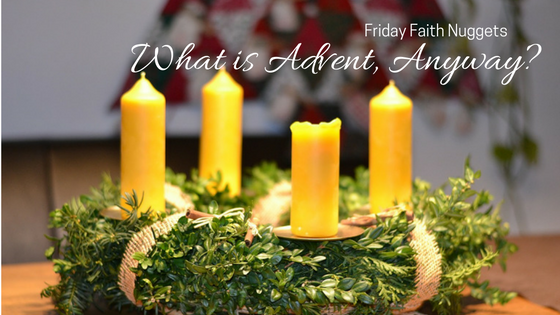
What is Advent, Anyway?

‘Tis the season when Advent books and products are everywhere! There are Advent wreaths, Advent calendars, Advent devotionals, Advent Bible studies . . . and the list goes on. But, what exactly is Advent? What does it mean?

Advent Defined

In one of his devotionals, my husband describes Advent as “the idea of coming, of expectation.” Christmas celebrates the incredible moment when Jesus, King of creation, left royalty beyond our imagining to come live as the humblest of humans — all for the sake of mankind’s redemption. Our redemption!

When we celebrate Advent, we do more than simply set aside one day to wish Jesus, “Happy birthday!” We reset our focus over the course of the whole season. Nothing can make Christmas more precious than an increased awareness of what Jesus really accomplished by taking on our flesh.

When is Advent?

Advent begins four Sundays before Christmas and runs through Christmas Day. Because of this, the season can vary in length from twenty-three to thirty-five days, depending on which day of the week Christmas falls.*

Some devotionals and celebration plans also include the Twelve Days of Christmas. No, that is not just an annoying Christmas song! It is, in fact, the time between Christmas and Epiphany (January 6), the day traditionally set aside to honor the Magi’s visit.

How Does One Celebrate Advent?

The celebration is about as varied as the people who celebrate. As long as you are diving into the spiritual significance of the incarnation of Christ on a weekly or daily basis, you are celebrating Advent. But, just in case you need a little more guidance, here are a few suggestions:

Find a Devotional

Advent devotionals range in style from weekly (each of the four Sundays and Christmas Day) to daily. Strive to find one that not only meets your schedule but also has content to appropriately meet your family’s needs.

Light Candles on an Advent Wreath

Advent wreaths, like devotionals, come in many forms, shapes, and sizes. But all Advent wreaths have at least four candle holders. The idea is to light one candle each Sunday of Advent. A fifth, larger candle should fit in the center of the wreath (some wreaths will have a candle holder for the middle). This is the “Jesus” candle, intended to be lit either on Christmas Eve or Christmas Day.

Each Sunday, light one candle. If you have chosen an Advent devotional, read the entry for that Sunday. If not, choose a focus for the season and discuss a portion of it each time you light a candle. Here are some ideas:

  • people of Advent such as the shepherds, Magi, angels, and Mary & Joseph; or Zacharias & Elizabeth, the innkeeper, Anna, and Simeon
  • Messianic prophecies
  • topics such as love, joy, peace, and patience, discussing how they relate to Christmas

Use an Advent Calendar

There are Advent calendars designed to open windows to cute pictures each day, create a manger scene, decorate a tree, discover a surprise, play music, and on and on! Whether you choose one of these or create one yourself, let this be more than just a daily countdown to Christmas Day. Let it be a time when you stop in the midst of the busy season and honestly refocus on the true reason for celebration.

Sing a Carol a Day

There are enough fantastic Christmas songs to pick one a day throughout Advent. Every day, sing or listen to one Christ-centered Christmas song as a family. Then discuss what that song communicates about Jesus and his first coming. (This can also take the place of a topical discussion when lighting the Advent wreath.)

In the words of my pastor husband, “You cannot fail Advent.” As long as you take a moment weekly or daily to step back and consider the truth of Christmas, you are appropriately celebrating Advent.

*This year, 2016, Advent began on Sunday, November 27, and runs a full five weeks. But, it’s not too late to start! 

This article was originally written for Well Planned Gal and published on hedua.com, now wellplannedgal.com. Reprinted with permission.

Posted in Marriage

In Time

Advent season officially started yesterday. Each Sunday between now and Christmas, we will light a candle representing one aspect of the Christmas story or season. On Christmas Eve, we’ll light the last one, symbolizing the birth of Jesus. I love the excitement and beauty of welcoming Christmas through Advent celebrations.

As we process through Advent, I can’t help but think of all those who waited but never saw the Messiah during their earthly lives. God promised a Savior all the way back in Genesis, as the first sin created an uncrossable divide between God and man. Generation upon generation of God’s people awaited the Messiah and never saw Him. But in the fullness of time, God sent Jesus.

I could go on and on about why the timing was beautiful and perfect and amazing. Instead, I want to focus on the waiting and the fulfillment – and how that relates to marriage.

It sounds like a stretch, doesn’t it? Connecting the long-awaited birth of Jesus to marriage? But, I invite you to stop for a moment and remember all of the times you waited for God in your marriage.

Somehow, you just knew it wasn’t the right time. Perhaps it wasn’t the right time to make a move or have a baby or change jobs. Maybe it was simpler and just wasn’t the right time to have a conversation with your spouse. Or even get a pet. Or buy a new car.

When we get an idea in our heads, an idea we know to be a good one, we often push for it. We push God. We push our spouses. We push our children. We push our finances. We push our schedules. We push, push, push to get something accomplished. And every time we push, we suffer the consequences.

But, if we wait…oh, if we wait, God’s timing is perfect!

I can look back on my own marriage and see the times I pushed. I regret those times profoundly. But I can also see the times I waited. I waited and prayed. In those times, God worked. Sometimes I waited in quiet, sensing that God just might be preparing my husband and me differently for something. Other times, Doug and I waited together after discussing and realizing that it wasn’t God’s timing yet.

And yes, the waiting has covered everything from children and moves to buying cars and houses or welcoming pets into our home.

So very often, it feels like God is stalling. Or withholding. Or denying. It seems to take so long for Him to come around to fulfilling the thing we’re waiting for. But, look how long mankind waited for its Savior! Look how long we continue to wait for the ultimate fulfillment of God’s promises in Jesus’ second coming!

God’s timing in my marriage is perfect in the same way His timing with eternal promises is perfect. Ultimately, His timing allows my marriage to give glory to Him, draw us closer to Him, and allow us to be more greatly emptied of ourselves and filled with Himself.

I don’t know about you, but I believe that’s fully worth waiting for.