Posted in Thoughts from Life

The In-Between

In case you haven’t noticed, I’m a wordy person. When I get a thought or idea in my head, I want to flesh it out well. Completely. I need you, my dear reader, to get the full picture. And that usually means a whole lotta words.

That also means I need to have learned a lesson or figured out an idea well enough to share it with you. Obviously, no lesson is ever fully learned and no idea is complete and finished because there’s always more growth in this life. But, I can give you the fullness of this particular part.

I also want to write regularly. Multiple times per week. But the truth is that I don’t have completion that often. Oh, I have experiences mixed in there that make for good writing fodder, but even that can dry out. As I try to rebuild a regular writing habit, I’m smacked in the face with the reality that much more of life is spent in in-between times than in times of fullness and completion.

That’s where I need to get comfortable. In the in-between. In the process. I need to become more aware of the many things that happen in those moments when nothing is complete. I need to be able to process the pieces, even before I see the last puzzle piece put into place.

That’s the thing about learning and growing. I often see it as big chunks, building blocks that go into place completely formed. Yes, we’re working on a building. I get that, and I know that’s going to take a while to complete. But, I like to look at each huge stone after it’s put into its place. I like to see exactly where it fits in the grand scheme of building.

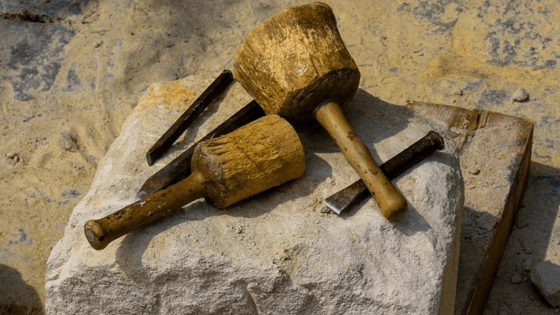
But each step to get the stone to that point is important as well. First, it has to be chosen from the right spot in the quarry. Then it must be cut out. It must be perfectly shaped so that it fits just right in its spot in the middle of dozens of other uniquely sized and shaped stones. It must be transported. Only then can it be placed.

Yes, so much more time is spent in-between, on the build-up to the placement of that stone. And there’s a lot of learning that happens in the process. A lot of growing. A lot of experiencing.

If we only share with one another what the finished product, or even a finished single step of the product, looks like, then we miss sharing the bulk of our lives together. And sharing life isn’t about showing off what we’ve become. It’s about walking together in the process and encouraging one another when the chisel hits and it hurts. When we’re jostled and bumped in the transport stage. Or even when the stone’s shape is really, really odd and we can’t figure out how in the world the next stone can possible fit around this one.

The in-between isn’t a comfortable place. But it’s a good place. A growing place. A learning place. I look forward to learning better how to live there. How to pay attention to each step. And how to walk it in community with those God has placed around me.

Let’s share the in-between.

Posted in Thoughts from Life

The Art of Growing

I’ve been thinking a lot about growth lately.

Part of it is spurred by the growth of my children, especially considering my youngest just became a legal adult and joined his sister at college.

Reviewing old blog posts has also spurred some of my thoughts as I’ve seen growth in my perceptions, mental processes, spiritual understanding, and even prejudices.

It’s all making me realize just how disdainfully we view growth sometimes. Think about how teenagers scoff at some of their own prior passions and interests, calling them childish. Think about how we sometimes find ourselves ashamed or embarrassed of how we used to be.

I think we’re wrong.

Just as we would never disdain an infant’s crawling phase now that they can walk or run or drive, perhaps should stop viewing some of our growing phases with disdain. Yes, I know that our growth is a bit different. I know that there are times when we realize that our previously deeply held beliefs and convictions were not just immature, they were wrong. I recognize that there are things we’ve confessed that we’d rather just leave behind.

But, sometimes instead of leaving them behind, we pretend they never existed. We act as if we never had to learn how to crawl in order to be able to run.

What if we were to celebrate spiritual, mental, and emotional growth just like we celebrate the amazing growth of an infant into a toddler and beyond? What if we were to process every aspect of our growth, the good and the bad and everything in between, as necessary components of who we are today? What if we were to see growth as an art form — a painting or sculpture developing over time with increasing complexity? With oopses and mistakes that needed to be corrected, yes, but with the understanding that even those mistakes spurred ideas and shaped the lines and curves that produced beauty?

What if we were to participate in the art of growing rather than hiding the process? What would that look like?

First, I think it would look like being honest about our growth. An example for me is some of those old blog posts. I started writing publicly when my youngest was a newborn, nearly 18 years ago. Some of the things I wrote were just plain wrong. In some instances, I wrote out of idealism. Ignorance. Naiveté. In others, I wrote out of stubbornness. Frustration. Hurt. Anger. All of those experiences and feelings and spaces of understanding meant that many times I was wrong. Not always. Not even usually. Much of what I wrote I still identify with, even if some of it is now outdated and irrelevant. But sometimes I was wrong or, at the very least, undeveloped or immature. I need to be okay with that. To be able to admit it, to be thankful for growth, and to learn from those experiences

Second, it would look like celebrating the things that have brought us where we are today. I can’t help but picture all of the building blocks of what I know now, even with the hits and misses and stumbles along the way. All of those times of falling when I was just trying to take a few steps forward, all of those times of being knocked down, make up the growth process. I would not be who I am today or know what I know now without all of them. Yes, even the times when I was just plain wrong.

Finally, it would look like sharing the process with one another instead of denying it, but doing so in a way that never shames someone else. There are other people walking through what I walked through 18 years ago. They are learning what I learned then. As I am being honest about ways that I was wrong then — and all through my learning process (And this will include things that I’m wrong about now that I’ll have to confess later, because I know those things exist even if I can’t see them right now!) — I have to be careful to not beat down someone who hasn’t yet been through the growing process. This doesn’t mean I can’t help them learn from my mistakes. But, I must never use my honesty to shame someone else on their journey, only to help them. Only and always.

Growing hurts. Growing involves times we are not going to be proud of. But growing is also art. It’s creation. It’s beauty. Shall we celebrate it together?

Posted in Thoughts from Life

Investment

As I went through my early morning routine, the thoughts were rolling. My overactive brain was fleshing out not one blog post idea but two, both begging to be released through my fingertips.

As soon as possible, I sat down at the computer. And almost immediately it all dried up. All of the eloquent words flowing through my brain. All of the passionate ideas welling up inside me. They weren’t necessarily gone. They were just…flat, refusing to come together in any coherent manner.

Frustrated with the lack of flow, it became easy to get distracted by the nature of the day. Conversations with various family members and little tasks here and there were much easier to focus on than the flashing cursor and impossible words. I tapped out a few notes and thoughts to make sure I was doing some writing, but, for the most part, I was derailed.

This isn’t a first for me. And it’s not just about writing, either. It happens with other projects and activities. Even chores, if I’m honest, but it’s really not hard to distract me from those tasks! The catch is that I usually do get back to chores or work tasks simply because it’s the responsible thing to do. It’s only the nourishing things I walk away from. Go figure.

Far too often, I never get back to the nourishing things. I let the realities of life leave me derailed. Sometimes it’s simply that I set aside a particular writing prompt thought or a specific project. Other times, I stall out completely, ignoring writing or working on any kind of project for weeks, months, or even years on end. I welcome distractions as excuses. I know the activity will be nourishing and that I should invest. But when it doesn’t flow easily, when it takes a lot of work, it’s easier to set it aside and invest energy in life’s essentials instead.

I don’t think it’s that I’m lazy. I think it’s that there’s something in my brain that tells me these things aren’t really worth my time. They’re selfish. They’re purposeless. They’re useless. I’m really not that great at them anyway. Why waste the time, both mine and other people’s? Why let these activities clutter the day?

Unfortunately, the productivity mantra of our culture not only supports those thoughts of uselessness but also gets hammered into our heads on a daily basis. We act on it, even as it systematically wears us down and makes it increasingly harder to actually do the things that nourish us.

And it’s all a lie. Sadly, even if we know it’s a lie, it’s a hard one to get around.

Nourishment is not useless or pointless or purposeless, nor is it selfish. I can tell someone else that all day long, but it takes a lot more work to convince myself of it. Far too often I don’t have what it takes to both convince myself to keep going and stick with the original plan.

Like that day everything dried up. I jotted down notes for the ideas that had been overflowing in me earlier in the morning, but then I did set them all aside. I walked away from the frustration of fighting both the battle of uselessness and the battle of getting those thoughts back. I chose to save them for another day. I still haven’t gotten back to them, even months later. But maybe someday I will.

The important thing about that morning, though, wasn’t that I saved up thoughts for the future. Instead, it was that I didn’t let myself give up. I came back from my distraction and chose a different topic. I wrote totally different words. I affirmed the nourishing action, even if the specific details of the nourishment didn’t work out as planned.

Losing those thoughts wasn’t an isolated event. The same thing has happened multiple times in the months since that specific day. Sometimes I’ve handled it well and other times I haven’t. But I know one thing for sure: investing in nourishment was never a bad idea. And the times I walked away and didn’t invest almost always led to greater exhaustion.

Today I was tempted to walk away again, this time without even trying to sit down and write. But I knew I needed nourishment, and that nourishment required investment. So, here I am, reinforcing the truth by writing about it.

Maybe next time I’ll be even more motivated to push forward and invest in the work of nourishment until it’s a steady habit again, one that overcomes the voice of stark productivity. One that strengthens my tendency to walk toward nourishment instead of away from it.

Posted in Thoughts from Life

I Was Wrong

Have you ever noticed how some words are so hard to say? You may know them to be true beyond all shadow of a doubt. But actually saying words verbally or writing them publicly moves truth from an idea to an action, something that you are putting your identity and reputation behind.

I love you holds specific connotation in our culture, and speaking those words out loud marks the speaker in a very specific manner.

I need goes against the core mentality of rugged individualism or the false mantra that God helps those who help themselves. We all need, yet we fear showing weakness by verbally admitting that need.

I am sorry admits that we have caused hurt. We struggle to let go of our intentions long enough to admit that others can be harmed by our words and actions — yes, sometimes even when we believe we have said or done the right thing.

One of the hardest things to say, though, can often be I was wrong.

I’ve been wrong many times in my life, but I also have a personality strongly inclined toward perfectionism. I vividly remember being a child who identified “wrong” as “bad.” If I was wrong, I was imperfect, and therefore I was a bad person. Not just a growing person who had made a mistake or a bad decision. Nope. A bad person to the core. And if I was wrong, and therefore by nature bad, how could people love me? How could my parents tolerate me? How could God desire to claim me? How would I ever have friends or eventually find a man who would be willing to be married to me if I was a bad person? Therefore, I had to be right. Yes, even as a child who had so very much to learn. Because otherwise I was doomed.

Typing those words, I realized how extreme and unrealistic they seem, yet I was well into my adult years before I began to even make the smallest steps toward clearing these thought processes from my mind. (And no, I have not fully succeeded, even knowing what I know today.)

It started with needing to learn how to say the words I was wrong to my husband and children, admitting to them where I’d failed them. In the process, a miracle happened. The thing I’d always feared, that admitting being wrong would drive people to hate me, was actually revealed to be the opposite of the truth. Refusing to admit my imperfection is what drove people away. Admitting when I was wrong actually bound us closer together! (No, I don’t always do this well. Sometimes I’m still pretty bad at it. But I’m learning and growing!)

Funny, isn’t it, that I had to admit to being wrong about a core belief — the idea that being wrong meant I was bad and unlovable — in order to learn that it’s a good thing to admit to being wrong? And that admission has led me to let go of a variety of other long-held, but incorrect, beliefs.

There’s one thing I’ve never been wrong about, though: the truth of Jesus Christ. At times I’ve been wrong about my understanding of Him. I’ve been wrong about some of my interpretations of His Word. I’ve been wrong about some theological understandings and about some of the traditional beliefs I’ve claimed without truly holding them up to the light of Scripture.

But each time I’ve admitted to being wrong in those areas, the Holy Spirit has used that admission to draw me closer to the truth. To give me a heightened understanding of God.

In the process, He’s also given me a greater passion to share His truth with the world around me. Because I hunger for them to see that the sacrifice of Jesus Christ allows them to know God, too! To know truth so they can walk in righteousness!

The problem is that fear tries to temper my passion to share. What if I say the wrong thing…again? How can others trust me to tell them about the Word of God if I don’t know perfectly yet?

In addition to learning to admit when I’ve been wrong, I’ve also had to learn to go ahead and share what I know now. I’ve had to learn to openly admit that what I say is based on what I understand now, but that I hope to be always growing until my understanding is made complete in eternity. This is a great opportunity to encourage others to learn and grow for themselves. To study and explore and find out for themselves whether or not I’m right (and to come back and share with me!).

It’s liberating, to be honest. I can be wrong!

I do still struggle. I’d be lying if I said otherwise. I still hate to be wrong. I still fear what people will think of me if I admit to being wrong. But I have also learned the freedom of that admission, and the freedom is gradually holding more sway over my actions.

Only Jesus Himself was never wrong. I hunger to be more like Him every day. But in the process, I’ll point to His righteousness and be thankful that He covers me, even when I’m wrong.

Posted in Thoughts from Life

Ready?

As I sit down to write, I’m enjoying a delicious fresh peach, picked last week from one of our own peach trees. We’ve planted peach trees in four of the last five towns we’ve lived in, but we’ve rarely been able to enjoy those peaches. Usually it’s because God has moved us before the trees have become mature enough to harvest, leaving a gift of peach trees behind for whoever came next.

This year, though, spring brought hope! First came the rumor that this year was expected to be a year of peach abundance. Somehow a variety of factors were supposedly coming together to produce a bountiful crop in a wide range of growing regions.

Second was the realization that our young trees were at the right age to produce their first real harvest.

Finally, for the first time in our personal peach tree planting history, I’d researched the best way and time to prune peach trees rather than going with the general guidance for fruit trees. (Did you know peach trees need a different approach from other fruit trees? Yeah, I’d missed that before this year.) I tackled that task with a bit of trepidation, sure my big-time black thumb and I would kill the trees. Within a few weeks, though, it was very obvious I had not. The remaining branches were literally bursting with blooms, followed by evidence of newly developing fruit. A late frost threatened to damage the blooms and baby peaches, but temps stayed just a few degrees above the danger threshold, much to our delight.

Over the following months, we watched closely. We knew it wouldn’t be a huge harvest because the trees were still quite young, but it looked like we’d get several dozen peaches! We thinned out where too many peaches were growing too closely together. We smelled the amazing fragrance of growing fruit. And we prayed that the squirrels would leave them alone.

The particular breed of tree we planted usually produces mature peaches by sometime in July. But, around mid-June, as we started to notice a change from greenish-yellow to a pretty orange on some of the fruit, we began to wonder if it was wise to wait until July.

One afternoon as we passed by the trees on our way up to church, we randomly checked on a couple of the peaches. They were a bit fuzzy, turning orange, and had a slight give when I lightly squeezed them. We picked them and shared one as we walked. It was mouthwateringly delicious!

And about a month earlier than we expected.

We almost didn’t check, simply because we didn’t expect the peaches to be ripe for a few more weeks. It was a whim. Maybe a bit of impatience. Who knows? But we checked. And we were rewarded, not only that day but over the course of the next couple of weeks as a few more peaches ripened each day.

That sometimes feels like the nature of readiness. It rarely falls when we expect or when we want. It’s often inconvenient and frequently frustrating. It requires watchfulness and expectancy, sometimes taking us by surprise when it comes early. But more frequently it discourages us by its delay.

We want readiness, whether in ourselves or in our circumstances, on our timetable. Not too early and not too late. When it fits with our busy schedules. When it will produce what we perceive to be maximum results. When it causes the least inconvenience.

I don’t know about you, but that’s rarely been my experience. Typically readiness has come much earlier than I was prepared for or exhaustingly later than I hoped. And yet somehow also at just the right time.

That “somehow” probably has something to do with the fact that God holds every detail of life and existence in the palm of His hand, and He has no trouble ensuring that readiness occurs in a perfect season, even if we can’t quite fathom that perfection.

I’m thankful for early peaches. Our summer schedule involves being away at camp the week I really expected the peaches to mature. By then, we’ll not only have picked them all but will have either eaten or put away the delicious little harvest. Readiness happened at an ideal time. Even at a time when we were able to share some of the first ones we picked with our daughter who lives over two hours away, thanks to an unexpected trip her direction!

Readiness isn’t on our timetable. It’s in the hands of our Creator. Whether earlier or later than we expect, He’s always right on time for His will to be accomplished.

May we tune our hearts and minds to an expectancy that allows us to enjoy His readiness as much as we enjoy a delicious fresh peach. Because His will is just as perfect and delicious, no matter when it happens.

Posted in Thoughts from Life

My View

I can see irises through my office window.

When we moved here, I transplanted just over a dozen of my iris bulbs. At our previous home, they were planted in a nice little circle around a large oak in the front yard. The new home also had a spot in the front yard where flowers could easily be planted around a tree, and that tree happened to be right outside the office window. Perfect location!

The catch was that the bulbs didn’t bloom. I didn’t really expect blooms the first year after we moved, one full year after transplanting, although I knew it was possible. But I did kind of expect them the second year. So, I was disappointed when there were no blooms at all. The third year, when I began seeing irises elsewhere around the community, I went out to check my own. Just leaves. Not even a sign of stalks growing.

Less than two weeks later, I suddenly had buds on three of plants! Then buds showed up on two more plants! Although it was still fewer than half of the transplanted bulbs, those five began to produce abundantly, providing wave after wave of beauty.

And the best part was that I could see them from my window. Every time I got up from my desk or passed through the room, the irises were there to make me smile.

It sounds perfect, doesn’t it? A beautiful view from my window! But what if I told you it was incomplete?

You see, only four of the five sets of blooms can be seen from my window. The fifth one is behind the tree.

But there’s more. My fledgling hydrangea bush is off to one side of the porch, out of sight from the window. It is just starting to produce color, pink this year instead of the blue it boasted when we bought it last year. I have to make sure to step outside if I want to enjoy the new growth. My Norfolk pine, the one bought years ago as a small living Christmas tree for our bedroom, comes inside during the cold winter months. During that season, I can easily see it on its high perch, safe and sound from cat attacks. But as soon as the overnight temperatures rise enough each spring, I move the large pot to a spot right beside the front door where it will be able to enjoy the humid warmth and get the right amount of sunlight. It sits just out of sight between the office window and the front door, along with the potted blueberry and elderberry bushes lined up on either side of it.

I’m honestly horrible at growing things, and more plants die at my hand than survive. But these are growing, and it’s delightful to see them. But in order to do so, I have to actually step outside. I can’t enjoy their beauty through the window like I can most of the irises.

Oh, and have I mentioned the peach trees? This is their first year to be mature enough to produce, and they are covered in maturing peaches. Not only can I not see them from the window, there is also no way to smell them from inside. The peach smell has been glorious from the moment those beautiful buds first began to swell and produce fruit! I just have to step outside the door to see and smell and enjoy.

Life is beautiful in the same way, isn’t it? God gives us so much to see from right where we are. It’s glorious and it’s nourishing. But do we catch the fact that it’s also incomplete?

God has given us the incredibly nourishment of our immediate families, our work and social spaces, and our church home. There is so much to see and smell and taste and touch in those spaces. It can be so very nourishing and powerful.

But as beautiful as life is in the immediate spaces God has created for us, if we don’t look further, we’ll miss the fuller and more powerful beauty. If we don’t step out of our comfortable spaces into the wider world, we’ll lack an understanding of how God creates beauty in the most unexpected ways. We’ll miss the smells and sights and visions of His expansive kingdom. We’ll miss the understanding that there is beauty beyond our wildest imaginations, beauty that will be fully revealed when we cross the boundary between temporary and eternal.

My view from my office window is precious and nourishing. But stepping into my yard gives me much more. Will we step out and see the greater Kingdom beauty that exists all around us?

Posted in Thoughts from Life, Thoughts from Prayer

Never to Return

I occasionally jot down writing ideas, or post starters, to come back to later. Sometimes I come back to them and have no clue what my notes mean, so they end up being ignored or discarded. Other times, the memory of what I was thinking comes flooding back with even greater clarity than when I first had the thoughts. The writing flows in a way it never would have had I written about it back then.

Still other times, though, the post starters feel almost prophetic. It’s in those times that I truly see how the Holy Spirit works in our hearts and minds to not only grow us but to prepare us for challenges that lie ahead.

I recently revisited one such post starter for about the third time. It’s over seven years old, but the implications are profoundly appropriate for right now. Here’s part of what I wrote:

Sometimes, normal will never return. It’s a new normal.

Restoration never involves going back. It involves going forward and realizing that the only constant is Christ Himself. Not normalcy.

I’d jotted down these thoughts as we watched two different dear friends process through losing their spouses. The circumstances and ages of the friends were very different, but the reality was the same: their lives could never go back to what they had previously considered to be normal. It wasn’t possible.

The realization led me to recognize my own struggle with some changes our family had made a couple of years before. We’d made such changes many times before, but this particular time, it was harder to figure out how to make the adjustment. There were just too many differences. We had tried for so long to settle back into normalcy. But, it always failed. Only when we realized that we needed to start from scratch were we able to make some sense of the changes. And in the experience of processing through all of this, we learned what it meant to be able to rediscover routine and normalcy again, even when everything had changed.

Who knew that a global pandemic would require us to fall back on that skill again years later? That was actually the second time I revisited this thought and fleshed it out a bit more. But I still wasn’t ready to put it out there. Everything felt very raw, and I struggled with how I was processing any of it.

And now, as I revisit this thought yet again, my family is in another stage of transition. Long, drawn-out transition that prevents settling into a “new normal.” (I grew to greatly dislike that phrase during Covid, and it’s not much happier now.) Through it all, I’m realizing that we haven’t really hit a “normal” for our family in a long, long time. That forces me back to the last part of my original thought, the one about our only constant being Christ Himself, not normalcy.

That’s hitting me hard.

What if I were to redirect my thoughts and focus on something other than normalcy? What if I were to focus instead on restoration? On truly letting Christ be my constant instead of always seeking after normal?

We often think of restoration as returning something to its former glory, but that’s never the case. We can’t accomplish that because there will always be a newness. Even if the restored treasure looks the same, the materials are always new. They are always bound to the time in which they were restored, no matter what style they may represent. It’s never a return. It’s always a newness.

That’s where we are right now. We’ll never return to “normal.” But, we can move into beautiful restoration. We can move into a newness of life. Of course, that’s only possible when we embrace the Author of life Himself. After all, He is the only constant. The only thing that ever remains the same, no matter the changes. The only One who can never be restored because He can never be damaged. Never changed. Never warped. He is. Continuously and always. He restores us, constantly remaking us into the image He intended from the very beginning. Were we to cling to our sense of normal, we would miss the restoration. We would never succeed in becoming what we were intended to be because our normal is warped. Incomplete. Corrupted. He is bringing us into the incorruptible, but that means that we must go through the refining.

Thinking of this, I realize I don’t want my old normal back. I don’t want to settle for a new normal, either. Instead, I want restoration. It’s a process that will continue until I see my God and Savior face to face, and that’s okay. That means that this “new normal” is temporary as the restoration continues.

May I walk faithfully through it, trusting His work all the way and never hungering to return.

Because what lies ahead is so much better.

Posted in Faith Nuggets, Thoughts from Life

On Puzzles and Noticing

I love puzzles. Fortunately for me, I also have a daughter who enjoys puzzles, maybe even more than I do! Over the years, we’ve loved sitting down to puzzles together, working on them for Sabbath rest or in stolen moments here and there.

The summer before she headed off to college, we started a rather complex puzzle. With 1500 pieces, it wasn’t an abnormally sized puzzle for us. We frequently tackle 1000-piece puzzles without a second thought, and a 500-piece puzzle isn’t even really a challenge at all. So, there wasn’t anything extraordinary about this 1500-piece puzzle in its size.

It was the image itself that caused us to wonder about our sanity as we dove in. This particular puzzle was constellations. A dark background covered in tiny words and dots and details. Several times I wondered if my eyes weren’t just a bit too old for this heavily detailed puzzle.

We started the puzzled over the summer. Then my daughter headed off to college. I tackled a couple of things here and there — parts that I knew wouldn’t be too challenging because I could see the patterns easily. But I didn’t make a lot of progress.

My daughter came home for Christmas, and we decided to spend some time puzzling. That first day back on the “job” I noticed something I had never seen before, even after months of having the puzzle out. I noticed blue lines and patterns connecting the stars in the middle of the puzzle. Images. Patterns. Designs with coherent flow.

I had expected the center to be almost impossible to figure out systematically because of the teeny tiny dots and numbers. But what I found was a series of patterns that would make the puzzle much more easy to solve. Connection points. Anchors.

These had been there all along, I just hadn’t noticed them.

Oddly enough, I’d just finished a book a few days before that talked about noticing. Sitting patiently with art or other aspects of beauty to observe and gain awareness that a glance — or even a long look — will never provide. The idea of sitting in front of a single painting for minutes, much less hours, seems so very hard to me. And yet, I’ve caught myself lingering at times before a snippet of beauty only to find that I could hardly tear myself away. So much to see and take in that a lifetime couldn’t possibly be enough!

I’ve long argued that we need to approach Scripture this way as well. Sitting with it, reading and rereading it, discovering what we can’t see quickly. This approach was pressed into my heart and mind by a college class. Our professor would hand us a passage and have us list all of our observations. When we felt we’d gleaned all we possibly could, he would tell us to go and do it again. We’d moan and groan, thinking there was nothing else to be seen. We’d get ornery and list blatantly obvious, seemingly ridiculous details, only to discover that those details would awaken us to a whole list of things we’d missed before.

In recent years, this concept of lingering and observing that once was as natural as breathing has become foreign to me. In some ways, I’ve been afraid to linger because lingering isn’t always happy. Sometimes it’s simply overwhelming, producing unexplained emotions that leave me with more questions than answers. Lingering can mean dealing with painful things. Things that I can’t fix. Things that only hurt.

Little observances have been awakening my heart. A lakeside sunrise so incredibly beautiful that I couldn’t bear to pull my eyes away. A pattern than stirred thoughts and made me want to create despite the fact that art is not in any way a gifting of mine. A puzzle that seemed so challenging because of all of its apparent sameness, only to reveal itself to be full of patterns and nuances that, once discovered, made it almost easy to complete.

Noticing stirs thoughtfulness. Thoughtfulness stirs emotions. Emotions stir connection. And connection breathes life back into parts of me that have been, at best, dormant and, at worst, dead.

Fortunately for me, I serve a Lord, Savior, and Master who not only awakens the dormant but can actually bring the dead back to life.

Sometimes with something as simple as a puzzle.

Posted in What I'm Learning

Reading

Anyone who knows us knows that we are a family of readers. I’m probably the least well-read member of my family, partially because of other obligations, but also because I often just don’t take the time to read. But, I do have a huge stack of books I really want to conquer.

Last Year

Last year, I decided to become more aggressive about conquering that stack, determining to always have two books going. The first would be something fiction, primarily because that is my number one way to relax. For years, I limited my fiction reading to slow times. But, I’m learning that rest does not come by waiting until after everything is done or life is slow. (When does that really happen, anyway?) It comes by trusting God to take care of the needs while I obey and take moments or days of rest. One of my active steps toward rest has been to intentionally keep a novel going. It might be just a chapter at night before I go to bed two or three nights a week, followed by a little more reading time on Fridays. But, it’s always progress.

The second book would always be a nonfiction title. I’m not a strong nonfiction reader, and it is very easy to not ever get around to that stack. But, the more I read nonfiction, the easier it becomes. So, while intentionally reading fiction was about rest, being intentional about nonfiction was an effort to stretch myself and grow. Last year, I chose titles I could read in short bursts during my morning Bible and prayer time. Again, it wasn’t much each day – typically only a section from a chapter, rather than even an entire chapter. But, I saw more progress through nonfiction than I have seen in a long time! Through the course of the year, I read several great books that way, including Aimee Byrd’s Housewife Theologian, Ken Shigematsu’s God in My Everything, and The Rest of God by Mark Buchanan.

What’s New

This year, I’m continuing the trend, but I’m adding a third reading slot to the schedule. I have a list of “want to read” titles that don’t really fit in my morning Bible reading and devotional time. These titles are aimed to help me with my writing goals, show me a little bit of what it means to adopt a child, or strengthen my ability to teach. So, on “normal” days, one work break will be a fifteen minute time slot set aside for reading one of those books.

Right now, I actually have six books going, which is incredibly odd for a gal who is typically a “one book at a time” kind of reader. But, that’s temporary. I just had some time-sensitive reads that needed to be tackled – including some school titles that I need to read alongside my high schooler. I’ve got a good rotation schedule going, and I’m enjoying every single book!

Right Now

Here are the titles I’m currently enjoying:

  • Catalyst – a Star Wars novel, prequel to Rogue One. The rest of the family has already read it, and considered it a fast read (a few hours). That means I’ll hopefully have it done in about a week!
  • The Heart of Revelation by J. Scott Duvall
  • Words That Change Everything by Karen Jordan
  • Passion and Purity by Elisabeth Elliot
  • Can You Drink This Cup? by Henri Nouwen
  • Self-Promotion for Introverts by Nancy Ancowitz

Meanwhile, I am finally making use of the Goodreads account I’ve had for a while, entering upcoming titles so I’ll be able to just glance at my list to pick my next read.

What about you?

Are you a reader? Do you make time to read, or do you just read when you can? What are some of your favorite – or current – reads?