Posted in Faith Nuggets, Thoughts from Life, Thoughts from Others

My Certainty

Oh my word, how I needed this reminder this morning! Once again, I am thankful for the record of what God has taught me in the past so I can continue to move forward in growth. And finding certainty in Him is definitely an area where He keeps pushing me to dive deeper and grow more.

Uncertainty. Don’t you just love it. Never knowing what’s around the next bend? Not being able to plan and anticipate?

Okay, if that excited you and made you say, “Yes! I do love it!” then I will go ahead and admit something right now – I don’t understand you. I may still love you, and I will probably try to draw on your strength and excitement when I’m overwhelmed by uncertainty. But I just cannot understand you.

No, I do not always have to have all of the answers, nor do I insist on a crystal clear path at all times. Admittedly, surprises are fun, and the unexpected keeps life interesting and exciting. But that’s not the same as uncertainty.

Uncertainty is knowing that there is something around the corner – and possibly even knowing what it is – but not really being able to predict how it will impact life. If I know that something uncertain is ahead of me, I want to at least have the chance to do something productive to prepare for the uncertainty.

It’s like knowing that tornado season is coming around. I’m an Arkansan, which means tornado season is a given. I do not know when storms will come, but I know they will. And although I cannot guarantee my family’s safety during a tornado, I can do practical, productive things to prepare. I can make sure that we all know where to go to take cover quickly and smoothly. I can make sure necessities are easy to grab. I can prepare.

The problem comes when I see uncertainty on the horizon and cannot do a thing about it. I can’t prepare. I can’t plan. I can only wait. Wait in the uncertainty.

That’s exactly where the Lord puts me from time to time. Why? Because I’m finding my certainty in activity. In preparation. In doing something. What does He want instead?

He wants to be my certainty.

Oswald Chambers says it quite well in My Utmost from His Highest.

Certainty is the mark of a common-sense life; gracious uncertainty is the mark of the spiritual life. To be certain of God means that we are uncertain in all our ways…

Ouch. I tried to argue with that rationale this week. I hoped that I could look at 1 John 3:2, the focal verse for the devotional, and determine that Chambers was out of context with his deductions. But no, he wasn’t. And I was stuck.

I had been living a common-sense life. The Lord was – and is – calling me to a life filled with Him. A life in which my only certainty is Himself. Not circumstances. Not preparation. Not clear answers or firm direction.

Just Himself.

Where is your certainty today? If it is anywhere but in Christ Himself, He will push you into circumstances that challenge your common-sense life. And it hurts. But it’s worth it.

Will you join me in “gracious uncertainty”? Together, let’s make our Lord and Savior our only certainty.

Posted in Thoughts from Life

The Thoughts that Don’t Make It

I’m sitting here this morning perusing my notes, in-progress thoughts, and rough drafts, wondering if I should start from scratch with today’s post or prepare something I’ve already started.

Some of the thoughts have been here a while. Months. Others are recent, but I need them to gel a bit to make sure that I’m saying things clearly. Sometimes I can sit down and go from idea to publication in an hour or so with no problem. But most of the things I’m skimming through this morning are thoughts that, for whatever reason, don’t fit into that mold. They were jotted down as incomplete ideas that needed to be pondered or fleshed out, but just haven’t made it to completion yet.

Some were thoughts hammered out in emotional times. Whether it was negative or positive emotions, my emotional writing frequently doesn’t make sense until I can pull back and separate the thoughts from the emotions. Sometimes, though, that makes it impossible to ever complete the thoughts, because emotional memories are strong.

Some will eventually find their way to publication. Others never will. I’ll never get them to work. And that’s okay. Because it’s not really the completion that matters in every situation. Sometimes thoughts are there to give birth to learning in other areas. They lead to other ideas and different growth — to things that I can share later. But it’s important to jot the thoughts down, because otherwise I’ll forget them. After all, if it’s not written down, it usually doesn’t happen! At least, that’s the way it is for my extremely visual brain.

The point is, I struggle sometimes to know which thoughts should be pushed through and which ones should never be publicly read. It’s important for us to learn to be vulnerable. To be real. But, there is wisdom in vulnerability. There must still be boundaries and guidelines for when and how to share parts of ourselves. And there are some things that will never be published on a public blog, even if the blog is rarely seen by more than a handful of people.

The key is to recognize which thoughts fit into which category. But there’s also the need to recognize my own mental acuity each time I try to make such a decision. Am I in touch with wisdom enough to know whether or not something needs to be published? Am I deciding from a place of insecurity or discernment? Some days I have more clarity than others. Am I willing to admit when I’m experiencing a day that lacks clarity?

Today is a day when I don’t really have much to say. But, it’s been a bit of a weird week, and my routine is thrown off. So, as I stumble through trying to make the most of each day, I recognize that it’s not a great day to process unpublished rough drafts or incomplete thoughts to see if they are worth publishing. It may not be a day conducive to fresh writing, but it’s also not really a great day for going back through old posts to see if they are worth republishing. It is instead a day to just be honest about where I am and move on.

I’m encouraged, though, because even on a day like today I’m trying. I’m not sharing a lovely life lesson or a glimpse from Scripture. But I’m still writing. I’m still doing. And I am continuing to build on habits and rhythms that will make it easier next time to either review well, write well, or just do like today and keep up the practice.

Not every thought makes it. But every thought has a purpose, even if it’s just to grow me toward the next thought. I’ll take it.

Posted in Thoughts from Books, Thoughts from Life

The Place of Joy

Do you have a happy place?

This question was mulling around in my mind one morning as I read a chapter in Longing for Joy by Alastair Stern. The first few chapters have had the potential to be a wee bit discouraging as the author explains that joy cannot be intentionally chosen, found, or created. It is instead rather elusive and seems somewhat haphazard.

What is the good of longing for it if it may or may not ever come to us?

And yet, oddly enough, the very nature of the discussion gives such hope. On that particular morning, I was reading chapter five, aptly entitled “Longing.” Woven throughout the chapter were descriptions of moments that seemed so full of joy and yet were also full of longing. Of an awareness that, no matter how amazing the moment, the joy was fleeting. Or incomplete. Or somehow lacking.

It all clicked in my heart and mind with an understanding, a greater appreciation for the moments and places of joy I’ve experienced throughout my life, and a realization that the longing — the incompletion even in those amazing moments — was all part of the amazing nature of joy. The reminder that there is still coming a time when our joy will be complete.

I’ve never longed more for the presence of God than in those places of incomplete joy, and it’s an amazing feeling.

In the early chapters of Longing for Joy, the author hints at the idea that, although we cannot choose joy on our own, we can cultivate a life that will welcome joy when it comes. That idea, combined with the awakened understanding of the longing that beautifully rests hand in hand with joy, made me realize something: my favorite spaces are the spaces where I can truly process joy. My happy places.

Oddly enough, they are the places where joy helps me process everything else, too.

I’m a nomad, so there aren’t many specific physical places where I feel at home. Home is life with Doug. Home is being able to continue to share life with my children, even as they transition into adulthood. But, there are still physical and geographic places that give me nourishment.

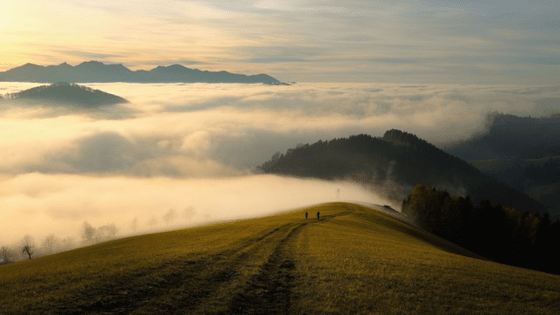
One of the earliest favorites place I can remember was a low, backless, stone bench on a hillside. The bench sat in the back yard of the house next to ours, one used by our mission group as a guest house or meeting place. Since it was typically unoccupied, it was easy for me to slip over there and enjoy the quiet. I could look out over the valley below us and up to the next hill where the ruins of an old crusader castle nestled at the top. That hill and the one next to it gave way to another valley in-between. Sometimes, when the air was clear, I could see more hills and valleys through the gap. In the haze of summer, I could barely see past those two hills. Still other times, fog rolled through the gap and across the valleys, looking like a cozy blanket.

It was my happy place growing up, and whenever I think of it I can’t help but smile. But, this morning I had an odd realization about my happy place: I wasn’t usually happy when I went there. I most often went when I was hurt or angry. When I just wanted to be alone or when I felt as if the weight of loneliness would suffocate me. When I was longing for life to slow down or aching for time to move more quickly. It was a place of tears. Of grieving. Of venting. Of longing and aching. Only very rarely did I go when I was happy and wanted to express joy. Usually I went because I longed for joy to find and rescue me.

And yet, although I know I had places of joy before then, that is the place my mind always returns to when I think of a foundational place of joy.

How can that be possible?

It took that chapter on longing to help me realize that joy often comes when we allow ourselves to process all of our emotions. There was nothing awesome about that stone bench. It was, in fact, quite uncomfortable to sit there for any length of time. And though I did love the view, it wasn’t perfect or extraordinary. Even so, that bench and the view it overlooked represented the space where I went to let everything go. Where I truly stopped to analyze my thoughts and feelings. Where I was most likely to be honest with myself.

It was the place where joy most easily found me during my growing up years, either helping me process my crazy thoughts and emotions or embracing me after I released them.

I haven’t been back to that spot in nearly 30 years, but I’ve found others like it. And now I realize what it is that makes those spaces special. Now I see that they are spaces that give me permission to stop and process. To take all of my thoughts and feelings, both good and bad, and let them soar in openness and honesty. To really see myself and determine what’s good and what’s not so good. To let myself feel. To let myself be. And to make myself hear what the Spirit is speaking into my emotions and circumstances.

In the middle of it all, I get a glimpse of what joy looks like. I see what I’m truly longing for. I understand what it is I’m seeking. And I can equip myself to go back and live a life that cultivates space for joy and gives permission to the longing for it.

There’s no magic formula for a place that produces joy. But there is a space for me that makes joy more tangible, even when all I take in with me is sorrow and ache. It’s a beautiful place to be.

Note: The image is a painting my mom did for me, showing the crusader castle mentioned above. It hangs above the mantle in our living room, reminding me of my favorite view from my growing up years, seen both from that stone bench and from my bedroom window.

Posted in Faith Nuggets, Thoughts from Scripture

Able To Aid

In full disclosure, I’ve been in a dry season when it comes to drawing from Scripture right now. I read faithfully. I process as best I can. But I’m struggling to draw out and engage with truths. In times like this, I find that going back and reviewing past journaling and writing is a huge help. It reminds me that this is just a phase and that sometimes I need to revisit old lessons and remember what I’ve forgotten. This just “happened” to be the old post I clicked on yesterday, and it was a reminder I so greatly needed in that moment. God is so faithful that He directs even my random clicks. I am thankful.

Some mornings as I sit down to process through my readings, I get sidetracked. This form of sidetracking isn’t by glancing at e-mails or Facebook, texting with a friend, or anything like that (although I confess that does happen far too often). In this particular instance, I’m referring to getting sidetracked by a verse that isn’t really part of the “point” for the day.

Then again, maybe it is. God has a funny way of doing that.

This week, the distraction was a passing devotional reference to a verse in Hebrews. It’s easy for me to get lazy and just ignore passing references like that, so years ago I determined to be intentional about looking up those references every time. Here’s what I read when I looked up this particular verse:

For since He Himself was tempted in that which He has suffered, He is able to come to the aid of those who are tempted. Hebrews 2:18 NASB (emphasis mine)

As I read these verses, I realized that I’ve always had an incomplete foundation when it comes to temptation. Had I ever stopped to process my understanding of how we are to biblically handle temptation, I would have realized that my foundation lacked something. But, until this week, I never gave it a second thought.

Here’s the foundation I’ve always had:

  • James 1 teaches that temptation is not of God, and I must flee it.
  • 1 Corinthians 10:13 shows me that God will provide a way of escape from temptation.
  • I still fall to temptation, but the blood of Jesus covers me, and I can come before Him in repentance and receive forgiveness even when I do not take the way of escape.

But, looking at Hebrews 2, there’s something else I was missing. Another crucial truth: I don’t have to run away on my own strength. I don’t have to find the escape with my own clouded vision. Jesus is able (and therefore willing) to come to my aid!

That is so logical. It’s so clear. It’s nothing really new. Yet, how often do I act on it?

I confess, often when I’m struggling against temptation, I feel too weak to even look for the way of escape. But my precious Savior has not left me to do it on my own. He is ready and able to help. I just have to call on Him.

He is my way of escape.

We cannot fight temptation on our own. We do not have the strength. (If we did, we wouldn’t need Christ’s salvation.) Only with the Spirit living within us can we walk through the escape provided. But in the ugliness of our temptation, we don’t feel able or worthy or permitted to call upon the purity that is Jesus Christ.

But oh how opposite from truth that is!

No, we’re not worthy, even at our best. But able? It only takes a plea for help! Oh, and the most glorious part is that we’re not only permitted, we’re invited. Welcomed. Encouraged. Admonished. Instructed. Commanded, even, to call upon Jesus.

And how do we remember that in the throes of temptation? How do we fight the darkness enough to convince ourselves that we can call upon Jesus for aid? By memorizing this verse now (and maybe a few around it – the whole context is powerful!), putting it in our arsenal so the Spirit can bring it to our minds in the moment of weakness.

He is able to come to my aid. Oh what a glorious truth!

Posted in Thoughts from Life, Thoughts from Scripture

The Place of Impact

If you’ve ever sought out advice about how to read the Bible, you’ve probably received a wide variety of recommendations. Some will suggest that you should read the Bible straight through from cover to cover every single year. Or, if not cover to cover, then in chronological order. But, definitely the whole thing. Every year.

Others suggest that if you read that quickly, you’ll miss details. So, you should focus in on individual books of the Bible and take as long as you need to explore them from year to year. It might be three, five, or more years before you get through the whole Bible, but the close focus is more important than getting all the way through.

As with much advice passed around in life, advice about how to approach Bible reading is frequently presented as one or the other with no in-between. There’s a right way and a wrong way. Which one are you going to pick?

If I’ve learned anything about advice over the years, it’s that the real solution is rarely black and white. It almost never falls to one extreme or the other. The best spot is somewhere in the middle. With Scripture reading, it’s a both-and approach. Get the big picture and get the details. We need both.

Recently, though, I realized that even that is not complete advice simply because it’s not a one-time thing. It’s not a situation of reading the Bible through one year to get the big picture, then slowing down from then on to get the details. It’s important to go back and forth. Get the big picture, get the details, then apply the details back onto the big picture again. And repeat. Again and again and again.

This reality was highlighted for me when preparing to teach a lesson from Philippians 3. All of it. Crammed into one short lesson.

Now, I love Philippians. It’s such a practical epistle, giving solid instruction. It’s also so…cheerful. It makes me smile and reminds me that healthy community is possible. But, let me tell you, there is a lot packed into that short epistle. And as I studied, I was overwhelmed by it all. I know Philippians well, having studied it deeply on multiple occasions. I have explored the big picture. I’ve focused on the details. I’ve studied and explored and learned so very much.

In this particular instance, though, that knowledge was working against me. I spent the entire week trying to figure out how to summarize the details of a whole chapter and do it in a way that was coherent and meaningful for a youth Sunday school lesson. I never could quite get it. It wasn’t until Sunday morning, day of the lesson, that I finally had my “aha” moment. I finally remembered to step back again. To take in the context of the whole epistle. To see where chapter 3 fit into the overall flow.

(To be completely transparent, I’m pretty sure the Spirit had been whispering that to me all week, but I’m pretty hard-headed sometimes and don’t listen well.)

As soon as I stepped back, the patterns showed up. I began to see how the various parts of chapter three all intertwined. No, we didn’t have time for the details. But we had time for a meaningful lesson.

I don’t say all of this to give my own brand of advice. I share this to remind us to wash all advice, especially advice on walking with Christ, through the lens of experience. Activity. Actually doing the walking while following the leadership of the Holy Spirit. A novel concept, I know.

We often don’t know what we’re missing in our studies of Scripture until we are pressed to share what we’ve learned with other people. Likewise, we don’t really see what’s missing in a lot of our pat spiritual answers until we’ve had to drag our methods, beliefs, and preconceived ideas through the realities of life. And sometimes those realities are a little messy — muddy, even.

My one-week experience of studying Philippians 3 for a Sunday school lesson was a small drop in the bucket of my overall life. But, that experience very much exemplifies how I need to pattern my life as a follower of Christ. The big picture view of Christian experience, idealistic though it may be, is very critical to our growth. The nitty gritty details — represented by our focus on how the Word and our faith speaks into today’s challenges, needs, and struggles — are also critical. Both grow us. They hone our listening skills and help us see Christ at work all around us, at every turn. In all honesty, though, they tend to limit us to a combination of idealism and very specific, personal application.

If we’re going to impact the world around us and give our neighbors a vision of Christ’s love for them, we have to move beyond both idealism and personal application. Fortunately, when we allow the Holy Spirit to be active and alive within us, He has the ability to merge the two and communicate the powerful love of God to those around us in a way that speaks to their own idealism and personal needs. He can handle using our growth to speak into the messy realities of the lives around us.

That’s where I want to live. In the place where both my big picture idealism and detailed experiences can truly be used by the Spirit to impact the life of another.

Posted in Thoughts from Life

Growth is Big

Over the past few years, I’ve been nurturing a new love for liturgy. I used to avoid anything related to liturgy simple because I assumed it would be stale. Pray someone else’s prayers? That would be impersonal. Do things by rote? That wouldn’t feel alive.

Then I started making a habit of reading the Psalms every day, kind of as a devotional reading alongside whatever other Bible reading plan I was following. I honestly don’t know how many years I’ve been doing this. It started with the idea of reading a psalm a day. Then, I realized I wanted to go deeper. So, I would take one psalm and read it every day for a week. Then I worked through a book that highlighted certain Psalms and I would stay in a psalm for as long as it took me to read the specific chapter related to that particular psalm.

Over time, I began to realize that this was a liturgical practice. I was meditating on and praying the prayers of ancient kings and psalmists.

In the middle of this, I discovered the book Every Moment Holy* and fell in love with the way some of those prayers spoke what I couldn’t come up with on my own, especially in some of the struggles I was facing.

Over time, liturgy became more personal than some of my own efforts to pull my thoughts into the words of a prayer or song. Repeating a psalm or prayer day after day after day made worship feel more alive instead of less.

Today’s real thought, though, isn’t actually about liturgy. It’s instead about my gradual acceptance of liturgy being the groundwork for a new way of processing. In recent years I’ve also been reading more about the seasons of the church and the celebrations of the church year. Baptists don’t really follow any of historical and traditional church calendars all that much, and since I’ve been in a Baptist tradition pretty much my whole life, I don’t have a lot of inherent understanding of the church seasons. But it’s a fascinating concept to me, and it’s been fun to learn about.

Pentecost Sunday is one of those points on the church calendar that we Baptists really don’t talk much about. We don’t mind exploring the original Pentecost Sunday when the Holy Spirit first descended on the disciples, causing them to explode onto Jerusalem with a message spoken in languages that simple Galileans had no business knowing! That’s a cool story. But, we don’t want to take it too much further because the implications are a bit…unnerving. We don’t want to be too Pentecostal, after all.

What I’ve been reading lately, though, includes liturgies that go back centuries, woven throughout the history of Roman Catholics, Anglicans, and various Orthodox traditions. The instructions for worship for the entire fifty days between Easter and Pentecost are filled with opportunities for celebration and invitation. The liturgical prayers burst with longing for the presence of the Holy Spirit and His life-giving work in our hearts. They are grounded in Scripture yet exploding with joy. Solidity and emotion all woven into a beautiful exclamation of praise.

This learning has both thrilled and devastated me. Thrilled me because I’ve been reminded of the amazing access to the Father that we have through the Holy Spirit. Devastated me because it has exposed the many places in my heart that I have closed off to the Spirit. Places that I have built walls and have even defended with black and white declarations of Scripture and theology. Areas where I have decided that the Word of God is static, not living and breathing and sharper than any two-edged sword. Because that’s easier. It’s neater. It’s cleaner than surrendering to the Spirit of the Living God who can challenge my perceptions and expand my horizons and show me where my understanding is not just limited but also show me where I’m just plain wrong. About Him. About His Word. About my own way of living as His subject, servant, and child.

So, what’s my point in all of this? It’s not really about being a Baptist who is learning more about non-Baptisty things like liturgies or the church calendar. I think it’s more about realizing just how big growth is. And how long it takes. And how hard it is. And how much it shakes my world.

I like black and white. I like concrete and understandable things. I don’t like to be on the verge of understanding. I like to understand. Completely. I am an emotional person by nature, but I like to be able to manage those emotions and keep them organized. I like excitement, but I want it to be excitement that I can figure out and share in a structured way.

Growth doesn’t fit any of that. We often think that life is either black and white or has grayed, blurred lines. But that’s not true. Life is colorful, and growth is the explosion of those colors in a way that breaks through our black and white lines and makes us realize that the edges we’ve defined aren’t really the true edges after all.

Growth makes us realize that what we once thought to be concrete and solid and complete is actually one small block in a massive structure we can’t even begin to process yet. Growth shows us that we’re nowhere near full understanding. Growth throws our organization and structure under the bus and keeps stretching and expanding.

Growth is realizing that the very things we once thought hindered us are actually tools to expand us. That things we thought old and stale are actually the very things that breathe life into our hearts. Like liturgies and centuries-old traditions.

Growth is surprising. I like surprises, but only those that I can manage or understand well. Growth is not easily managed. It requires constant adjustment and expansion. Constant change. Constant confession and reassessment. Those are hard surprises for me. Things that are too big for me to grasp often cause me to want to shut down. But that’s what growth is…something that is too hard for me to grasp.

Will I grasp it all anyway?

*That was Every Moment Holy, vol 1. There are now three volumes, and I highly recommend all of them!

Posted in Thoughts from Life

Don’t Wanna

I have a bad case of “don’t wanna” today.

I didn’t want to get up. I definitely didn’t want to get on the treadmill. I didn’t want to make myself do chores. But, I pushed through them all because they were necessities. I just made myself do and do some more. Because all of those things had to be done.

But now it’s time to sit down and write, and the “don’t wanna” bug is striking here, too. My Choffy is gone and the will power that triumphed over my earlier lack of motivation is now waning.

Writing isn’t a chore. It’s something I ultimately enjoy. But it is still work. It takes effort. It’s not the mindless fluff we as a society like to fall back on when we lack motivation. When I have a case of “don’t wanna,” anything that takes work suddenly becomes less appealing, including those things that I know to be good and nourishing for me.

I had to get out of bed. Exercise and chores were necessities and part of the routine, and I made myself do them. But writing? Writing is much more optional. Yes, it’s something that Doug and I have agreed is an essential part of my day — something that we feel God has instructed me to do daily in this stage of life. But, once my allotment of motivation starts to wane, it can be hard to truly make myself sit down and process through thoughts enough to type them out in a way that makes sense.

Especially when the Choffy is gone.

(If I’m rambling incoherently, you now know why.)

But here I am, sitting down to do it anyway. And in a bit, I’ll pick up the guitar and continue to work on reforming callouses on my fingers so I can hopefully relearn the little bit that I once knew — and maybe even add some skill growth to that. After that, I’ll do the other, less optional, tasks that will finish out my day, but those will be more like the chores. I will find the motivation because there’s not much choice. The writing and guitar practice, though, have to be a little different.

You see, there are times when we just have to stubbornly push through the things we don’t want to do. We have to make ourselves take care of necessities. But when we apply that same attitude toward the things that are good for us, the things that nourish us, we end up losing something. I think we lose the nourishment.

That’s why I stopped writing personally for years on end, devoting my writing energy to work tasks only. That’s why I stopped learning guitar. That’s why my daughter was the only one to use the sewing machine for quite some time. That’s why my yarn sat unused. I tried to apply the same motivation to those activities that I applied to life’s required activities and just make myself do them. As a result, they became the same. Requirements. Work and exercise and chores were essential for life and had very tangible repercussions if I didn’t do them. But an activity intended for nourishment that no longer gives nourishment but only feels like a chore? Yeah, that’s a different story. There reason for doing goes away.

And therefore so does the activity.

So, what do we do about it? Do we just quit the activity and try to find something new that nourishes? Personally, I think that’s a mistake. I think that leaves us on a wild goose chase, hunting down some magical “thing” that will someday maybe make us happy. But we’re not looking for happiness. We’re looking for nourishment that comes from doing the things God created us to do.

I believe that instead we need to rethink our motivation. I still need to do the activity on “don’t wanna” days, just like I do with chores and exercise and simply getting out of bed. But, when it comes to things like writing and guitar — and sewing and knitting and even making a spreadsheet just for the fun of it (yes, I’m that nuts) — just pushing through and doing for the sake of doing defeats the purpose. I need to seek the nourishment.

That’s hard to do. Honestly, I don’t have a practical step-by-step suggestion for how to make it happen other than to hunger for the nourishment. Today, I’m not writing because I feel like it. I’m writing because I need to process how I feel. I didn’t feel like sitting down and trying to figure out what to write. So, instead I just wrote about how I felt.

And suddenly, I’m feeling nourished. Not because I pushed through but because I processed. Not because I forced myself to work but because I chose to work through the “don’t wanna” and find nourishment.

When a case of “don’t wanna” hits and infects even those things that are supposed to bring nourishment, then maybe we don’t need to just push through. Maybe instead we need to receive nourishment. We need to remind ourselves that mindless things we tend to fall back on when we “don’t wanna” are never nourishing. So we do the work. Not to fill an obligation but to be nourished. Because we know it’s important. Because we know it will fuel us, not just to do the necessary, but to truly live.

Posted in Thoughts from Life

The In-Between

In case you haven’t noticed, I’m a wordy person. When I get a thought or idea in my head, I want to flesh it out well. Completely. I need you, my dear reader, to get the full picture. And that usually means a whole lotta words.

That also means I need to have learned a lesson or figured out an idea well enough to share it with you. Obviously, no lesson is ever fully learned and no idea is complete and finished because there’s always more growth in this life. But, I can give you the fullness of this particular part.

I also want to write regularly. Multiple times per week. But the truth is that I don’t have completion that often. Oh, I have experiences mixed in there that make for good writing fodder, but even that can dry out. As I try to rebuild a regular writing habit, I’m smacked in the face with the reality that much more of life is spent in in-between times than in times of fullness and completion.

That’s where I need to get comfortable. In the in-between. In the process. I need to become more aware of the many things that happen in those moments when nothing is complete. I need to be able to process the pieces, even before I see the last puzzle piece put into place.

That’s the thing about learning and growing. I often see it as big chunks, building blocks that go into place completely formed. Yes, we’re working on a building. I get that, and I know that’s going to take a while to complete. But, I like to look at each huge stone after it’s put into its place. I like to see exactly where it fits in the grand scheme of building.

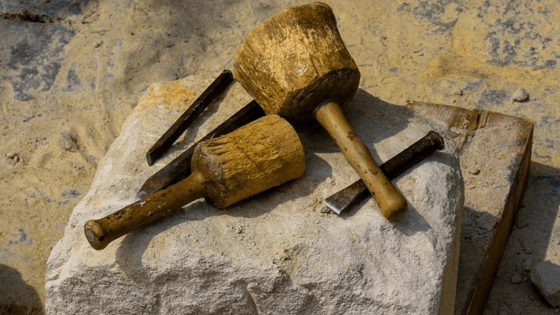
But each step to get the stone to that point is important as well. First, it has to be chosen from the right spot in the quarry. Then it must be cut out. It must be perfectly shaped so that it fits just right in its spot in the middle of dozens of other uniquely sized and shaped stones. It must be transported. Only then can it be placed.

Yes, so much more time is spent in-between, on the build-up to the placement of that stone. And there’s a lot of learning that happens in the process. A lot of growing. A lot of experiencing.

If we only share with one another what the finished product, or even a finished single step of the product, looks like, then we miss sharing the bulk of our lives together. And sharing life isn’t about showing off what we’ve become. It’s about walking together in the process and encouraging one another when the chisel hits and it hurts. When we’re jostled and bumped in the transport stage. Or even when the stone’s shape is really, really odd and we can’t figure out how in the world the next stone can possible fit around this one.

The in-between isn’t a comfortable place. But it’s a good place. A growing place. A learning place. I look forward to learning better how to live there. How to pay attention to each step. And how to walk it in community with those God has placed around me.

Let’s share the in-between.

Posted in Thoughts from Life

I Was Wrong

Have you ever noticed how some words are so hard to say? You may know them to be true beyond all shadow of a doubt. But actually saying words verbally or writing them publicly moves truth from an idea to an action, something that you are putting your identity and reputation behind.

I love you holds specific connotation in our culture, and speaking those words out loud marks the speaker in a very specific manner.

I need goes against the core mentality of rugged individualism or the false mantra that God helps those who help themselves. We all need, yet we fear showing weakness by verbally admitting that need.

I am sorry admits that we have caused hurt. We struggle to let go of our intentions long enough to admit that others can be harmed by our words and actions — yes, sometimes even when we believe we have said or done the right thing.

One of the hardest things to say, though, can often be I was wrong.

I’ve been wrong many times in my life, but I also have a personality strongly inclined toward perfectionism. I vividly remember being a child who identified “wrong” as “bad.” If I was wrong, I was imperfect, and therefore I was a bad person. Not just a growing person who had made a mistake or a bad decision. Nope. A bad person to the core. And if I was wrong, and therefore by nature bad, how could people love me? How could my parents tolerate me? How could God desire to claim me? How would I ever have friends or eventually find a man who would be willing to be married to me if I was a bad person? Therefore, I had to be right. Yes, even as a child who had so very much to learn. Because otherwise I was doomed.

Typing those words, I realized how extreme and unrealistic they seem, yet I was well into my adult years before I began to even make the smallest steps toward clearing these thought processes from my mind. (And no, I have not fully succeeded, even knowing what I know today.)

It started with needing to learn how to say the words I was wrong to my husband and children, admitting to them where I’d failed them. In the process, a miracle happened. The thing I’d always feared, that admitting being wrong would drive people to hate me, was actually revealed to be the opposite of the truth. Refusing to admit my imperfection is what drove people away. Admitting when I was wrong actually bound us closer together! (No, I don’t always do this well. Sometimes I’m still pretty bad at it. But I’m learning and growing!)

Funny, isn’t it, that I had to admit to being wrong about a core belief — the idea that being wrong meant I was bad and unlovable — in order to learn that it’s a good thing to admit to being wrong? And that admission has led me to let go of a variety of other long-held, but incorrect, beliefs.

There’s one thing I’ve never been wrong about, though: the truth of Jesus Christ. At times I’ve been wrong about my understanding of Him. I’ve been wrong about some of my interpretations of His Word. I’ve been wrong about some theological understandings and about some of the traditional beliefs I’ve claimed without truly holding them up to the light of Scripture.

But each time I’ve admitted to being wrong in those areas, the Holy Spirit has used that admission to draw me closer to the truth. To give me a heightened understanding of God.

In the process, He’s also given me a greater passion to share His truth with the world around me. Because I hunger for them to see that the sacrifice of Jesus Christ allows them to know God, too! To know truth so they can walk in righteousness!

The problem is that fear tries to temper my passion to share. What if I say the wrong thing…again? How can others trust me to tell them about the Word of God if I don’t know perfectly yet?

In addition to learning to admit when I’ve been wrong, I’ve also had to learn to go ahead and share what I know now. I’ve had to learn to openly admit that what I say is based on what I understand now, but that I hope to be always growing until my understanding is made complete in eternity. This is a great opportunity to encourage others to learn and grow for themselves. To study and explore and find out for themselves whether or not I’m right (and to come back and share with me!).

It’s liberating, to be honest. I can be wrong!

I do still struggle. I’d be lying if I said otherwise. I still hate to be wrong. I still fear what people will think of me if I admit to being wrong. But I have also learned the freedom of that admission, and the freedom is gradually holding more sway over my actions.

Only Jesus Himself was never wrong. I hunger to be more like Him every day. But in the process, I’ll point to His righteousness and be thankful that He covers me, even when I’m wrong.

Posted in Thoughts from Life

The Work of Learning

Let’s set a scene for a moment. Child comes in from school. Parent, grandparent or other adult is waiting, ready to start a conversation, hoping to discover how the school day went. Despite all of the hopes of the adult, the conversation frequently ends up being little more than a brief exchange, going something like this:

“What did you learn today?”
“Nothing.”

You just might be chuckling right now as you connect those words to familiar voices. You’ve probably overheard that exchange once or twice, if not had it yourself. It’s possible you’ve even been on both sides of the conversation. The adult sometimes pushes, hoping the child will dig a little deeper and realize that learning really has occurred. Other times, the adult simply chuckles, recognizing the truth that, even if the exchange remains exactly the same day after day after day, it will be obvious by the end of the year that the child did, in fact, learn a great deal through the course of the year.

Every single day, students receive information, engage with it, process it, and reinforce the learning of it through discussions, projects, and tests. Learning happens slowly but steadily, reinforced through the very system that they often assume is failing them because they don’t tangibly see what they learned that day, week, month, or year. Learning is work. It takes time. But our educational systems are designed to guide students through that lengthy process in such a way that they don’t even realizing the work is truly…well…working.

Now, I admit that not all of our educational systems are successful. That’s another discussion for another time and place. But the point is that learning happens for students whether they are consciously aware of it or not, simply because they are engaged in a system that helps them engage with the information presented to them. It is a system designed to equip the learning process.

Then we graduate and the system changes. We have avenues for learning how to meet the demands of our jobs. And we have demands that insist we learn even when there are not systems in place to help us with the learning. Tax season insists that we learn how to file properly. Life management requires that we learn how to keep up with cleaning and maintenance of our homes and vehicles.

But, there is so much more to learn than just how to do our jobs or pay our taxes or maintain homes and vehicles. A wide range of personal growth awaits us throughout our adult years. It’s just so easy to miss that growth because we lack the automatic systems that present the information we need before guiding us through a pattern of reinforcement.

So, we have to create those systems ourselves. We have to build habits of taking in, processing, and engaging with new information. And we have to make ourselves push through, even as they days, weeks, and months pass with us feeling like that child who has learned “nothing” in school. Just like that child, we don’t see the increments of growth. We’ll only discover it when we look back after a year or two, or maybe even ten, and see how we are different now. How our understanding has grown. How our patterns have changed. How our hobbies or habits or skills are more developed.

Friends, that’s hard work.

But it’s worthwhile work. It’s worth it to have a huge “to be read” stack of personal growth books. It’s beneficial to make yourself journal something every single day even if it’s hard to pinpoint what stood out. It’s progress when you keep practicing, keeping pounding, keep persevering even when you don’t benefit or progress from your effort.

It’s worth it because you’re learning something, even when it feels like nothing. Yes, it’s hard work. Yes, it seems as pointless as sitting in a classroom often did when you were a student. But, at the end of the year, you’ll be able to look back and see that somewhere along the way you really did learn. You grew. You improved. You advanced. You progressed.

That’s the hard work of learning. And it’s worthwhile. So, what have you learned today?