Posted in Thoughts from Life

Don’t Wanna

I have a bad case of “don’t wanna” today.

I didn’t want to get up. I definitely didn’t want to get on the treadmill. I didn’t want to make myself do chores. But, I pushed through them all because they were necessities. I just made myself do and do some more. Because all of those things had to be done.

But now it’s time to sit down and write, and the “don’t wanna” bug is striking here, too. My Choffy is gone and the will power that triumphed over my earlier lack of motivation is now waning.

Writing isn’t a chore. It’s something I ultimately enjoy. But it is still work. It takes effort. It’s not the mindless fluff we as a society like to fall back on when we lack motivation. When I have a case of “don’t wanna,” anything that takes work suddenly becomes less appealing, including those things that I know to be good and nourishing for me.

I had to get out of bed. Exercise and chores were necessities and part of the routine, and I made myself do them. But writing? Writing is much more optional. Yes, it’s something that Doug and I have agreed is an essential part of my day — something that we feel God has instructed me to do daily in this stage of life. But, once my allotment of motivation starts to wane, it can be hard to truly make myself sit down and process through thoughts enough to type them out in a way that makes sense.

Especially when the Choffy is gone.

(If I’m rambling incoherently, you now know why.)

But here I am, sitting down to do it anyway. And in a bit, I’ll pick up the guitar and continue to work on reforming callouses on my fingers so I can hopefully relearn the little bit that I once knew — and maybe even add some skill growth to that. After that, I’ll do the other, less optional, tasks that will finish out my day, but those will be more like the chores. I will find the motivation because there’s not much choice. The writing and guitar practice, though, have to be a little different.

You see, there are times when we just have to stubbornly push through the things we don’t want to do. We have to make ourselves take care of necessities. But when we apply that same attitude toward the things that are good for us, the things that nourish us, we end up losing something. I think we lose the nourishment.

That’s why I stopped writing personally for years on end, devoting my writing energy to work tasks only. That’s why I stopped learning guitar. That’s why my daughter was the only one to use the sewing machine for quite some time. That’s why my yarn sat unused. I tried to apply the same motivation to those activities that I applied to life’s required activities and just make myself do them. As a result, they became the same. Requirements. Work and exercise and chores were essential for life and had very tangible repercussions if I didn’t do them. But an activity intended for nourishment that no longer gives nourishment but only feels like a chore? Yeah, that’s a different story. There reason for doing goes away.

And therefore so does the activity.

So, what do we do about it? Do we just quit the activity and try to find something new that nourishes? Personally, I think that’s a mistake. I think that leaves us on a wild goose chase, hunting down some magical “thing” that will someday maybe make us happy. But we’re not looking for happiness. We’re looking for nourishment that comes from doing the things God created us to do.

I believe that instead we need to rethink our motivation. I still need to do the activity on “don’t wanna” days, just like I do with chores and exercise and simply getting out of bed. But, when it comes to things like writing and guitar — and sewing and knitting and even making a spreadsheet just for the fun of it (yes, I’m that nuts) — just pushing through and doing for the sake of doing defeats the purpose. I need to seek the nourishment.

That’s hard to do. Honestly, I don’t have a practical step-by-step suggestion for how to make it happen other than to hunger for the nourishment. Today, I’m not writing because I feel like it. I’m writing because I need to process how I feel. I didn’t feel like sitting down and trying to figure out what to write. So, instead I just wrote about how I felt.

And suddenly, I’m feeling nourished. Not because I pushed through but because I processed. Not because I forced myself to work but because I chose to work through the “don’t wanna” and find nourishment.

When a case of “don’t wanna” hits and infects even those things that are supposed to bring nourishment, then maybe we don’t need to just push through. Maybe instead we need to receive nourishment. We need to remind ourselves that mindless things we tend to fall back on when we “don’t wanna” are never nourishing. So we do the work. Not to fill an obligation but to be nourished. Because we know it’s important. Because we know it will fuel us, not just to do the necessary, but to truly live.

Posted in Thoughts from Life

The In-Between

In case you haven’t noticed, I’m a wordy person. When I get a thought or idea in my head, I want to flesh it out well. Completely. I need you, my dear reader, to get the full picture. And that usually means a whole lotta words.

That also means I need to have learned a lesson or figured out an idea well enough to share it with you. Obviously, no lesson is ever fully learned and no idea is complete and finished because there’s always more growth in this life. But, I can give you the fullness of this particular part.

I also want to write regularly. Multiple times per week. But the truth is that I don’t have completion that often. Oh, I have experiences mixed in there that make for good writing fodder, but even that can dry out. As I try to rebuild a regular writing habit, I’m smacked in the face with the reality that much more of life is spent in in-between times than in times of fullness and completion.

That’s where I need to get comfortable. In the in-between. In the process. I need to become more aware of the many things that happen in those moments when nothing is complete. I need to be able to process the pieces, even before I see the last puzzle piece put into place.

That’s the thing about learning and growing. I often see it as big chunks, building blocks that go into place completely formed. Yes, we’re working on a building. I get that, and I know that’s going to take a while to complete. But, I like to look at each huge stone after it’s put into its place. I like to see exactly where it fits in the grand scheme of building.

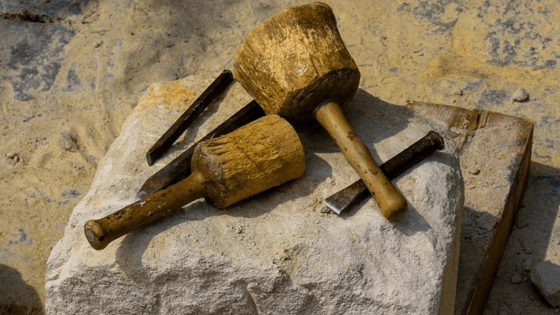
But each step to get the stone to that point is important as well. First, it has to be chosen from the right spot in the quarry. Then it must be cut out. It must be perfectly shaped so that it fits just right in its spot in the middle of dozens of other uniquely sized and shaped stones. It must be transported. Only then can it be placed.

Yes, so much more time is spent in-between, on the build-up to the placement of that stone. And there’s a lot of learning that happens in the process. A lot of growing. A lot of experiencing.

If we only share with one another what the finished product, or even a finished single step of the product, looks like, then we miss sharing the bulk of our lives together. And sharing life isn’t about showing off what we’ve become. It’s about walking together in the process and encouraging one another when the chisel hits and it hurts. When we’re jostled and bumped in the transport stage. Or even when the stone’s shape is really, really odd and we can’t figure out how in the world the next stone can possible fit around this one.

The in-between isn’t a comfortable place. But it’s a good place. A growing place. A learning place. I look forward to learning better how to live there. How to pay attention to each step. And how to walk it in community with those God has placed around me.

Let’s share the in-between.

Posted in Thoughts from Life

I Was Wrong

Have you ever noticed how some words are so hard to say? You may know them to be true beyond all shadow of a doubt. But actually saying words verbally or writing them publicly moves truth from an idea to an action, something that you are putting your identity and reputation behind.

I love you holds specific connotation in our culture, and speaking those words out loud marks the speaker in a very specific manner.

I need goes against the core mentality of rugged individualism or the false mantra that God helps those who help themselves. We all need, yet we fear showing weakness by verbally admitting that need.

I am sorry admits that we have caused hurt. We struggle to let go of our intentions long enough to admit that others can be harmed by our words and actions — yes, sometimes even when we believe we have said or done the right thing.

One of the hardest things to say, though, can often be I was wrong.

I’ve been wrong many times in my life, but I also have a personality strongly inclined toward perfectionism. I vividly remember being a child who identified “wrong” as “bad.” If I was wrong, I was imperfect, and therefore I was a bad person. Not just a growing person who had made a mistake or a bad decision. Nope. A bad person to the core. And if I was wrong, and therefore by nature bad, how could people love me? How could my parents tolerate me? How could God desire to claim me? How would I ever have friends or eventually find a man who would be willing to be married to me if I was a bad person? Therefore, I had to be right. Yes, even as a child who had so very much to learn. Because otherwise I was doomed.

Typing those words, I realized how extreme and unrealistic they seem, yet I was well into my adult years before I began to even make the smallest steps toward clearing these thought processes from my mind. (And no, I have not fully succeeded, even knowing what I know today.)

It started with needing to learn how to say the words I was wrong to my husband and children, admitting to them where I’d failed them. In the process, a miracle happened. The thing I’d always feared, that admitting being wrong would drive people to hate me, was actually revealed to be the opposite of the truth. Refusing to admit my imperfection is what drove people away. Admitting when I was wrong actually bound us closer together! (No, I don’t always do this well. Sometimes I’m still pretty bad at it. But I’m learning and growing!)

Funny, isn’t it, that I had to admit to being wrong about a core belief — the idea that being wrong meant I was bad and unlovable — in order to learn that it’s a good thing to admit to being wrong? And that admission has led me to let go of a variety of other long-held, but incorrect, beliefs.

There’s one thing I’ve never been wrong about, though: the truth of Jesus Christ. At times I’ve been wrong about my understanding of Him. I’ve been wrong about some of my interpretations of His Word. I’ve been wrong about some theological understandings and about some of the traditional beliefs I’ve claimed without truly holding them up to the light of Scripture.

But each time I’ve admitted to being wrong in those areas, the Holy Spirit has used that admission to draw me closer to the truth. To give me a heightened understanding of God.

In the process, He’s also given me a greater passion to share His truth with the world around me. Because I hunger for them to see that the sacrifice of Jesus Christ allows them to know God, too! To know truth so they can walk in righteousness!

The problem is that fear tries to temper my passion to share. What if I say the wrong thing…again? How can others trust me to tell them about the Word of God if I don’t know perfectly yet?

In addition to learning to admit when I’ve been wrong, I’ve also had to learn to go ahead and share what I know now. I’ve had to learn to openly admit that what I say is based on what I understand now, but that I hope to be always growing until my understanding is made complete in eternity. This is a great opportunity to encourage others to learn and grow for themselves. To study and explore and find out for themselves whether or not I’m right (and to come back and share with me!).

It’s liberating, to be honest. I can be wrong!

I do still struggle. I’d be lying if I said otherwise. I still hate to be wrong. I still fear what people will think of me if I admit to being wrong. But I have also learned the freedom of that admission, and the freedom is gradually holding more sway over my actions.

Only Jesus Himself was never wrong. I hunger to be more like Him every day. But in the process, I’ll point to His righteousness and be thankful that He covers me, even when I’m wrong.

Posted in Thoughts from Life

The Work of Learning

Let’s set a scene for a moment. Child comes in from school. Parent, grandparent or other adult is waiting, ready to start a conversation, hoping to discover how the school day went. Despite all of the hopes of the adult, the conversation frequently ends up being little more than a brief exchange, going something like this:

“What did you learn today?”
“Nothing.”

You just might be chuckling right now as you connect those words to familiar voices. You’ve probably overheard that exchange once or twice, if not had it yourself. It’s possible you’ve even been on both sides of the conversation. The adult sometimes pushes, hoping the child will dig a little deeper and realize that learning really has occurred. Other times, the adult simply chuckles, recognizing the truth that, even if the exchange remains exactly the same day after day after day, it will be obvious by the end of the year that the child did, in fact, learn a great deal through the course of the year.

Every single day, students receive information, engage with it, process it, and reinforce the learning of it through discussions, projects, and tests. Learning happens slowly but steadily, reinforced through the very system that they often assume is failing them because they don’t tangibly see what they learned that day, week, month, or year. Learning is work. It takes time. But our educational systems are designed to guide students through that lengthy process in such a way that they don’t even realizing the work is truly…well…working.

Now, I admit that not all of our educational systems are successful. That’s another discussion for another time and place. But the point is that learning happens for students whether they are consciously aware of it or not, simply because they are engaged in a system that helps them engage with the information presented to them. It is a system designed to equip the learning process.

Then we graduate and the system changes. We have avenues for learning how to meet the demands of our jobs. And we have demands that insist we learn even when there are not systems in place to help us with the learning. Tax season insists that we learn how to file properly. Life management requires that we learn how to keep up with cleaning and maintenance of our homes and vehicles.

But, there is so much more to learn than just how to do our jobs or pay our taxes or maintain homes and vehicles. A wide range of personal growth awaits us throughout our adult years. It’s just so easy to miss that growth because we lack the automatic systems that present the information we need before guiding us through a pattern of reinforcement.

So, we have to create those systems ourselves. We have to build habits of taking in, processing, and engaging with new information. And we have to make ourselves push through, even as they days, weeks, and months pass with us feeling like that child who has learned “nothing” in school. Just like that child, we don’t see the increments of growth. We’ll only discover it when we look back after a year or two, or maybe even ten, and see how we are different now. How our understanding has grown. How our patterns have changed. How our hobbies or habits or skills are more developed.

Friends, that’s hard work.

But it’s worthwhile work. It’s worth it to have a huge “to be read” stack of personal growth books. It’s beneficial to make yourself journal something every single day even if it’s hard to pinpoint what stood out. It’s progress when you keep practicing, keeping pounding, keep persevering even when you don’t benefit or progress from your effort.

It’s worth it because you’re learning something, even when it feels like nothing. Yes, it’s hard work. Yes, it seems as pointless as sitting in a classroom often did when you were a student. But, at the end of the year, you’ll be able to look back and see that somewhere along the way you really did learn. You grew. You improved. You advanced. You progressed.

That’s the hard work of learning. And it’s worthwhile. So, what have you learned today?

Posted in Thoughts from Others

Before the Experience

There is a wise bit of advice often given to writers: write what you know. Obviously, knowledge of a topic can come either from experience or research, and there is a very solid place for research. (My amazing hubby’s research for his dissertation, for instance, is giving him a great deal of understanding!). But when it comes to writing about walking through life, it has often seemed to me that research without experience can lead to a sense of untested idealism. Advice is tied up in a neat package, but it leaves readers in the trenches feeling like failures because their experience doesn’t fit into the neat package that a writer presents.

I’m a practical person, so I tend to get frustrated by those who write out of a sense of idealism. This is why I have long felt that I need to have experience before I write. I need to be able to say, “I’ve been there!” Experience shines a light into corners that research never reaches, granting a sense of companionship and camaraderie between the writer and the reader. Because of this conviction, I’ve put certain topics on the shelf, convinced that I really don’t have a solid leg to stand on when it comes to writing on those topics, no matter how passionate I was about them and how much I’d studied them.

Then along came the story of an author I follow, and suddenly my conviction waffled.
Don’t get me wrong — I still don’t like untried idealism. But…well, let me tell you about Shelly Miller, and you’ll understand what I mean.

I first “met” Shelly Miller through her book Rhythms of Rest: Finding the Spirit of Sabbath in a Busy World. I’d been studying Sabbath as my family attempted to begin incorporating it into the fabric of our weekly lives, and Rhythms of Rest provided another source of insight. I found Shelly to be real and accessible, her insights presented from the perspective of one who had pushed through the complications of observing Sabbath in a culture that, well, didn’t. And, to top it all off, she knew what it meant to figure out Sabbath from within the world of ministry. All in all, Rhythms of Rest was obviously a book that stemmed from experience. I could trust Shelly to tell me like it was, not spout of some idealistic nonsense that a homeschooling pastor’s wife like me could never implement.

In late 2019, I started noticing references to a new book by Shelly Miller, one that would come out in 2020. It was entitled Searching for Certainty: Finding God in the Disruptions of Life. I immediately put it on my wish list. I knew the Millers had experienced their ups and downs, their times of struggle and uncertainty. I knew, once again, that I could trust her.

That was proven a few months later when Shelly was diagnosed with a rare and aggressive form of cancer. Suddenly, the book she’d already written — the one that was just waiting to process through the steps necessary to get it to publication — was coming back to strengthen her. She found herself revisiting all that she had explored, studied, and researched to compile this book, almost afraid that it wouldn’t hold up to a real disruption. But it did. All that she’d studied was now proving true in her life, and she was drawing real comfort from the truths she’d written about.

Don’t get me wrong…she’d known before what it meant to find God in disruptions and uncertainties. But she was now experiencing a disruption greater than any she’d experienced before. And the truths were still holding up. God had prepared her. She thought she was sharing with her readers. Instead, she was storing up truths for what she and her family were about to face.

How powerful that the last book she’d ever get to write would also hold the very truths that she’d have to lean on to get her through her final months on earth.

So the question comes to me: Do I trust my God to be big enough to teach me truths before the experience, truths that will hold firm during the experience?

You see, there is research and study and experience. Then there is God. There’s a God who can teach us what we need before we need it. There’s a God who can build in us and prepare us and strengthen us. There’s training and growth that comes from experience, and then there’s training and growth that comes simply because we’re daily immersing ourselves in the Word, allowing ourselves to be taught by the Spirit, and dwelling in the presence of a holy, omniscient God who loves us and desires to equip us in every way.

That’s the God I want to serve.

The God who can teach me through it all.

While on the one hand, I need to be willing to admit when what I’ve said, taught, or written has been rife with idealism (because, trust me, I’ve been guilty of that!). But, sometimes I need to go ahead and say it, then prove that God is who He says He is when the time comes for the lessons to be tested.

Posted in Thoughts from Life

5 Simple Steps

Recently someone I knew recommended an article as “good” and “helpful.” It was on a topic of interest to me, discussing an area where I have been seeking to grow, so I went ahead and clicked the link. And I was immediately deflated and reminded why I don’t typically click such links.

Oh, the suggestions in it were accurate. They were all things you should do. But they were all the most basic suggestions imaginable. The obvious. The starting point. They weren’t suggestions for those who were actually struggling to find encouragement and guidance in the work itself.

Imagine it this way.

You are trying to give someone guidance on how to learn to cook, so you give them these five pointers:

  • Gain access to a kitchen.
  • Make sure the kitchen is stocked well with pots, pans, sturdy cooking utensils, and a good set of knives.
  • Always have salt and pepper on hand, and consider a few additional spices.
  • Find a recipe you want to prepare and go grocery shopping.
  • Make sure you set out all of your ingredients and supplies before starting to cook.

All of those tips are accurate, right? But, do they really teach someone to cook? Even if you were to add a paragraph under each point, ensuring more clarity about what it meant to be “stocked well” or what to pay attention to when seeking recipes, there is still so much lacking. This doesn’t teach someone how to cook. At all. In fact, an individual who had never cooked before would probably be headed for disaster if this were their sole source of encouragement and instruction.

And yet, this is what we have to offer, not just for beginners but also for those veterans who find themselves stuck and in need of help. Five quick tips to ensure success in parenting, marriage, other relationships, business, ministry, homeschooling, political engagement, job hunting, navigating menopause, battling mental health…you name it. These are the suggestions handed down by the people who are successful. The people who have “made it.”

People are floundering because of it. They are discouraged and frustrated. They feel like failures because they’ve tried all the best tips and still can’t seem to figure things out. They have believed the lie that they can never be successful simply because they can’t take these five simple tips handed out by the “experts” and produce a five-star meal.

I’ve been guilty of writing these articles just to produce content. But I’ve also been on the side of frustration and failure when the articles do nothing to really help me figure out solutions.

So, what is the solution?

Relationship. Community. Real hands-in-the-dirt work and partnership.

You see, the problem with the cooking suggestions is not that the guidance is wrong. It is instead that we have decided to give people a witty 400-800 word article instead of instruction and aid. We have chosen to keep our distance and offer our brilliant, simple points rather than walk through learning with someone. Because if we were to do that, we know we would inevitably hit upon some uncomfortable truths.

We’d see that not everyone has what we had when we were learning the same lessons. Some people are coming from very different circumstances. Others have different strengths and talents. Different skills. Different manners of thinking and approaching life.

And that makes training messy. It means that it’s not a one-size fits-all proposition. And it means that sometimes we have to admit we don’t know all of the answers. It means that we have to recognize our own need to keep learning. We haven’t actually “made it” after all.

We don’t like to be put in that position. The 5 Simple Steps approach is so much easier.

And never successful.

We have so much more to give. Will we make the effort to build the relationships and invest the time necessary to give it?

Posted in Faith Nuggets

A Blown Mind

I enjoy a good, fictional story. Whether it’s a movie or a book, I like the experience of working through the tale from start to finish and enjoying the nice, neatly wrapped package of an introduction, a crisis, a climax, and a resolution.

Yes, I know life is not like that. Life never presents us a concluded story. From birth to death, life is one long, complex, interwoven series of stories that never truly find solid conclusion. They are ever evolving, ever changing, and ever intermingling with one another. When we watch movies, read novels, or even dive into biographies, we are essentially pulling a single thread – maybe even two or three – from a much more complex piece of fabric. We focus on this relationship or that experience, but the remaining realities such as work or extended family or history that, in real life, strongly impact those threads are only side thoughts and setting for our compact story.

And you know what? That’s okay! It is not wrong to enjoy the narrative of a few threads, even learning powerful truths from that narrative if we choose our entertainment well.

The problem comes, though, when we apply the same reading style to Scripture.

Too often, I read God’s Word with a desire for a nicely wrapped package. I enjoy meditating on a passage for days on end, but if I have my preference, each day will bring a thought that I can wrap my head around. Even if the learning grows each day, I want something tangible and solid every time I meditate.

But, it doesn’t always work that way. Some days, what I end up with is the birth of a realization. The first tricklings of learning that completely evade understanding. In a nutshell, my mind is just blown, and it feels like the millions of scattered pieces will never come back together.

Sometimes, the light bulb begins to come on within a day or two, and increased depth of learning follows understanding. But other times it’s a slower development. I’ve hashed through certain mind blowing concepts for years on end, pulling in a piece here and an edge there, assembling the most challenging puzzle I have ever encountered in an attempt to get even the smallest glimpse of what the final picture looks like.

As overwhelmed as I feel when my mind is blown by Scripture – as much as I prefer the nice, neat, storybook package of study, learning, and growth – I am learning to crave this type of open-ended learning more and more. I’m learning to hunger for questions that take weeks, months, or even years of study and exploration to answer.

The written Word that we hold in our hands, creation all around us, and even God’s active work in our daily lives and throughout history are all just a tiny glimpse of the essence of the Almighty King of all existence. He is so much greater. So much more profound than anything we can imagine. His gifts of revelation represent a depth that our hearts and minds will never fully reach, no matter how many years we are given on this earth. But that should never prevent us from diving!

If our minds are not blown at least every now and then, it is not evidence of the vastness of what we know. Instead, it is an indictment against us, showing our failure to even try to plumb the depths of the revelation our amazing, loving Father has so graciously given us.

Oh, may I hunger more and more for a glimpse of just how much I have left to learn.

May I never fear a blown mind.

Posted in Thoughts, Thoughts from Life

Lost Words

Earlier this week, I had a great brainstorm for a blog post. Fortunately, I had a notepad handy, and I was able to furiously scratch notes. The notes flowed as smoothly and rapidly as the train of thought, and everything seemed to make clear and perfect sense…then.

I was not in a position at the time to sit down at the computer or with anything more than that little scratch pad, but I fully intended to make writing a priority that morning so I could turn those notes into a blog post immediately. I’m trying to do better about that, knowing how often I wait too long and then lose the context of what I was thinking. But, this week took my by storm. By the time I even had a few minutes to look at those notes again, several days had passed. By that time, the notes might as well have been gibberish.

I have no idea what I was thinking. No clue about the context. No comprehension of the thoughts that were so strong that morning. I can remember the feeling of the thoughts flowing forth with clarity and strength. But I cannot remember the details to save my life.

In a way, it feels like I’ve lost something precious. The thoughts were that powerful.

In another way, though, I am comforted. You see, those thoughts were meant for that morning. I do remember them motivating, encouraging, and propelling me into my day. They planted in me a strength and a determination to face this very full week. I may be forgetting the context right now, but on the morning of the brainstorm, I know I stepped into the day with an internalized lesson.

The words may have been lost, but the lesson – and its impact – remained.

I am married to a pastor, but I frequently cannot recall the points of his sermons from one week to the next. Even when I am intentional about taking thorough notes, I often look at them later with confusion, not sure what I was thinking as I wrote. But, each Sunday as I listen and write, my goal is often to plant in my head one way I can implement the message in the coming week. One way I can actively choose to grow in response to what God has said through my husband.

Again, I may not be able to dredge up the specific points or context, but the lessons remains.

Not everyone is stirred by words. We don’t all process that way. We do, however, all have a method by which truths are best communicated to our hearts and lessons are merged into our lives. But none of this happens naturally. When blog posts create themselves in my head, it’s very easy to tap them out, then forget them. Sometimes I go back and read articles and am stunned to find that I wrote them! They feel so foreign because I never truly internalized the message. It takes an effort and a choice to pour those truths into my soul instead of simply pounding them out on a computer keyboard.

It takes an effort and a choice to decide to act on a sermon instead of simply listening and then walking out unchanged. (Think about it – have you ever said, “Good sermon, Preacher,” because you have already forgotten that what you should instead be saying is, “Ouch!”)

Truths are constantly moving from the mouth of God to our eyes and ears, giving us the choice each and every day. What will we do with them? Will they just become lost words, or will we turn them into lessons internalized?